Buscar este blog

Mostrando entradas con la etiqueta Cementerios militares. Mostrar todas las entradas

jueves, 24 de octubre de 2013

Cementerios militares: Jonkerbos.


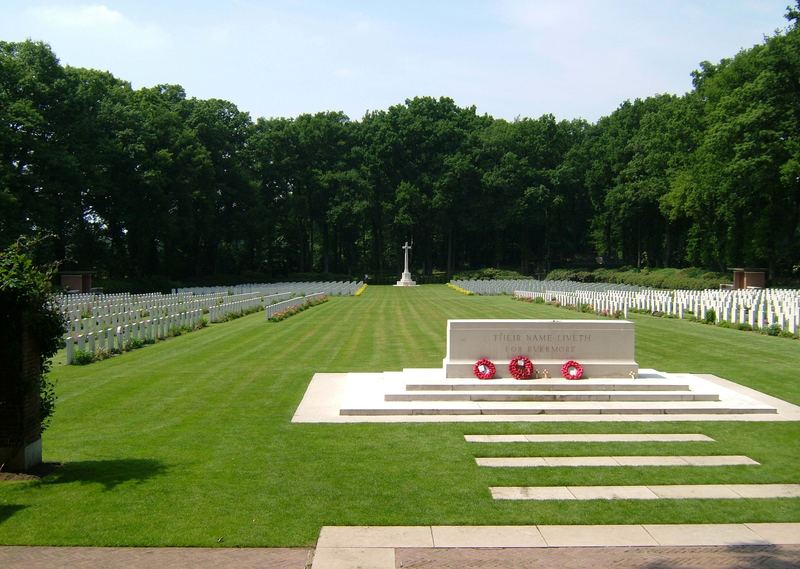
Cementerio militar aliado de Jonkerbos


La ciudad de Nijmegen se encuentra al sur de Arnhem y el cementerio de Jonkerbos se encuentra en la parte suroeste de la ciudad. Nijmegen se convirtió en la línea del frente desde el 17 de septiembre de 1944 hasta febrero de 1945. El cementerio fue creado por el No. 3 Casualty Clearing station en una zona arbolada conocida como Jonkers Bosch y de ahí toma su nombre con el que se conoce.

Allí reposan los restos de 1.629 soldados de la Commonwealth, 99 de ellos están sin identificar y 13 de otras nacionalidades (1.385 británicos, 88 canadienses, 34 australianos, 21 neozelandeses, 6 polacos, 5 belgas, 1 holandés, 1 ruso y 99 sin identificar).

Fuentes:
Commonwealth War Graves Commision

English version

The city of Nijmegen is located south of Arnhem and Jonkerbos Cemetery is located in the southwestern part of the city. Nijmegen became the front line from the September 17, 1944 until February 1945. The cemetery was created by No. 3 Casualty Clearing station in a wooded area known as Jonkers Bosch, hence the name with which it is known.

There lie the remains of 1,629 soldiers of the Commonwealth, 99 of them are unidentified and 13 of other nationalities (1,385 Britons, 88 Canadians, 34 Australians, 21 New Zealanders, 6 Poles, five Belgians, one Dutch, one Russian and 99 unidentified)


Sources:
Commonwealth War Graves Commision

miércoles, 16 de octubre de 2013

Cementerios militares: Bilbao


Cementerio británico en la iglesia de la Trinidad (Bilbao)


En este campo santo se encuentran enterrados 56 soldados Aliados y de la Commonwealth caídos durante la Segunda Guerra Mundial. La mayoría de ellos se encontraban enterrados en otros emplazamientos situados en la costa norte y noroeste española pero su gestión no resultaba sencilla. El traslado lo ejecutó la Commonwealth War Graves Commission al lugar escogido, una parcela dispuesta en la Iglesia de la Trinidad. En dicha parcela también descansan los restos de 7 soldados de la Gran Guerra. En su origen estuvo situado en el centro de la ciudad, a orillas del río Nervión (conocido como “Los siete árboles”) siendo utilizado para súbditos británicos durante la segunda mitad del s.XVIII. No fue hasta la llegada del nuevo cónsul británico a Bilbao, Horace Young, en 1859 cuando se remodeló al encontrarlo en un estado de abandono. A pesar de su voluntad de recuperarlo debido a la escasez de fondos no se pudo llevar a cabo. Parece ser que muchas tumbas se perdieron debido a las frecuentes inundaciones que sufría el campo santo. Tras la concesión al Gobierno Británico por parte de la Corona Española del uso a perpetuidad del solar como cementerio por Real decreto del 31 de diciembre de 1860, el consulado recaudó el dinero suficiente de particulares como para que el Cementerio fuera restaurado.

A principios del siglo veinte la ubicación del cementerio fue cuestionada argumentando posibles problemas de higiene pública y también porque la autoridad portuaria deseaba adquirirlo para sus instalaciones. Finalmente en 1926 se llegó a un acuerdo comprando un solar en la vecina Lujua. Se construyó una capilla protestante, otra católica y una casa para el guarda. Durante el traslado se decidió ampliar el uso del cementerio a enterramientos católicos pero también de la comunidad británica. Las capillas y sus zonas fueron consagradas por el obispo anglicano de Gibraltar y el párroco de Lujua en mayo de 1929. En este cementerio también se pueden encontrar entre otros, alemanes, americanos, españoles, franceses, griegos, irlandeses, noruegos, suecos y suizos.

Fuentes:
War Graves Commission
Iglesia de la Trinidad

English versión

In this cemetery are buried 56 soldiers Allies and Commonwealth who died during the Second World War. Most of them were buried in other locations in the north and northwest Spanish coast but its management was not easy. The transfer was executed by the Commonwealth War Graves Commission at the site chosen, a plot arranged in the Trinity Church. In this plot also the remains of seven soldiers of the Great War. Originally it was located in the city center, on the banks of the Nervion River (known as "The Seven Trees") being used to British subjects during the second half of the eighteenth century. It was not until the arrival of the new British Consul Bilbao, Horace Young, in 1859 when it was remodeled to find it in a state of neglect. Despite their desire to recover due to the shortage of funds could not be carried out. It appears that many graves were lost due to frequent flooding suffered by the cemetery. Following the granting to the British Government by the Spanish Crown in perpetuity use the site as a cemetery by Royal Decree of December 31, 1860, the consulate raised enough money from private to the cemetery was restored.

In the early twentieth century cemetery location was questioned arguing potential public health problems and also because the port authority wanted to buy it for their facilities. Finally in 1926 he agreed to buy a plot in neighboring Lujua. A chapel was built Protestant, a Catholic, and a guard house. During the transfer was decided to extend the use of the cemetery to burials Catholics but also of the British community. The chapels and their areas were consecrated by the Anglican Bishop of Gibraltar and the pastor of Lujua in May 1929. In this cemetery can also be found among others, German, American, Spanish, French, Greek, Irish, Norwegian, Swedish and Swiss.


Sources:
War Graves Commission
Iglesia de la Trinidad

viernes, 27 de septiembre de 2013

Cementerios militares: La Cambe


Cementerio alemán en La Cambe (Francia)


La durísima campaña desarrollada en Normandía causó miles de bajas al ejército alemán y sus caídos se encontraban diseminados por una vasta zona. Muchos de ellos fueron enterrados en tumbas aisladas, pequeños cementerios de campaña o directamente en el campo allí donde cayeron. En los años posteriores al final de la contienda la VDK (Comisión Alemana de Cementerios de Guerra) se puso manos a la obra para establecer un total de seis cementerios en la zona normanda, uno de ellos es el que nos ocupa hoy.

Su construcción comenzó en 1954 y en él se reunieron los restos de más de 12.000 soldados alemanes que fueron trasladados desde 1.400 localidades de los departamentos de Calvados y Orne. También incluye los caídos en la Playa Omaha durante el Día D. Las obras finalizaron en 1961 siendo inaugurado en septiembre de ese mismo año. La continua búsqueda de los caídos durante la Segunda Guerra Mundial ha provocado que desde aquella fecha otros 700 soldados más fueran enterrados en La Cambe aunque la cifra final asciende a 21.222 soldados alemanes. Del total 207 son desconocidos y junto con otros 89 soldados más (identificados) se encuentra enterrados en el kamaradengraben (fosa común) que se localiza tras el túmulo central. 


Fuentes:
VDK

English versión

The grueling campaign in Normandy caused thousands of casualties on the German army and their dead were scattered over a wide area. Many of them were buried in tombs isolated, small cemeteries campaign or directly in the field where they fell. In the years following the end of the war the VDK (German Commission Cemeteries of War) began to work to establish a total of six cemeteries in the Norman, one of them is the one that concerns us today.

Construction began in 1954 and he met the remains of over 12,000 German soldiers were moved from 1,400 locations in the departments of Calvados and Orne. It also includes those killed at Omaha Beach during D-Day. The work was completed in 1961 to be opened in September of that year. The continuous search for the fallen during World War II has caused since that time another 700 soldiers were buried in La Cambe although the final figure amounts to 21,222 German soldiers. Of the total 207 are unknown and along with other 89 soldiers (identified) is buried in the kamaradengraben (mass grave) located behind the central mound.


Tank ace Michael Wittmann is buried here

Sources:
VDK

martes, 6 de noviembre de 2012

Cementerios militares: Arnhem Oosterbeek

Cementerio aliado en Arnhem Oosterbeek.

En el cementerio de guerra de Arnhem Oosterbeek contiene las tumbas de la mayoría de las bajas durante la batalla de Arnhem de septiembre, y muchos de los muertos en más combates en la zona. En la actualidad hay 1.680 soldados de la Commonwealth de la Segunda Guerra Mundial enterrados. 245 de los allí enterrados no son identificadas y dos bajas tienen monumentos especiales. También hay 73 polacos, 3 holandeses y 3 que no son de guerra (ex empleados de la Comisión).

English versión

In the cemetery at Arnhem Oosterbeek War contains the tombs of most of the casualties during the battle of Arnhem in September, and many more killed in fighting in the area. There are now 1,680 Commonwealth soldiers from World War II buried. 245 of those buried there are no casualties have identified and two special landmarks. There are also 73 Poles, three Dutch and three non-war (former employees of the Commission).


lunes, 21 de mayo de 2012

Cementerios militares: Deutsche Soldatenfriedhofe


Deutsche Soldatenfriedhofe

 
El Deutsche Soldatenfriedhofe situado en Crimea está en la carretera de Sebastopol - Gontscharnoje y es relativamente de nueva construcción. Allí tienen su último lugar de reposo 11.000 soldados del eje están enterrados en este campo santo. Este, al igual que otros muchos, está gestionado por el VDK que se encarga de la mayoría de los campos santo alemanes repartidos por toda Europa y el norte de África.

Del total de soldados que allí han encontrado su último reposo, 3.870 han sido enterrados en los últimos 12 meses hasta mayo de 2004. Grupos de tres cruces, siguiendo el modelo de otro cementerios alemanes, marcan las fosas mientras que un largo muro corrido recoge el nombre de todos los soldados enterrados. En el centro del cementerio podemos encontrar una gran cruz a modo de memorial en una pequeña plazoleta. 


Fuente:
VDK

English version

The Deutsche Soldatenfriedhofe is located in Crimea, road Sebastopol - Gontscharnoje and is relatively new construction. They have their final resting place of 11,000 soldiers are buried in this axis cemetery. This, like many others, is managed by the VDK that handles most holy German camps across Europe and North Africa.

Of all the soldiers there found their last resting, 3,870 have been buried in the past 12 months to May 2004. Groups of three crosseson the model of other German cemeteries, marking graves while along wall run includes the name of every soldier buried. In the center of the cemetery we find a large cross as a memorial in a small square.


Source:
VDK

lunes, 23 de abril de 2012

Cementerios militares: Montecassino (III)


Cementerio italiano de Montecassino


 Bajo el control de la 36ª División, el primer grupo italiano motorizado intentó sin éxito tomar Monte Lungo a los alemanes el 8 de diciembre de 1943, y sufrieron grandes bajas. Fue la primera acción importante de la guerra en la que los italianos lucharon con los aliados y no contra ellos.

En el cementerio italiano de Montelungo están enterrados 975 soldados italianos que lucharon junto con los aliados y murió en las batallas por la liberación de Italia 1943-45, se reunieron también en los cementerios temporales a lo largo de la Línea Gótica.

English version

Under the control of the 36th Division, the first Italian group tried unsuccessfully to take motorized Monte Lungo to the Germans on December 8, 1943, and suffered heavy casualties. It was the first major action of the war in which the Italians fought with the Allies and not against them.

In the cemetery are buried Montelungo Italian 975 Italian soldiers who fought alongside the Allies and died in the battles for the liberation of Italy 1943-45, also met in temporary cemeteries along the Gothic Line.


domingo, 11 de marzo de 2012

Cementerios militares: Rossoschka


Cementerio de Rossoschka (Stalingrado)


La mayoría de los cementerios alemanes en la ciudad y sus alrededores fueron destruidos cuando el terreno fue ocupado de nuevo por los rusos. En muchas ocasiones, en las urbanizaciones y tierras de labor suelen aparecer restos de soldados alemanes pues se contruyó sobre ellos. Durante la época estival muchos grupos de voluntarios se dedican a la búsqueda de estos soldados olvidados, fáciles de encontrar debido a su cantidad. La única manera de identificarlos, es mediante las Erkennungsmarke que se encuentran junto a los restos. En el caso de tratarse de soldados soviéticos, portan un tubo metálico con el nombre del soldado en su interior.

Existe un cementerio alemán en Rossoschka, además de otro ruso, donde descansan cerca de 37.000 soldados alemanes, y donde miles de sus nombres figuran en las paredes de bloques de granito.


 Nombres de los caídos alemanes.

English version

Most German cemeteries in the city and its surroundings were destroyed when the land was occupied again by the Russians. Many times in the housing and arable land are car parks remains of German soldiers was built on them since. During the summer many groups of volunteers dedicated to finding these forgotten soldiers, easy to find because of its quantity. The only way to identify them is through Erkennungsmarke found with the remains. In the case of Soviet soldiers, carrying a metal tube with the soldier's name inside.

There is a German cemetery Rossoschka, along with another Russian, where lie about 37,000 German soldiers, and where thousands of their names appear on the walls of granite blocks.

 Tombs of the Russian side

domingo, 22 de enero de 2012

Cementerios militares: Montecassino (II)

 Cementerio alemán de Montecassino


El cementerio alemán (Kriegsgräberstätte) de Cassino se sitúa en Caira a 3 kilómetros al norte de la ciudad de Cassino. El cementerio ha sido creado en una colina con las tumbas de los 20.027 que cayeron en acción. No sólo los soldados que murieron en la batalla de Montecassino, sino también a las víctimas que perecieron durante las batallas en el campo italiano al sur de la línea de Pescara - Terracina han sido enterrados aquí.

Muchos murieron en la batalla por la cabeza de puente en el golfo de Salerno y también a los soldados que cayeron en acción durante la retirada en la costa del Adriático (especialmente en el área alrededor de Ortona), así como durante los combates en las cercanías de Montecassino. Después de llegar a un acuerdo entre el Gobierno alemán y las autoridades italianas acerca de esto en 1955, el Servicio Alemán de Cementerios han vuelto a enterrar a todos aquellos en este cementerio en el período de 1959 a 1960.

Un paseo por el ancho de la ladera, lleva al visitante a la entrada del edificio de aspecto cúbico. Dentro de este edificio, luz de día ilumina, a través de una abertura cuadrada grande, una escultura que simboliza el luto y el confort. Dejando este edificio, el visitante entra en un gran campo militar de honor que se compone de varias terrazas elípticas. Cada terraza se ha separado del siguiente por una pared de piedra caliza. Las tumbas llevan una cruz de mármol de travertino, los nombres han sido grabados con sus fechas de nacimiento, rango y fecha de la muerte. Todas las tumbas están cubiertas de hierba de San Juan.


English version


The German cemetery (Kriegsgräberstätte) Cassino in Cairo is located 3 miles north of the town of Cassino. The cemetery has been set on a hill with the graves of the 20,027 who fell in action. Not only the soldiers who died in the battle of Monte Cassino, but also the victims who died during the battles in the Italian countryside south of the fishing line - Terracina have been buried here.

Many died in the battle for the bridgehead in the Gulf of Salerno and the soldiers who fell in action during the retreat on the Adriatic coast (especially in the area around Ortona) and during the fighting in the vicinity of Montecassino. After reaching an agreement between the German Government and the Italian authorities about this in 1955, the German Cemetery were reburied to all those in this cemetery in the period 1959 to 1960.

A walk along the width of the slope, takes visitors to the entrance of cubic aspect. Inside this building, daylight illuminates, through a large square opening, a sculpture that symbolizes mourning and comfort. Leaving this building, the visitor enters a large military camp of honor which is composed of several terraces elliptical. Each terrace is separated from the next by a wall of limestone. The tombs are a cross of travertine, the names have been engraved with their dates of birth, rank and date of death. All the tombs are covered with grass of San Juan.

miércoles, 4 de enero de 2012

Cementerios militares: Montecassino


Cementerio aliado de Montecassino


El cementerio de Montecassino es el mayor de los cementerios ubicados en Italia con 4.265 lápidas, incluyendo 855 canadienses. En el centro del cementerio hay un memorial a los desaparecidos en combate, en sus losas se encuentran los nombres de los más de 4.000 desaparecidos en Italia y Sicilia.

En el cementerio polaco de Montecassino se encuentran los restos de 1.052 soldados polacos caídos en la batalla y se encuentra ubicado entre la cota 445 y la abadía de Montecassino. El 2º Cuerpo de Ejército polaco, a las ordenes del teniente general Wladyslaw Anders, jugó un papel importante en el ataque final sobre las posiciones alemanas en la abadía. Finalmente, el 18 de mayo de 1944, una escuadra del 12º Regimiento de Lanceros logró entrar en el recinto e izar la bandera polaca sobre las ruinas.

El cementerio presenta una forma de anfiteatro con un altar que fue finalizado en 1963 y en cuya puerta se puede leer la siguiente inscripción:

Los soldados polacos
Por nuestra libertad y la tuya
Han dado a nuestras almas a Dios
Nuestros cuerpos al suelo de Italia
Y nuestros corazones a Polonia.


Entre sus lápidas se pueden apreciar los diferentes credos de los soldados, católicos, ortodoxos, diferenciados por sus cruces, y los judíos que tienen su lápida como una estrella de David.

Por su parte el teniente general Wladyslaw Anders sobrevivió a la guerra muriendo el 12 de mayo de 1970 en Londres sin embargo, según sus últimos deseos, fue trasladado y enterrado en este campo santo, junto a los hombres que murieron en la batalla bajo su mando.

English versión

Montecassino Cemetery is the largest of the cemeteries located in Italy with 4265 gravestones, including 855 Canadians. In the center of the cemetery is a memorial to the missing in action in their slabs are the names of more than 4,000 missing in Italy and Sicily.

In the Polish cemetery at Monte Cassino are the remains of 1,052 Polish soldiers fallen in battle and is located between the elevation 445 and the Abbey of Montecassino. The 2nd Polish Army Corps under the command of Lieutenant General Wladyslaw Anders, played an important role in the final assault on German positions in the abbey. Finally, on May 18, 1944, a squadron of the 12th Regiment of Lancers managed to enter the premises and hoist the Polish flag over the ruins.

 Canadian zone

The cemetery has a shape of an amphitheater with an altar which was completed in 1963 and in the door you can read the following inscription:

Polish soldiers
For our freedom and yours
They have given our souls to God
Our bodies to the soil of Italy
And our hearts to Poland.

Among their tombstones you can see the different faiths of the soldiers, Catholics, Orthodox, differentiated by their crosses, and Jews have their tombstone as a star of David.

For his part, Lieutenant General Wladyslaw Anders survived the war died on May 12, 1970 in London, however, according to his last wishes, he was transferred and buried in this cemetery, along with the men who died in battle under his command .