Buscar este blog

martes, 21 de julio de 2015

Hawker Henley


Hawker Henley


En 1934 el Ministerio del Aire emitió las especificaciones para la creación de un nuevo bombardero ligero para apoyo cercano. Las empresas que se lanzaron a la consecución del proyecto fueron Fairey, Gloster y Hawker, cada una de ellas con sus propias propuestas. Las especificaciones iniciales hablaban de una carga modesta de bombas de modo que Hawker optó por construir un aparato similar en tamaño al Hurricane. Por aquellas fechas el Hurricane se encontraba en una fase avanzada de su diseño y no había un beneficio inmediato en compartir componentes. A pesar de ello compartieron algunas plantillas de ala y de la deriva. El motor elegido para el nuevo aparato fue el Rolls-Royce Merlin que ofrecía una mejor relación potencia/peso así como un área frontal mínima. El tren de aterrizaje era retráctil y disponía de una cabina para dos tripulantes, piloto y artillero.

Su construcción comenzó a mediados de 1935 pero su historia cambió cuando se priorizó el desarrollo del Hurricane a partir del 10 de marzo de 1937. Cuando los motores fueron destinados a otros aparatos se optó por utilizar motores “F” Merlin y posteriormente Merlin I. El Henley alcanzaba una velocidad máxima de 480 Km/h pero el Ministerio del Aire decidió que ya no era necesario un bombardero ligero siendo utilizado como remolcador. El segundo prototipo fue equipado con un cabrestante para remolcar blancos aéreos volando por primera vez el 26 de mayo de 1938.

El aparato de producción fue designado como Henley III y fue distribuido entre los Escuadrones Bombing and Gunnery Schools No.1, 5 y 10 así como Air Gunnery Schools en Barrow, Millom y Squires Gate. Poco después se demostró que el Henley debía restringir su velocidad de remolque hasta los 355 Km/h ya que si esta velocidad máxima era superada la tasa de fallos en el motor era extraordinariamente alta. Con estos fallos a la espalda fueron relegados a otras misiones de remolque aéreo en cooperación con las unidades antiáereas, pero también mostró ser inadecuado para este tipo de tareas. Ninguna solución pudo ser encontrara y ya a mediados de 1942 el Henley fue retirado del servicio activo siendo sustituidos por el Boulton Paul Defiants. Se solicitó inicialmente un lote de 400 aparatos pero tan sólo se completaron 100 de ellos equipados con motores Merlin II y otros 100 equipados con Merlin III fabricados por Gloster. 


Fuentes:
COOPER, H.J.,O.G. “Aircraft of the Fighting Powers - Volume II” Harborough Publishing, 1942
HANNAH, D. “Hawker FlyPast Reference Library” Key Publishing Ltd., 1982
MASON, F. “Hawker Aircraft since 1920” Putnam, 1991
MONDEY, D. “The Hamyln Concise guide to British aircraft of World War II” Hamlyn/Aerospace, 1982

English version

In 1934 the Air Ministry issued specifications for the creation of a new light bomber for close support. Companies that took to the achievement of the project were Fairey Gloster and Hawker, each with their own proposals. The initial specifications were talking about a modest bomb load so that Hawker chose to build an apparatus similar in size to Hurricane. At that time the Hurricane was in an advanced stage of design and there was an immediate benefit in sharing components. However they shared some wing templates and drift. The engine chosen for the new device was the Rolls-Royce Merlin featuring better power/weight ratio and a minimum frontal area. The retractable landing gear was available and a cabin for two crew, pilot and gunner.

Its construction began in mid-1935 but his story changed when Hurricane development was prioritized from 10 March 1937. When the engines were intended for other devices it was decided to use engines "F" Merlin and then Merlin I. Henley had a top speed of 480 km / h but the Air Ministry decided it was no longer necessary light bomber being used for towing. The second prototype was equipped with a winch for towing aerial targets flying for the first time on May 26, 1938.

The production apparatus was designated as Henley III and was distributed among the squads Bombing and Gunnery Schools No.1, 5 and 10 as well as Air Gunnery Schools in Barrow, Millom and Squires Gate. Shortly after it was demonstrated that Henley should restrict its towing speed to 355 km/h because if the speed limit was exceeded the rate of engine failure was extremely high. These faults were relegated back to other air missions trailer in cooperation with the anti-aircraft units, but also proved to be inadequate for these tasks. No solution could be found and since mid-1942 the Henley was retired from active service being replaced by the Boulton Paul Defiants. Initially it requested a batch of 400 apparatuses but only 100 of them were completed Merlin II equipped with engines and another 100 equipped with Merlin III manufactured by Gloster.


Sources:
COOPER, H.J.,O.G. “Aircraft of the Fighting Powers - Volume II” Harborough Publishing, 1942
HANNAH, D. “Hawker FlyPast Reference Library” Key Publishing Ltd., 1982
MASON, F. “Hawker Aircraft since 1920” Putnam, 1991
MONDEY, D. “The Hamyln Concise guide to British aircraft of World War II” Hamlyn/Aerospace, 1982

miércoles, 15 de julio de 2015

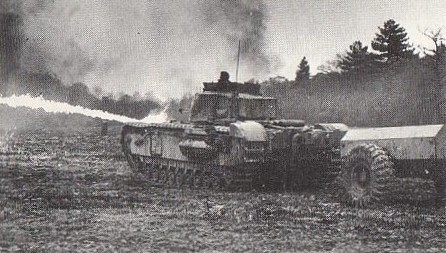
Churchill Mk VII Crocodile


Churchill Mk VII Crocodile


Durante el asalto aliado en Dieppe en 1942 se emplearon tres Churchill Mk II Oke´s en los combates. Estos tres carros de combate fueron los primeros equipados con lanzallamas. A pesar de las expectativas creadas por su capacidad de combate no pudieron demostrar nada ya que fueron puestos fuera de combate por las defensas alemanas. El carro de combate mantuvo su armamento principal instalado en su torreta, pero la ametralladora frontal del casco fue sustituida por el lanzallamas.

En octubre de 1943 se optó por modificar un Churchill Mk VII para crear un nuevo carro de combate lanzallamas bajo el sobrenombre “Cocodrile”. El sistema era entregado en un kit que podía ser instalado incluso en los talleres de campaña. El combustible era como una especie de gelatina que se almacenaba en un depósito remolcado tras el vehículo. El combustible era bombeado hasta el lanzallamas por una tubería por alta presión. El arma era operada por un artillero en la parte frontal del casco que podía lanzar hasta 80 ráfagas de un segundo o vaciar todo el depósito de una sola ráfaga. Las ráfagas podían alcanzar hasta 100 metros de distancia. Una vez vaciado el depósito este podía ser desechado sobre la marcha mientras que el carro de combate podía continuar la lucha con su armamento de la torreta. El efecto psicológico del lanzallamas era devastador provocando un alto índice de rendiciones ante él. Ante el peligro de este carro de combate en el campo de batalla recibía más atención hostil sin piedad para sus tripulantes. Hasta mayo de 1945 se completaron 800 Churchill Mk VII Crocodile, de los cuales 250 fueron enviados al Lejano Oriente. 

 
Fuentes:
CHANT, C. “An Illustrated Data Guide to Battle Tanks of World War II
PERRET, B. “Churchill Infantry Tank 1941-1945” Osprey, 1993
FLETCHER, D. “The Great Tank Scandal: British Armour in the Second World War” 1989
DELAFORCE, P. “Churchill's Secret Weapons: the story of Hobart's Funnies” Pen & Sword, 2006

English version

During the Allied assault on Dieppe in 1942 they used three Churchill Mk II Oke's in the fighting. These three tanks were the first equipped with flamethrowers. Despite the expectations created by their combat capability they could not prove anything as they were knocked out by German defenses. The chariot kept its main armament installed on your turret, but the front hull machine gun was replaced by the flamethrower.

In October 1943 it was decided to modify a Churchill Mk VII to create a new battle tank flamethrower under the nickname "Crocodile". The system was delivered in a kit that could be installed even in shops campaign. The fuel was a kind of gelatin was stored in a tank towed behind the vehicle. The fuel was pumped through a pipe flamethrower high pressure. The gun was operated by a gunner in the front of the helmet that could throw up to 80 bursts of a second or empty the entire deposit of a single burst. Gusts could reach up to 100 meters away. Once emptied the tank that could be disposed on the fly while the chariot could continue the fight with weapons turret. The psychological effect was devastating flamethrower causing a high rate of surrenders before him. Given the danger of this car battle in the battlefield he received more attention mercilessly hostile to the crew. Until May 1945 were completed 800 Crocodile Churchill Mk VII, of which 250 were sent to the Far East.


Sources:
CHANT, C. “An Illustrated Data Guide to Battle Tanks of World War II
PERRET, B. “Churchill Infantry Tank 1941-1945” Osprey, 1993
FLETCHER, D. “The Great Tank Scandal: British Armour in the Second World War” 1989
DELAFORCE, P. “Churchill's Secret Weapons: the story of Hobart's Funnies” Pen & Sword, 2006

martes, 14 de julio de 2015

Reggiane Re.2001


Caza italiano Reggiane Re.2001


El caza italiano Reggiane Re.2001 surgió como un desarrollo del anterior modelo Re.2000 Falco I. Este modelo anterior fue rechazado por la Regia Aeronautica debido a su deficiente motorización. Este problema, sin embargo, quedó resuelto en el nuevo modelo gracias a su motor Alfa Romeo RA 1000, que era  una copia mejorada del motor alemán Daimler-Benz DB 601.

El Re.2001 incorporaba en su diseño gran parte de la estructura del Re.2000 incluyendo la distribución de sus tanques de combustible (un tanque en el fuselaje y cuatro en las alas con una capacidad de 544 litros). El caza estaba armado con dos ametralladoras Breda-SAFAT de 12´7 mm montadas sobre el capó y dos ametralladoras más de 7´7 mm  situadas en las alas. Este armamento se mostró insuficiente a medida que avanzaba la contienda.

En aspecto, el Re.2001 Falco II resultó muy similar al Macchi MC.202 Folgore que ya había entrado en producción y se fabricó en mayor cantidad. El retraso en la entrada en producción lo provocó el deseo de la Regia Aeronautica de que los depósitos de combustible estuviesen instalados en las alas. Esta ubicación precisaba de un rediseño casi por completo de la estructura del aparato. Esto retrasó su entrada en servicio del caza a junio de 1941, casi un año más tarde de lo programado. A pesar de todo se realizó un pedido inicial de 300 unidades aunque finalmente se completaron 252 aparatos debido a la falta de motores disponibles. Este lote incluyó 100 Re.2001 Serie I, Serie II y Serie III con distintas modificaciones en el armamento, cazabombarderos de la Serie IV, y 150 cazas nocturnos Re.2001 CN. El Re.2001 alcanzaba una velocidad máxima de 542 Km/h con una autonomía de 990 Km.

Se desarrollaron otras versiones para desempeñar otras labores en el campo de batallas, como el cazabombardero Re.2001 CB (Cacciabombardiere) que fue fabricado a partir de 1942 para misiones de ataque a tierra. Este aparato podía transportar hasta 250 Kg de bombas bajo el fuselaje. También se desarrolló un caza nocturno, el Re.2001 CN (Caccia notturno) que contaba con los elementos precisos para su labor nocturna como bocachas apagallamas en los gases de escape y dos cañones MG 151/20 de 20 mm en sendas góndolas bajo las alas. De esta versión se solicitó un pedido inicial de 50 unidades aunque tan sólo se llegaron a entregar 34 aparatos. 


Fuentes:
TAYLOR, J. “Reggiane Re.2001 Falco II (Falcon)". Combat Aircraft of the World from 1909 to the Present” G.P. Putnam's, 1969
BRINDEY, J. “Caproni Reggiane Re 2001 Falco II, Re 2002 Ariete & Re 2005 Sagittario", Aircraft in Profile, Volume 13” Profile Publications, 1973

English version

The Italian hunting reggiane re.2001 emerged as a development of the previous model Re.2000 Falco I. The previous model was rejected by the Regia Aeronautica due to poor engine. This problem, however, was solved in the new model with its engine Alfa Romeo RA 1000, which was an improved copy engine of the German Daimler-Benz DB 601.

The Re.2001 incorporated in its design much of the structure of Re.2000 including distributing their fuel tanks (tank in the fuselage and four in the wings with a capacity of 544 liters). The fighter was armed with two Breda-SAFAT 12.7 mm machine guns mounted on the hood and two machine guns placed more than 7.7 mm in the wings. These weapons proved insufficient as the race progressed.

In appearance, the Re.2001 Falco II was very similar to Macchi MC.202 Folgore had already gone into production and is produced in greater quantities. The delay in the start of production what caused the desire of the Regia Aeronautica that the fuel tanks were installed in the wings. This required a location almost completely redesign the structure of the apparatus. This delayed their entry into service of hunting to June 1941, almost a year later than scheduled. Yet an initial order of 300 units was performed apparatuses 252 but eventually completed due to lack of available engines. This batch included 100 Re.2001 Series I, Series II and Series III with different modifications to the weapons, fighter bombers of the Fourth Series, and 150 night fighters Re.2001 CN. The Re.2001 had a top speed of 542 km / h with a range of 990 km.

Other versions to perform other tasks in the field of battle, as the bomber Re.2001 CB (Cacciabombardiere) which was manufactured from 1942 to ground attack missions were developed. This device could carry up to 250 kg bombs under the fuselage. A night hunting, Re.2001 CN (Caccia Notturno) which had the elements necessary for its night work as flame arresters bocachas in the exhaust and two guns of 20 mm MG 151/20 in separate nacelles under the wings also developed . This version is called an initial order of 50 units but only 34 were ever delivered equipment.


Sources:
TAYLOR, J. “Reggiane Re.2001 Falco II (Falcon)". Combat Aircraft of the World from 1909 to the Present” G.P. Putnam's, 1969
BRINDEY, J. “Caproni Reggiane Re 2001 Falco II, Re 2002 Ariete & Re 2005 Sagittario", Aircraft in Profile, Volume 13” Profile Publications, 1973

lunes, 13 de julio de 2015

15 cm Kanone 39


Cañón alemán 15 cm Kanone 39


El cañón alemán 15 cm Kanone 39 (15 cm K39) fue empleado durante la contienda mundial como artillería de campo. El arma fue diseñada por Krupp con un doble propósito, artillería pesada de campo y defensa costera, para ser vendida a Turquía a finales de los años 30. De los fabricados tan sólo dos de ellos fueron vendidos a Turquía mientras que el resto fue absorbido por la Wehrmacht antes de estallar el conflicto. En su desempeño como batería costera contaba con una plataforma giratoria para poder encararlo desde su posición fija. Esta plataforma tenía doce puntales radiales que se conectaban a un anillo exterior. Estos se bloqueaban entre sí mientras que se desplazaba por un anillo exterior, una vez bloqueados, sólo se permitía un giro de 6º. Para facilitar su transporte el cañón se podía desmontar en dos bloques, uno de ellos con el tubo del cañón. El convoy se componía de tres transportes, uno de ellos destinado al transporte de la plataforma de tiro. El 15 cm K39 podía disparar la misma munición que el 15 cm Kanone 18, así como su propia munición diseñada para el uso en Turquía.

Las primeras unidades se utilizaron durante la campaña de Francia en 1940, desplegados en el batallón de artillería independiente Artillerie-Batterie 698. Durante la operación Barbarroja fue desplegado en los Artillerie-Abteilungen 680, 731, 740 y 800. Un año más tarde, durante la operación Blau, estaban desplegados en los Artillerie-Abteilungen 511, 620, 680, 767 y 800. 


Fuentes:
ENGELMANN, J. & SCHEIBERT, H. “Deutsche Artillerie 1934-1945: Eine Dokumentation in Text, Skizzen und Bildern: Ausrüstung, Gliederung, Ausbildung, Führung, Einsatz.” C. A. Starke, 1974
HOGG, I. “German Artillery of World War Two” Stackpole Books, 1997

English version

The German cannon 15 cm Kanone 39 (15 cm K39) was used during world war as field artillery. The weapon was designed by Krupp with a dual purpose, heavy field artillery and coastal defense, to be sold to Turkey in the late 30s of the manufactured only two of them were sold to Turkey while the rest was absorbed by the Wehrmacht before the conflict broke out. In his role as a coastal battery had a turntable to face him from the fixed position. This platform was twelve radial struts that connected to an outer ring. These are blocking each other while moved by an outer ring, once locked, only a rotation of 6 is allowed. For easy transport the cannon could be disassembled into two blocks, one with the gun tube. The convoy consisted of three transports, one for the transport of the firing platform. 15 cm K39 could fire the same ammunition as the 15 cm Kanone 18, as well as its own ammunition designed for use in Turkey.

The first units were used during the campaign of France in 1940, deployed in separate artillery battalion Artillerie-Batterie 698. During Operation Barbarossa was deployed in the Artillerie-Abteilungen 680, 731, 740 and 800. A year later, during Blau operation, were deployed in the Artillerie-Abteilungen 511, 620, 680, 767 and 800.


Sources:
ENGELMANN, J. & SCHEIBERT, H. “Deutsche Artillerie 1934-1945: Eine Dokumentation in Text, Skizzen und Bildern: Ausrüstung, Gliederung, Ausbildung, Führung, Einsatz.” C. A. Starke, 1974
HOGG, I. “German Artillery of World War Two” Stackpole Books, 1997