Buscar este blog

jueves, 21 de junio de 2012

Semovente en la Wehrmacht


Semovente en las unidades alemanas

 
La precipitada salida italiana del conflicto dejó a las fuerzas alemanas destacadas en Italia en una difícil situación. Muchas unidades italianas se pasaron al bando aliado pero otras tantas continuaron luchando al lado del Eje. Gran cantidad de material pasó a engrosar las filas alemanas y su cazacarros no escaparon a esto. Estos vehículos se alistaron en las unidades alemanas en Italia y los Balcanes.

Entre el material que nos ocupa encontramos los siguientes vehículos:
Semovente da 149/40

Brigadas independientes.

Fallschirm-Sturmgeschütz Brigade XI
Brigada armada con una mezcla de StuG M42/M43.

 Semovente 75/34 al servicio del Fallschirm-Sturmgeschütz Brigade XI

Incluidas en las Divisiones de infantería.

71º Infanterie Division
171. Panzerjäger Abteilung
1 Kompanie de StuG M42 75/18 75/34.

94º Infanterie Division
194. Panzerjäger Abteilung
1 Kompanie de StuG M42 75/18 y 75/34.

334º Infanterie Division.
334. Panzerjäger Abteilung
1 Kompanie de StuG M42 75/18 y 75/34.

356º Infanterie Division
356. Panzerjäger Abteilung
1 Kompanie de StuG M42 75/18 y 75/34.

362º Infanterie Division.
362. Panzerjäger Abteilung
1 Kompanie de StuG M42 75/18 y 75/34.

278º Infanterie Division
278. Panzerjäger Abteilung
1 Kompanie de StuG M42 75/18 y 75/34.
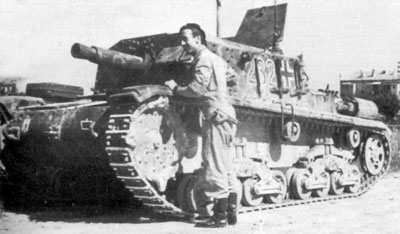
 Semovente M42 75/18 del 278 Panzerjäger Abteilung.

44º Reichsgrenadier Division Hoch und Deutschmeister
46. Panzerjäger Abteilung
1 Kompanie de StuG M42 75/18 y 75/34

5º Gebirgs Division
95. Panzerjäger Abteilung
1 Kompanie de StuG M42 75/18 y 75/34

114º Jäger Division
114. Panzerjäger Abteilung
1 Kompanie de StuG M42 75/18 y 75/34.

305º Static Infanterie Division
304. Panzerjäger Abteilung
1 Kompanie de StuG M42 75/18, 75/34 y StuG M43 105/25 y 75/34

65º Infanterie Division
165. Panzerjäger Abteilung
1 Kompanie de StuG M42 75/18, 75/34 y StuG M43 105/25 y 75/34

162º (Turkistani) Infanterie Division
262. Panzerjäger Abteilung
1262. Sturmgeschütz Abteilung
1 Kompanie de StuG M42 75/18 y 75/34.


12º Polizei-Panzer Kompanie.
Estaba formada por 3 secciones, las dos últimas armadas con 4 Semoventes cada una.
Polizei-Panzerabteilung
1. Zug K-Pzkw (5 x Ketten-Panzerkraftwagen M15)
2. Zug (4 x StuG M42)
3. Zug (4 x StuG M42)

 Semovente 75/18, 12º SS Polizei Panzer Kompanie. Budapest, Marzo de 1945

Sturmgeschütz Abteilung

Fallschirm-Sturmgeschütz Abteilung “Schmitz” (después renombrada Brigade XXI)
StuG M42/M43

242º Sturmgeschütz Abteilung
33 StuG M42/M43 (Mayo de 1944)


Fuentes:
JOHNSON, R. “Beutepanzer 1939-45 (Die Wehrmacht)” Feist Books, 2011
KOCH, F. “Beutepanzer im Ersten Weltkrieg: Britische, franzosische und russische Kampf- und Panzerwagen im deutschen Heer” Podzun-Pallas, 1994
REGENBERG, W. “Beutepanzer unterm Balkenkreuz” Dörfler Verlag GMBH, 2003


English version

The hasty departure of the conflict left Italian German forces stationed in Italy in a difficult situation. Many Italian units defected to the Allies but many others continued to fight the Axis side. Lot of material went to swell the German lines and tank destroyers did not escape this. These vehicles are enrolled in the German units in Italy and the Balkans.

Among the material before us we find the following vehicles:
Semovente da 149/40

Independent brigades.

XI Brigade Fallschirm-Sturmgeschütz
Brigade armed with a mixture of StuG M42/M43.

Included in the Infantry Divisions.

71º Infanterie Division
171. Panzerjäger Abteilung
1 StuG M42 75/18 Kompanie of 75/34.

  Semovente 75/34, 2.Kp. of Pz.Jg.Abt. 171, July, 1944


94° Infanterie Division
194. Panzerjäger Abteilung
1 of StuG M42 75/18 Kompanie and 75/34.

334º Infanterie Division.
334. Panzerjäger Abteilung
1 of StuG M42 75/18 Kompanie and 75/34.

356º Infanterie Division
356. Panzerjäger Abteilung
1 of StuG M42 75/18 Kompanie and 75/34.

362º Infanterie Division.
362. Panzerjäger Abteilung
1 of StuG M42 75/18 Kompanie and 75/34.

278º Infanterie Division
278. Panzerjäger Abteilung
1 of StuG M42 75/18 Kompanie and 75/34.


44th Division Hoch und Deutschmeister Reichsgrenadier
46. Panzerjäger Abteilung
1 of StuG M42 75/18 Kompanie and 75/34

5º Division Gebirgs
95. Panzerjäger Abteilung
1 of StuG M42 75/18 Kompanie and 75/34

114º Jäger Division
114. Panzerjäger Abteilung
1 of StuG M42 75/18 Kompanie and 75/34.

305º Infanterie Division Static
304. Panzerjäger Abteilung
1 of StuG M42 75/18 Kompanie, StuG M43 75/34 and 105/25 and 75/34

65° Infanterie Division
165. Panzerjäger Abteilung
1 of StuG M42 75/18 Kompanie, StuG M43 75/34 and 105/25 and 75/34

162° (Turkistani) Infantry Division
262. Panzerjäger Abteilung
1262. Abteilung Sturmgeschütz
1 of StuG M42 75/18 Kompanie and 75/34.

12º Polizei-Panzer Kompanie.
It consisted of 3 sections, the last two Semoventes armed with 4 each.
Polizei-Panzerabteilung
1. K-Pzkw Zug (5 x Ketten-Panzerkraftwagen M15)
2. Zug (4 x StuG M42)
3. Zug (4 x StuG M42)

Abteilung Sturmgeschütz

Sturmgeschütz Fallschirm-Abteilung "Schmitz" (later renamed Brigade XXI)
StuG M42/M43

Abteilung 242º Sturmgeschütz
M42/M43 StuG 33 (May 1944)

 Reg. "Barenthin"

Sources:
JOHNSON, R. “Beutepanzer 1939-45 (Die Wehrmacht)” Feist Books, 2011
KOCH, F. “Beutepanzer im Ersten Weltkrieg: Britische, franzosische und russische Kampf- und Panzerwagen im deutschen Heer” Podzun-Pallas, 1994
REGENBERG, W. “Beutepanzer unterm Balkenkreuz” Dörfler Verlag GMBH, 2003

miércoles, 20 de junio de 2012

Aeródromos de la IIGM: Bain-Tumen

Aeródromo de Bain-Tumen


Localizado al norte de Choybalsan (Sanbeisu, Tumen Bayan), Lat 48°6'32"N Long 114°33'52"E. Está situado a 300 kilómetros de la zona de Khalkhin Gol y también es conocido como “Bayantumen”, “Bayan Tumen” o “Bain Tumen” hasta 1941, cuando la ciudad y el aeropuerto fue renombrado Choybalsan.

Fue construido por Rusia en la década de 1930 y fue operativo al menos hasta 1936. Tenía dos pistas que corrían de este a oeste y uno de sus primeros comandantes fue Z. Bor.

Durante la batalla de Khalkhin Gol este campo de aviación fue nombrado con el código “Leningrado”. El 28 de mayo llegó al campo el IAP 22 con una dotación de 28 I-16 Tipo 10 y 35 I-15bis bajo el mando del Mayor Glazykina. Estos aparatos no estaban mimetizados y recibieron simplemente una capa de color gris claro. El 27 de mayo un destacamento de 16 aparatos fueron enviados a un campo más próximo, al aeródromo de Hamar-Daba. En mayo de 1939 llegó una unidad equipada con bombarderos SB-2 para ocupar el campo.


Misiones japonesas contra Bain-Tumen y su aeródromo.

24 de junio de 1939
(JAAF) Ki-15, vuelo de reconocimiento sobre el aeródromo de Baintumen, pero fracasa debido al mal tiempo.
27 de junio de 1939
El aeródromo es atacado por cazas y bombarderos japoneses.

Fuentes:
MAURER, M. “Air Force Combat Units Of World War II”. Maxwell AFB, Office of Air Force History, 1983
Pacificwrecks

English version

Located north of Choybalsan (Sanbeisu, Tumen Bayan), Lat 48° 6'32 "N Long 114° 33'52" E. Located 300 kilometers from the area Khalkhin Gol and is also known as "Bayantumen", "Tumen Bayan" or "Bain Tumen" until 1941, when the city and the airport was renamed Choybalsan.

It was built by Russia in the 1930s and became operational at least until 1936. It had two tracks running from east to west and one of its first commander was Z. Bor.

During the battle of Gol Khalkhin this airfield was named with the code "Leningrad." On May 28 the IPA came to the field 22 with a staff of 28 I-16 Type 10 and 35 I-15bis under the command of Major Glazykina. These devices were not camouflaged and were simply a layer of light gray. On May 27 a detachment of 16 aircraft were sent to a camp near you, the Hamar-Daba airfield. In May 1939 came a unit equipped with SB-2 bombers to occupy the field.

Japanese Missions Against Bain-Tumen and Bain Tumen Airfield
June 24 - September 12, 1939

June 24, 1939
(JAAF) Ki-15 reconnaissance flight over Baintumen failed to observe anything due to bad weather.
June 27, 1939
(JAAF) On June 27, 1939 the airfield was attacked by JAAF fighters and bombers.


Sources:
MAURER, M. “Air Force Combat Units Of World War II”. Maxwell AFB, Office of Air Force History, 1983
Pacificwrecks

martes, 19 de junio de 2012

Focke Wulf Fw 190 F-4


Focke Wulf Fw 190 F-4


En octubre de 1943 se contempló el inicio de la producción de una nueva versión de ataque al suelo, el Fw 190 F-4. Se trataba de una modernización del modelo anterior (F-3) cuyas dos versiones variaban en el armamento. El Fw 190 F-4/R1 disponía de dos soportes ETC 50 bajo las alas y otro ETC 501 ventral, mientras que al Fw 190 F-4/R3 se le montaron una pareja de cañones MK 103 de 30 mm. El armamento para ambos aparatos era de dos ametralladores MG 17 de 7´92 mm y dos cañones MG 151/20 de 20 mm. A pesar de sus expectativas la producción en serie no comenzó y solo se completó un pequeño número de aparatos para su evaluación, como sucedería más adelante con el F-5 (Fw 190 V36) y el F-6 (Fw 190 V37 y V40). Estos aparatos dispondrían del nuevo motor BMW 801 de 2.400 caballos de potencia, sin embargo el motor no estaba siendo fabricado en masa de modo que ambos modelos fueron cancelados. Algo similar ocurrió en el Fw 190 F-7, basado en la estructura del A-7. A finales de 1943 todo el esfuerzo se concentró en el trabajo con el Fw 190 A-8 de modo que los esfuerzos en el proyecto de F-7 fue abandonado.   


Fuente:
ORMEÑO, J. “Focke Wulf Fw 190. El pájaro carnicero”

English versión

In October 1943 saw the beginning of the production of a new ground attack version, the Fw 190 F-4. It was an upgrade from the previous model (F-3) whose two versions differed in armament. The Fw 190 had two brackets F-4/R1 ETC 50 under the wings and one ETC 501 ventral, while the Fw 190 was F-4/R3 a pair of cannons mounted MK 103 30 mm. The armament for both units was two MG 17 machine guns of 7'92 mm cannon and two MG 151/20 to 20 mm. Despite expectations the series production began and was completed only a small number of devices for evaluation, as would happen later with the F-5 (Fw 190 V36) and the F-6 (V37 and V40 Fw 190) . These devices dispondrían the new BMW 801 engine of 2,400 horsepower, but the engine was not being manufactured in bulk so that both models were canceled. Something similar happened in the Fw 190 F-7, based on the structure of the A-7. In late 1943 all efforts were concentrated on working with the Fw 190 A-8 so that the efforts in the proposed F-7 was abandoned.


Source:
ORMEÑO, J. “Focke Wulf Fw 190. El pájaro carnicero”

lunes, 18 de junio de 2012

Guy Armoured Car

Blindado británico 
Guy Armoured Car


En 1938 Guy Motors construyó un pequeño lote de cinco prototipos basados en el chasis del tractor de artillería Quad bajo la designación de Guy Quad. Estos vehículos fueron testados intensamente en los campos de pruebas ordenándose un lote inicial de 101 vehículos a fabricar entre 1939 y 1940. Estos vehículos recibieron la designación oficial de Guy Wheeled Light Tank.

El vehículo disponía de un casco soldado convirtiéndose en el primer blindado británico construido enteramente con soldadura y con la plancha del glacis inclinada para mejorar su protección balística. Una torreta alojaba el armamento principal compuesto por dos ametralladoras Vickers o Besa de 7´92 mm. El motor se encontraba alojado en la parte posterior y disponía de un equipo de radio para transmisiones. Posteriormente su habitáculo sería utilizado para la construcción del blindado Humber con un nuevo chasis. De la primera versión, el Mk.I, se construyeron un total de 50 vehículos tras él vino el Mk.IA que disponía de una ametralladora pesada Besa de 15 mm y otra Vickers 7´92 mm con un lote de 51 vehículos.

Un pequeño lote de tan solo 6 vehículos fueron enviados a Francia junto con el BEF (Britsh Expeditionary Force) para oponerse a la ofensiva alemana de mayo. Cuatro de ellos fueron empleados por el 12º de Lanceros, perteneciente a la Guardia Real, y los otros dos para mando. Todos ellos se perdieron con la rendición francesa y la evacuación de Dunkerque. Por su parte el resto de vehículos fueron encuadrados en diferentes unidades británicas, belgas, danesas y holandeses estacionadas en Inglaterra hasta que finalmente fue reemplazado en 1943 por vehículos más modernos.


Fuentes:
MOSCHANSKIY, I. “Armored vehicles of the Great Britain 1939-1945 part 2” Bronekollektsiya 1999-02
GEORGE, F. “World War Two Armoured Fighting Vehicles and Self-Propelled Artillery” Osprey, 1996


English versión

In 1938 Guy Motors built a small batch of five prototypes based on the chassis of the prime mover under the designation Quad, Guy Quad. These vehicles were tested extensively in the fields of testing ordained an initial batch of 101 vehicles manufactured between 1939 and 1940. These vehicles received the official designation of Guy Light Wheeled Tank.

The vehicle had a welded hull becoming the first British built entirely shielded welding and sloping glacis plate to improve ballistic protection. A turret housed the main armament consists of two Vickers machine guns or Kiss of 7'92 mm. The engine was housed in the back and had a radio for transmissions. Then the compartment would be used to build the Humber armored with a new chassis. In the first version, the Mk.I, built a total of 50 cars behind him came the Mk.IA that had a heavy machine gun Besa 15 mm and a Vickers 7'92 mm with a batch of 51 vehicles.

A small batch of only six vehicles were sent to France with the BEF (Britsh Expeditionary Force) to oppose the German offensive of May. Four of them were employed by the 12 th Lancers, belonging to the Royal Guard, and two for control. They were lost with the French surrender and the evacuation of Dunkirk. Meanwhile the other vehicles were framed in different units British, Belgian, Danish and Dutch stationed in England until it was finally replaced in 1943 by modern vehicles.


Sources:
MOSCHANSKIY, I. “Armored vehicles of the Great Britain 1939-1945 part 2” Bronekollektsiya 1999-02
GEORGE, F. “World War Two Armoured Fighting Vehicles and Self-Propelled Artillery” Osprey, 1996

viernes, 15 de junio de 2012

Hallazgo del U-480


Hallazgo del U-480


El U-480 era un U-Boot del Tipo VIIc construido en los astilleros Deutsche Werke AG, Kiel-Gaarden y botado el 17 de agosto de 1943. El 18 de mayo de 1944 zarpó de Kiel llegando a Arendal al día siguiente, formando parte de la 5.U-Flottille, Kiel como Ausbildungsboot. El U-480 estaba equipado con el recubrimiento antisolar Alberich y realizaría varios ensayos a finales de mayo cerca de las costas noruegas siendo comparado con el U-247 y U-999 que no disponían de este recubrimiento.

Su segunda patrulla comenzó el 7 de junio cuando zarpó desde Arendal para patrulla al noreste de las islas Británicas y ya estaba equipado con el sistema Schnorkel. Sin embargo el U-Boot recibió otras órdenes durante su travesía y puso proa al Canal de la Mancha. El día 13 fue sorprendido por un hidroavión Catalina del Squadron 162 de la RCAF pero el certero fuego antiaéreo logró derribarlo cayendo al mar. La tripulación de este aparato había hundido dos días antes al U-980 pero en esta acción murieron 3 de sus 8 tripulantes, 4 más murieron en el bote salvavidas sobreviviendo solo uno de ellos. A principios de julio cruzó el Canal junto con otros dos U-Boot para alcanzar la zona de desembarco aliado pero de nuevo varió su rumbo hacía Brest por órdenes recibidas. Los otros dos U-Boot que le acompañaban, el U-243 y U-678, fueron hundidos en el trayecto. Finalmente alcanzó Brest el 7 de julio sin problemas.

Desde allí comenzó su tercera patrulla el 3 de agosto de nuevo hacia el Canal de la Mancha y el día 18 atacó sin éxito un convoy al noreste de Barfleur. El día 21 logró hundir a la corbeta HMCS Alberni, el día 22 al dragaminas HMS Royalty y al día siguiente dañó con sus torpedos al carguero británico SS Fort Yale de 7.134 toneladas. Con ayuda logró alcanzar puerto pero sus daños eran enormes y no fue reparado siendo desguazado posteriormente. El día 25 se encontraba sumergido cuando el convoy FTM74 pasó por encima de él y comenzó a seguirlo hundiendo al carguero británico SS Orminster de 5.712 toneladas que estaba rezagado del resto. Esto alertó a los escoltas que pronto se lanzaron a la caza del atacante. Tras siete angustiosas horas el U-480 logró escapar de sus hostigadores gracias a su revestimiento de caucho Alberich. El 4 de octubre entró en el puerto de Trondheim dónde su tripulación pudo descansar. 


No sería hasta el 6 de enero de 1945 cuando zarpó en la que sería su cuarta patrulla de guerra, de nuevo hacia aguas británicas. El U-480 desapareció en el campo de minas Brazier D2 entre los días 29 de enero y 20 de febrero muriendo sus 48 tripulantes. En 1998 unos buzos se toparon con los restos del desaparecido U-480 al sur de la isla de Wight.

Fuentes:
NIESTLE, A. “German U-Boot losses during World War II ” Naval Institute Press 1998
BLAIR, C. “Hitler´s U-Boat war” Random House, 1998
WYNN, K. “U-Boat operations of the Second World War” Naval Institute Press 1998


English version

The U-480 was a Type U-Boot VIIc built in the shipyards Deutsche Werke AG, Kiel-Gaarden and launched on August 17, 1943. On May 18, 1944 sailed from Kiel Arendal reaching the next day, as part of the 5.U-Flottille, Kiel as Ausbildungsboot. The U-480 was equipped with solar control coating Alberich and perform several tests in late May near the Norwegian coast being compared to U-247 and U-999 that did not have this coating.

 Memorial Panel fallen men in the U-Bootte

His second patrol began on June 7 when he sailed from Arendal to patrol northeast of the British Isles and was already equipped with the Schnorkel. However, the U-Boot received other orders during the trip and headed the English Channel. Day 13 was stunned by a Catalina flying boat of 162 Squadron of the RCAF but accurate flak shot down dropping into the sea. The crew of this aircraft had sunk two days before the U-980 but this action killed 3 of his 8 crew, four more died in the lifeboat only surviving one. In early July he crossed the Channel with two other U-boats to reach the Allied landing area but again changed its course towards Brest orders. The other two U-boats that accompanied him, the U-243 and U-678 were sunk on the way. Finally he reached Brest on July 7 with no problems.

From there he began his third patrol on August 3 back to the Channel and on the 18th unsuccessfully attacked a convoy northeast of Barfleur. On 21 managed to sink the corvette HMCS Alberni, on 22 to minesweeper HMS Royalty and the next day with their torpedoes damaged the British freighter SS Fort Yale of 7134 tons. Using managed to reach port but its damage was huge and was not being scrapped subsequently repaired. Day 25 was submerged when the convoy FTM74 passed over him and began to follow sinking the British freighter SS Orminster of 5712 tons that was behind the rest. This alerted the guards soon took to hunting the attacker. After seven agonizing hours the U-480 managed to escape their persecutors with its Alberich rubber coating. On October 4, entered the port of Trondheim where the crew could rest.


It was not until January 6, 1945 when he sailed in what would be her fourth war patrol, back to British waters. The U-480 disappeared in the minefield Brazier D2 between 29 January and 20 February killing all 48 crew members. In 1998 some divers came across the remains of the missing U-480 south of the Isle of Wight.

Sources:
NIESTLE, A. “German U-Boot losses during World War II ” Naval Institute Press 1998
BLAIR, C. “Hitler´s U-Boat war” Random House, 1998
WYNN, K. “U-Boat operations of the Second World War” Naval Institute Press 1998

jueves, 14 de junio de 2012

Sd.Kfz 234/3

SdKfz 234/3 
(Sonderkraftfahrzeug 234)

 
Al igual que el resto de vehículos de la serie 8 Rad, el SdKfz 234/3 disponía de una conducción bidireccional, con un motor más potente que la versión anterior. La dirección a las 8 ruedas y la escasa presión que ejercía el vehículo sobre el suelo le hicieron muy popular entre sus tripulaciones.

Como ya se ha mencionado en el tema del SdKfz 250, la necesidad de un vehículo de reconocimiento pesado para el frente del Este dio origen a esta serie de vehículos (Schwerer Panzerspähwagen). Tras la campaña de Francia el SdKfz 232 comenzó a dar síntomas de haber sido superado en sus funciones por lo que se hacía  necesario la creación de un vehículo pesado para labores de reconocimiento y, que además, contase con más potencia de fuego. La empresa encargada para este desarrollo fue Bussing-NAG que pronto se puso manos a la obra.

La configuración del SdKfz 232 de 8x8 había dado buenos resultados de modo que se decidió conservarla aumentando la potencia de la planta motriz, con un motor Tatra 103 de 12 cilindros en V refrigerados por aire. Este motor proporcionaba una potencia de 210 caballos con una transmisión de seis marchas hacia delante y otras seis hacia atrás. Los sistemas de ventilación recibieron especial atención para que pudiera operar sin problemas en climas tropicales como el Norte de África y el sur de Rusia. Los retrasos en el diseño y producción provocaron que no pudiera tomar parte en la lucha en los desiertos norteafricanos. 


En cuanto a sus prestaciones básicas del SdKfz 234 podemos destacar su velocidad punta, de 85 Km/h con una capacidad de combustible de 360 litros de diesel. Tenía una autonomía de 900 Km por carretera y 600 Km campo a través. Su tripulación la componía cuatro hombres; comandante, artillero, cargador y conductor.

El blindaje del vehículo se reforzó tal y como se había especificado en un principio, aumentándose su blindaje frontal hasta alcanzar los 30 mm, con muchas zonas dispuestas en ángulo que aumentaba su protección balística. Otro de los puntos de interés del vehículo fue el armamento, aumentado para hacer frente a nuevos adversarios. Algunos de los modelos como el SdKfz 234/3 y SdKfz 234/4 disponían de una torreta abierta por arriba simplemente porque el armamento instalado era demasiado grande como para una torreta cerrada. Sumando todas las versiones del SdKfz 234 se completaron un total de 510 vehículos.

Por su parte el SdKfz 234/3, el vehículo que nos ocupa, estaba armado por un cañón de tubo corto KwK 37 L/24 de 75 mm, empleado anteriormente por el PzKpfw IV, PzKpfw III y StuG III. Tras ser desmontados de estos vehículos sucesivamente fue el SdKfz 234/3 los que los recibieron como armamento principal. Para el armamento principal se tenía una capacidad de 50 proyectiles

El principal cometido de este vehículo era el de eliminar las posiciones de ametralladoras enemigas y cañones anticarro con su fuego directo de alto explosivo. Para su defensa cercana disponía de una MG 42 de 7,92 mm con 1.920 proyectiles. Entre junio y diciembre de 1944 se completaron 88 vehículos de este tipo.

 
Fuentes:
GANDER, T. “SdKFz 231/234 8-rad. 8x8 Armored car”
GAWRYCH, W. “SdKfz 234” Progress, 2002
PARADA, G. “Sd.Kfz 234” Kagero, 2004
JENTZ, T. “Schwerer Panzerspähwagen (Sd.Kfz 234)”

English versión

Like the other vehicles in the series 8 Rad, the SdKfz 234/3 available bidirectional conduction, with a more powerful engine than the previous version. The address at 8 wheels and low pressure exerted by the vehicle on the ground made him very popular with their crews.

As mentioned in the subject of SdKfz 250, the need for a heavy reconnaissance vehicle for the Eastern Front led to this series of vehicles (Schwerer Panzerspähwagen). After the French campaign the SdKfz 232 began to show signs of having been beaten in their duties so it was necessary to the creation of a heavy vehicle for reconnaissance and, also, contase more firepower. The company responsible for this development Bussing-NAG was soon put to work.

232 SdKfz configuration 8x8 had given good results is decided so that keep increasing the power of the power plant, with a motor 103 Tatra V 12 cylinder air-cooled. This engine provided a power of 210 hp with a six-speed transmission forward and six back. Ventilation systems received special attention so that he could operate without problems in tropical climates such as North Africa and southern Russia. Delays in the design and production caused could not take part in the fighting in North African deserts.


In terms of its basic features we can highlight SdKfz 234 top speed of 85 Km/h with a fuel capacity of 360 liters of diesel. Had a range of 900 km road and 600 km cross country. His crew comprised four men, commander, gunner, loader and driver.

The shield of the vehicle is reinforced as was specified in the beginning, increasing its front armor up to 30 mm, with many areas arranged at an angle which increased its ballistic protection. Another point of interest was the arming of the vehicle, increasing to meet new opponents. Some of the models such as the SdKfz 234/3 and SdKfz 234/4 possessed an open-topped turret armament installed simply because it was too big for a turret closed. Adding all versions of the SdKfz 234 was completed a total of 510 vehicles.

In turn, the SdKfz 234/3, the vehicle in question, was armed by a short tube cannon KwK 37 L/24 75 mm, previously employed by the PzKpfw IV and StuG III PzKpfw III. After being removed on these vehicles was the SdKfz 234/3 which received them as main armament. For the main armament had a capacity of 50 rounds

The main task of this vehicle was to eliminate the positions of enemy machine guns and antitank guns with direct fire high explosive. For a defense available near 7.92 mm MG 42 with 1,920 rounds. Between June and December 1944 were completed 88 vehicles of this type.


Sources:
GANDER, T. “SdKFz 231/234 8-rad. 8x8 Armored car”
GAWRYCH, W. “SdKfz 234” Progress, 2002
PARADA, G. “Sd.Kfz 234” Kagero, 2004
JENTZ, T. “Schwerer Panzerspähwagen (Sd.Kfz 234)”

miércoles, 13 de junio de 2012

Kolomyja, Galizien


Exhumación en Kolomyja, Galizien

 
La expedición se prolongó desde el 11 al 25 de abril de 2009 y se hallaron 40 soldados, entre ellos 8 soldados húngaros.
Los nueve miembros de la expedición se trasladaron en avión desde Berlín a Riga, y desde allí la idea era viajar en otra aerolínea a Kiev pero el vuelo se canceló y tuvieron que ir en coche, 12 horas para hacer 720 kilómetros hasta alcanzar Kolomyja (a unos 50 km al este de Stanislav). En ese lugar se encontraban una fosa con 350 soldados de la Wehrmacht. El suelo era duro y arcilloso y no fue hasta el día 21 cuando aparecieron los primeros restos, una fosa con 20 soldados enterrados. Ese día se recuperaron 11 de ellos con 7 placas de identificación, pero lamentablemente sólo 5 eran legibles. Al día siguiente y sin motivo aparente el propietario del terreno les denegó el acceso para continuar con los trabajos de búsqueda. Marcharon a otro lugar pero de nuevo se les denegó el permiso para acceder a los terrenos con la demanda de un pago de 5.000 dólares para excavar “sus muertos”. A pesar de la intervención del alcalde los intentos por convencer a este avaro civil fueron infructuosos.

En los dos últimos días la expedición se marchó a una iglesia en la que se habían enterrado a 200 soldados húngaros pertenecientes al 1º Ejército. En los trabajos participó una excavadora y el apoyo de un grupo de rescate ucraniano que lograron rescatar 21 soldados alemanes con 12 placas de identificación y 8 soldados húngaros. Al final la expedición costó unos 6.300 euros, a 700 por miembro que se los costearon ellos mismos.


Con la información disponibles en las chapas se pudieron encontrar;

PZ.Gren.(F.A.)Rgt./ -6-
Stuka.- Schütz- Kitz. Tech. Kp./ -238- , 0
2./ Geb.Jg.Ers.Rgt. 137 / -1630-, 0
J.Pz.Jäg.E.K.75/ -890-, 0
…/ J. E. B.75/ -5592, A
Stm/ Le. Art. Ers. Abt 11 – 5183 –
2. / Inf. Ers. Btl. 169 – 2112 –
T. Kp. Pz. Jg. TRS. ABT. 47 – 1247 – A
Ers.Art.N 684 Zg. 3 – 6178
L.PI.KOL. _ I.BTL – 30 – O
Pz.Pi.BTL. 39 – 380
Tr.BTL. 1 – 247 – A
Stamm.Kp.Pio.Ers.Btl. 1 – 1613 – A
19. Div.Pz.Gr.Ers.Btl. 230 – 832
--BE 107 – 1701
2.JNF.ERS.BTL. 189 – 2112

Dos de las chapas no eran legibles y además se encontró una medalla por herida en plata.

En 2010 se pretende realizar una nueva expedición al lugar para localizar los 350 soldados allí enterrados, además de otras numerosas tumbas aisladas. En particular, soldados pertenecientes a la 101º y 367º Infanterie Divisione, 16º Panzerdivision, 301º Sturmgeschütz Abteilung. Estas unidades participaron desde el 23 de abril hasta el 7 de mayo de 1944 en la batallas de Bortniki.

Trasfondo.

Después de las duras batallas defensivas del 1º Panzerarmee en Viñitas la 101º Infanterie Divisione, junto con la 367º y la 18º División de infantería ligera húngara participaron en duros combates en abril de 1944 contra fuerzas muy superiores.

En la mañana del 23 de abril de 1944 la 101º y la 18º húngara se unieron para atacar Bortniki, pero el ataque fracasó por la densa defensa soviética. A la mañana siguiente un ataque renovado por parte de la 367º Infanterie Divisione logró tomar parte de Bortniki y se trasladó un regimiento de cazadores del 229º Gebirgsjäger que debían atravesar los bosques de norte a sur, una zona muy hostil. Entre el 24 y el 25 se defendió las ganancias en Bortniki, sobre todo la carretera que la unía con Bohorodyczyn. El 26 de abril continuaron los duros enfrentamientos, realizando numerosos contraataques locales y el bosque se convirtió en un campo de batalla. Los StuG del 301º eliminaron numerosos carros de combate enemigos hasta que un Kampfgruppe de la 16º Panzerdivision llegó a la zona (dos batallones de Panzergranadier y unos cuantos carros de combate) bajo el mando del Hauptman Jacobi quién recibiría también el mando de la 101º Jäger. La lucha se prolongó hasta los primeros días de mayo, extendiendo la lucha hasta la zona montañosa al suroeste de Bortniki hasta que la presión soviética aflojó. Durante estos días, la 101º Infanterie Divisionen por ejemplo, perdió 190 soldados y 24 desaparecidos.


Fuente:
VKSVG e

English version

The expedition lasted from 11 to 25 April 2009 and 40 soldiers were found, including 8 Hungarian soldiers.

The nine members of the expedition was flown from Berlin to Riga, and from there the idea was to travel on another airline to Kiev but the flight was canceled and had to drive 12 hours to make up to 720 kilometers Kolomyja (a about 50 km east of Stanislav). In that place were a mass of 350 soldiers of the Wehrmacht. The ground was hard and clay and it was not until day 21 when the first remains, a burial pit with 20 soldiers. That day, 11 of them recovered with 7 badges, but unfortunately only 5 were legible. The next day, for no apparent reason the landowner denied access to continue the search work. They went to another place but again were denied permission to access land to demand a payment of $ 5,000 to dig "dead." Despite the intervention of the mayor's attempts to convince this greedy civilian were unsuccessful.

In the last two days the expedition went to a church where they had buried 200 soldiers belonging to the 1 st Hungarian Army. Participated in an excavator work and support of a rescue team managed to rescue 21 Ukrainian German soldiers with dog tags 12 and 8 Hungarian soldiers. At the end of the expedition cost about 6,300 euros, to 700 per member to the defrayed by themselves.


With the information available on the plates could be found;

PZ.Gren. (F.A.) Rgt. / -6 –
Stuka .- Schütz-Kitz. Kp Tech. / -238 -, 0
2. / Geb.Jg.Ers.Rgt. 137 / -1630 -, 0
J.Pz.Jäg.E.K.75 / -890 -, 0
... / J. E. B.75 / -5592, A
Stm / Le. Art Ers. Abt 11-5183 –
2. / Inf Ers. Btl. 169 - 2112 –
T. Kp. Pz. Jg. TRS. ABT. 47-1247 – A
684 Ers.Art.N Zg. 3-6178
L.PI.KOL. _ I. BTL - 30 – O
Pz.Pi.BTL. 39 to 380
Tr.BTL. 1-247 – A
Stamm.Kp.Pio.Ers.Btl. 1-1613 – A
19. Div.Pz.Gr.Ers.Btl. 230 to 832
- BE 107 – 1701
2.JNF.ERS.BTL. 189 – 2112

Two of the plates were not readable and also found a silver medal for wounds.

In 2010 it intends to conduct an expedition to the site to locate the 350 soldiers buried there, as well as numerous other isolated tombs. In particular, soldiers from the 101º and 367º Infanterie Division, Panzer 16º, 301º Sturmgeschütz Abteilung. These units participated from April 23 until May 7, 1944 in Bortniki battles.

Background.

After the tough defensive battles Panzerarmee 1 in Vinita the 101st Infanterie Division, along with the 367 th and the 18th Light Infantry Division Hungary participated in heavy fighting in April 1944 against overwhelming odds.

On the morning of April 23, 1944 the 101st and the 18th Hungarian Bortniki joined to attack, but the attack failed because of heavy Soviet defense. The next morning a renewed attack by the division achieved 367º Infanterie Bortniki take part and moved an infantry regiment of 229º Gebirgsjäger to be through the forests from north to south, a very hostile. Between 24 and 25 fought Bortniki gains, especially the road that linked with Bohorodyczyn. On April 26, heavy fighting continued, making numerous local counterattacks and the forest became a battlefield. The StuG of 301º eliminated numerous tanks enemies until a Kampfgruppe of the 16th Panzer Division reached the area (two battalions Panzergranadier and a few tanks) under the command of Hauptman Jacobi who also receive the command of the 101st Jäger. The fighting continued until early May, extending the fight to the mountainous area southwest of Bortniki until loosened Soviet pressure. During these days, the 101° Infanterie Divisionen for example, lost 190 soldiers and 24 missing.


Source:
VKSVG e 

martes, 12 de junio de 2012

Experten alemanes: Friedrich-Karl Müller


Oberleutnant Friedrich-Karl “Tutti” Müller


Logró 140 victorias en 600 misiones de combate, 53 de ellas en el Frente del Oeste incluyendo la destrucción de 23 bombarderos pesados. Al terminar la campaña francesa había logrado 8 victorias y dos más que lograría durante la Batalla de Inglaterra (dos cazas Spitfire).

En el frente del Este las victorias fueron aumentando y para el 19 de septiembre de 1942 ya había sumado su victoria número 100 y 101 al derribar dos aparatos soviéticos. El 1 de noviembre de 1942 fue trasladado, junto con su unidad, el I./JG 53 a Túnez, dónde prestó servició desde el 25 de noviembre al 30 de abril. Durante este periodo logró el derribo de otros 12 aparatos enemigos más, elevando su registro hasta las 115 victorias. El 25 de enero de 1943 su Messerschmitt Bf 109 G-2 (W.Nr. 14510) “<< +” fue dañado teniendo que realizar un aterrizaje forzoso en Bizerte. 

El 12 de febrero de 1944 fue nombrado Gruppenkommandeur del Sturmgruppe IV./JG 3 volando misiones Reichverteidigung. Durante una misión de intercepción el 8 de marzo logró derribar 3 bombarderos pesados, siendo sus victorias número 120, 121 y 122. El 24 de marzo de ese mismo año fue nombrado Kommodore del JG 3. El 18 de abril volvió a derribar otro trío de bombarderos pesados de la USAAF. Müller resultó muerto en un accidente al aterrizar en Salzwedel el 29 de mayo de 1944 cuando su Bf 109 G-6 (W.Nr. 410 827) cuando su aparato cayó desde 15 metros de altura.

 Bf 109 E-7 Muller (JG 53)

Fuente:
ORMEÑO, J. “Messerschmitt Bf 109. El cazador de la Luftwaffe”


English versión

Achieved 140 victories in 600 combat missions, 53 of them in the Western Front including the destruction of 23 heavy bombers. After the French campaign had managed 8 wins and two more that achieved during the Battle of Britain (two Spitfire fighter).

On the Eastern Front victories were increasing and the September 19, 1942 and had added win number 100 and 101 to shoot down two Soviet aircraft. On November 1, 1942 was transferred, along with his unit, the I./JG 53 to Tunisia, where he served from November 25 to April 30. During this period did the shooting down 12 enemy aircraft of other more, raising his record to the 115 victories. On January 25, 1943 the Messerschmitt Bf 109 G-2 (W.Nr. 14510) "<< +" was damaged having to make an emergency landing at Bizerte.

 100th victory, Tusow 19 September 1942

On February 12, 1944 was appointed Sturmgruppe Gruppenkommandeur of IV./JG 3 flying missions Reichverteidigung. During a mission to intercept the March 8 three heavy bombers shot down, with his wins number 120, 121 and 122. On 24 March the same year was appointed Kommodore of JG 3. On April 18 again down another trio of heavy bombers of the USAAF. Müller was killed in an accident on landing at Salzwedel on May 29, 1944 when his Bf 109 G-6 (W.Nr. 410,827) when his unit fell from 15 meters.

Source:
ORMEÑO, J. “Messerschmitt Bf 109. El cazador de la Luftwaffe”