Buscar este blog

Mostrando entradas con la etiqueta StuG III. Mostrar todas las entradas

viernes, 20 de diciembre de 2013

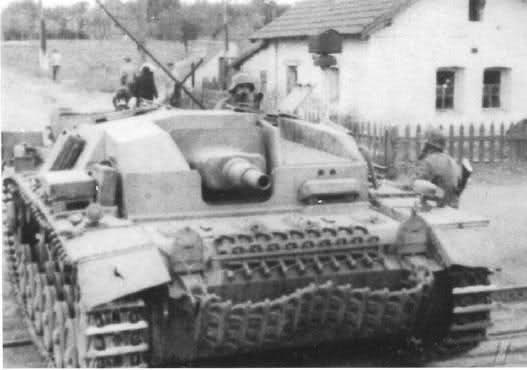
StuG 33


Sturminfanteriegeschütz 33
15 cm siG 33 Auf PzKpfw III


El Sturminfanteriegeschütz 33 fue un proyecto desarrollado por Alkett entre diciembre de 1941 y octubre de 1942 destinado al combate urbano y posiciones fortificadas. El StuG 33 estaba armado con un obús sIG33/1 L/11 de 150 mm que podía transportar 30 proyectiles para su uso inmediato. En total se produjeron 24 unidades, 12 sobre el bastidor de StuG III Ausf E y otros 12 sobre el bastidor del StuG III Ausf F/8. Para dar cabida a su nuevo armamento se rediseñó la superestructura dando origen a una casamata blindada sobreelevada. Debido al tamaño del arma y el limitado espacio interior el cañón solo se podía girar 3º a izquierda y derecha aunque para su cometido esto no era determinante. De mayor interés era la elevación para atacar edificaciones pudiéndose elevar 25º y deprimirse 6º.

Los primeros 12 ejemplares, utilizando bastidores StuG III Ausf E, fueron concluidos entre diciembre de 1941 y enero de 1942. El 20 de septiembre de 1942 se ordenó un segundo pedido decidiéndose utilizar bastidores ya fabricados de otros vehículos. En este punto existe discrepancia entre las fuentes ya que Trojca indica que los 24 vehículos fueron completados por Alkett comenzando en septiembre de 1942 utilizándose StuG III Ausf B, C, D y E devueltos del frente para reparaciones.

Para su defensa cercana contaba con una ametralladora MG 34 en montaje de bola al lado izquierdo con una previsión de 600 proyectiles. Podía girar 15º a la izquierda, 20º a la derecha, elevarse 20º y deprimirse 10º para atacar objetivos muy cercanos. También estaba equipado con un equipo de radio FuG Spr-D. Su tripulación estaba compuesta por cinco hombres que también estaban armados con al menos dos MP 40 y varias granadas debido a la propia naturaleza del vehículo, ya que muy frecuentemente se encontraba en combate cerrado contra infantería enemiga.


El vehículo disponía de un motor Maybach HL 120 TRM que le proporcionaba 300 caballos de potencia. Su velocidad máxima era de 20 Km/h y disponía de una capacidad de combustible de 320 litros para una autonomía de 110 Km en carretera o 85 Km en campo a través. En cuanto a su blindaje contaba con 80 mm de protección frontal, 50 mm en los laterales, 15 mm en la parte trasera del vehículo y 17 mm en el techo. Todo ello, junto con su armamento y munición, alzaba el peso del vehículo hasta las 21 toneladas.

Los primeros vehículos fueron distribuidos en los Sturmgeschütz Abteilung 177 y 244 que vieron combate en los alrededores de Stalingrado. Tras la caída del 6º Armee todos ellos se perdieron. Los restantes 12 vehículos no pudieron ser entregados al Sturmgeschütz Abteilungen 243 y 245 como se tenía previsto ya que el 6º Armee había sido rodeado. Estos fueron asignados para formar el Sturm-Infanterie-Geschütz-Batterie/Lehr-Bataillon XVII (Batería de cañones de asalto/Batallón demostración). Esta nueva unidad fue asignada a la 22º Panzerdivision, una de las unidades enviadas para socorrer al 6º Armee. Tras duros combates la 22º Panzerdivision quedó reducida a su mínima expresión y la Sturm-Infanterie-Geschütz-Batterie/Lehr-Bataillon XVII fue reasignada a la 23º Panzerdivision dónde cambiaría su designación por la de Sturm-Infanterie-Geschütz-Batterie/Panzer-Regiment 201 (o 9. Kompanie/Panzer-Regiment 201). Los informes muestran que en 1944 aún quedaban operativos 5 de estos vehículos, uno de ellos se conserva en el museo de Kubinka.


Fuentes:
CHAMBERLAIN, P. “Encyclopedia of German Tanks of World War Two: A Complete Illustrated Directory of German Battle Tanks, Armoured Cars, Self-propelled Guns, and Semi-tracked Vehicles, 1933–1945” Arms and Armour Press, 1993
TROJCA, W. “Sturmtiger and Sturmpanzer in Combat” Katowice, 2008
DOYLE, H. “Sturmgeschütz III Assault gun 1940-42” Osprey, 1996

English version

The Sturminfanteriegeschütz 33 was a project developed by Alkett between December 1941 and October 1942 intended for urban combat and fortified positions. The StuG 33 was armed with a howitzer sIG33/1 L/11 150 mm could carry 30 rounds for immediate use . In total there were 24 units, 12 on the frame StuG Ausf E and 12 on the frame of StuG Ausf F/8. To accommodate the new superstructure was redesigned weapons giving rise to a bunker reinforced sobreelevada. Due to the size of the weapon and the limited space inside the barrel could only turn 3rd left and right but for this role was not decisive. Of greater interest was the elevation to attack buildings and being able to raise 25º depressed 6º .

The first 12 copies, using racks StuG III Ausf E, were completed between December 1941 and January 1942. The September 20, 1942 ordered a second request and deciding to use racks made ​​of other vehicles. At this point there is a discrepancy between the sources as Trojca indicates that 24 vehicles were completed by Alkett starting in September 1942 used StuG III Ausf B , C , D and E Front returned for repairs.

For close defense had a MG 34 machine gun mounted on the left side ball with a forecast of 600 rounds. He could rotate 15° left , 20° right , 20° rise and depressed 10º to attack targets nearby. It was also equipped with a radio set FuG Spr- D. Her crew consisted of five men who were also armed with at least two grenades MP 40 and due to the very nature of the vehicle, as very often was in close combat against enemy infantry.


The disposal of a motor vehicle Maybach HL 120 TRM that provided 300 horsepower. Its maximum speed was 20 km/h and available fuel capacity of 320 liters for a range of 110 Km on road or 85 Km through field. Regarding its shielding had 80 mm frontal protection, 50 mm in the lateral, 15 mm at the rear of the vehicle and the roof 17 mm. This, along with weapons and ammunition, vehicle weight rose to 21 tons.

The first vehicles were distributed in the Sturmgeschütz Abteilung 177 and 244 that saw combat around Stalingrad. After the fall of the 6th Armee all of them were lost. The remaining 12 vehicles could not be delivered to Sturmgeschütz Abteilungen 243 and 245 as planned since the 6th Armee had been surrounded . These were assigned to form the Sturm-Infanterie-Geschütz-Batterie/Lehr-Bataillon XVII (assault gun battery/ Demonstration Battalion). This new unit was assigned to the 22nd Panzer Division, one of the units sent to aid the 6th Armee. After heavy fighting the 22nd Panzer Division was reduced to a minimum and XVII Sturm-Infanterie-Geschütz-Batterie/Lehr-Bataillon was reassigned to the 23rd Panzer where change his designation of Sturm-Infanterie-Geschütz-Batterie/Panzer-Regiment 201 (or 9. Kompanie/Panzer-Regiment 201). Reports show that in 1944 there were still operating 5 of these vehicles, one of which is preserved in the museum of Kubinka.


Sources:
CHAMBERLAIN, P. “Encyclopedia of German Tanks of World War Two: A Complete Illustrated Directory of German Battle Tanks, Armoured Cars, Self-propelled Guns, and Semi-tracked Vehicles, 1933–1945” Arms and Armour Press, 1993
TROJCA, W. “Sturmtiger and Sturmpanzer in Combat” Katowice, 2008
DOYLE, H. “Sturmgeschütz III Assault gun 1940-42” Osprey, 1996

miércoles, 20 de noviembre de 2013

KwK 37 de 75 mm


7.5 cm Kampfwagenkanone 37 L/24


El KwK 37 de 75 mm es, probablemente, uno de los cañones más emblemáticos de la primera etapa de la II Guerra Mundial. Sirvió como armamento principal para los primeros modelos tanto del PzKpfw IV (Ausf A, Ausf B, Ausf C, Ausf D y Ausf E) como de las primeras versiones del cañón de asalto StuG III (Ausf A, Ausf B, Ausf C, Ausf D y Ausf E)

El cañón no fue diseñado para uso carro contra carro si no para el apoyo cercano a la infantería con una velocidad inicial baja, 385 m/s, y con proyectiles de 6´8 Kg de peso para su munición estándar Pz.Gr. 39/43. Disponía de varios tipos de munición como el anticarro (K.Gr.rot.Pz.), de humo (Nbgr. Kw. K.), alto explosivo anticarro (Gr.38 Hl/A, Gr.38 Hl/B, Gr.38 Hl/C) y alto explosivo (Sprgr.34) entre otros. Gracias a la buena óptica utilizada en su sistema de puntería tenía un 82% de acertar a un objetivo a 1.500 metros (sobre un blanco de 2´5 x 2 m) logrando una penetración de 33 mm sobre un blindaje con 30º sobre la horizontal. El porcentaje aumentaba hasta el 97% sobre blancos situados a 1.000 metros, penetrando 35 mm. Este cañón solía estar asociado con la instalación de sistemas de puntería TZF5b, TZF56b, Rblf32 o SflZF1

 PzKpfw IV Ausf E

Según avanzaba la contienda se demostró que este cañón no era el más idóneo para combatir a los medios acorazados enemigos de modo que se buscó un sustituto con mejores prestaciones. De este modo a partir de marzo de 1942 los nuevos vehículos de PzKpfw IV y StuG III comenzaron a salir de las cadenas de montaje con el cañón de tubo largo KwK 40 de 75 mm. Posteriormente estos cañones serían utilizados en otros vehículos para el apoyo cercano a la infantería como el Sd.Kfz 251/9
Fuentes:
CROW, D. “Armoured Fighting Vehicles of Germany World War II” Profile Pub., 1973
BISHOP, C. “The Encyclopedia of Weapons of WWII: The Comprehensive Guide to over 1,500 Weapons Systems, Including Tanks, Small Arms, Warplanes, Artillery, Ships, and Submarines” Metrobooks, 2002

English version

The 75 mm KwK 37 is probably one of the most iconic guns of the first stage of World War II. He served as the first main armament for both the Panzer IV models (Ausf A, Ausf B, Ausf C, Ausf D and Ausf E ) and early versions of the StuG III assault gun (Ausf A, Ausf B, Ausf C, Ausf D and Ausf E)

The gun was not designed to use car into car if not for close support to the infantry with a low initial velocity, 385 m/s, and 6.8 kg projectile weight to standard ammunition Pz.Gr. 39/43. It had various types of ammunition as the antitank (K.Gr.rot.Pz), smoke (Kw Nbgr. K.), high explosive anti-tank (Gr.38 Hl/A, Gr.38 Hl/B, Gr 38 Hl/C) and high explosive (Sprgr.34) among others. With good optics used in targeting system had a 82 % to hit a target at 1,500 meters (on a white 2.5 x 2 m), achieving a penetration of 33 mm on a shield with 30° above the horizontal. The percentage increased to 97% on targets located at 1,000 meters, penetrating 35 mm. This gun used to be associated with the installation of targeting systems TZF5b, TZF56b, Rblf32 or SflZF1

As the war progressed it was shown that this canyon was not the most appropriate means to fight the enemy battleships so sought a replacement with better performance. Thus from March 1942 new vehicles PzKpfw IV and StuG III began to leave the assembly with the barrel long tube of 75 mm KwK 40. Later these guns would be used in other vehicles for close support to the infantry as the Sd.Kfz 251/9


Panzerkampfwagen III Ausf N


Sources:
CROW, D. “Armoured Fighting Vehicles of Germany World War II” Profile Pub., 1973
BISHOP, C. “The Encyclopedia of Weapons of WWII: The Comprehensive Guide to over 1,500 Weapons Systems, Including Tanks, Small Arms, Warplanes, Artillery, Ships, and Submarines” Metrobooks, 2002

jueves, 10 de enero de 2013

StuG.Abt. 192

Sturmgeschütz Abteilung 192


Tras comprobar el éxito de este nuevo sistema de armas los Sturmgeschütz Abteilung comenzaron su expansión dentro de la Wehrmacht. En este sentido el Sturmgeschütz Abteilung 192 fue creado el 7 de febrero de 1941 y la unidad se puso bajo el mando del Major Erich Hammon.

Ante el inminente ataque alemán sobre Rusia el 28 de mayo de 1941 el StuG.Abt. 192 ((Staff, HQ Battery, 1. y 3. Batteries) abandonó su localización para trasladarse a un área próxima al río Bug, cerca de Janow Podlaski, y adscrito a la 31º Infanterie Division para labores de reconocimiento. El 5 de marzo de 1941 fue incluida en el orden de batalla del 4º Armee (XXXXIV Armeekorps, Heeresgruppe Mitte). Desde el 4 de junio de ese mismo año fue incluido en el orden de batalla del XII Armeekorps (4º Armee) hasta el día de la invasión de Rusia. La unidad fue adscrita al mismo cuerpo pero dentro del 2º Panzergruppe.

Orden de batalla del StuG.Abt. 192, 22 de junio de 1941
-         Derecha: III./IR 82 (Major Zenker) reforzado con el 1./ Stug Abt 192
-         Izquierda: I./IR 82 (Major Bantje) reforzado con el 3./ Stug Abt 192
-         Reserva: II./ IR 82 (Major Berg)

El resto del año 1941 continuó con el 2º Armee, desde el 22 de septiembre hasta 24 de diciembre, día que pasó bajo el mando del 4º Armee. El 3 de febrero de 1942 pasó a la reserva del 4º Armee, menos una de sus baterías que fue enviada al XII Armeekorps (4º Armee). En marzo de 1942 fue enviada de regreso a Alemania y disuelta hasta que en abril se unió al Sturmgeschütz-Batterie 640 para formar el Sturmgeschütz-Abt.Großdeutschland.


Fuentes:
PERRET, B. “Sturmartillerie & Panzerjäger Osprey, 1979
CLUVER, B. “Sturmgeschütz III” Squadron/Signal, 1976
JENTZ, T. “Sturmgeschütz. Assault gun 1940-1942” Osprey, 1996
 
MÜNCH, K. “StuG. Abt. 192 - Einsatz- und Bilddokumentation der Sturmgeschütz-Abteilung 192” VDM, 2011

English version

After confirming the success of this new weapon system the Abteilung Sturmgeschütz began its expansion into the Wehrmacht. In this sense the Sturmgeschütz Abteilung 192 was created on February 7, 1941 and the unit was placed under the command of Major Erich Hammon.

Faced with the imminent German attack on Russia on 28 May 1941 the StuG.Abt. 192 ((Staff, HQ Battery, 1. & 3. Batteries) left his location to move to an area near the Bug River, near Janow Podlaski, and assigned to the 31st Infantry Division for reconnaissance. On 5 March 1941 was included in the order of battle of the 4th Armee (XXXXIV Armeekorps, Heeresgruppe Mitte). since June 4 of that year was included in the order of battle of the XII Armeekorps (4th Armee) until the day of the invasion of Russia . the unit was attached to the same body but within the 2nd Panzer.

StuG.Abt 192. Order of Battle, June 22, 1941
-         Right: III./ IR 82 (Major Zenker) reinforced with 1./ Stug Abt 192
-         Left: I./ IR 82 (Major Bantje) reinforced with 3./ Stug Abt 192
-         Reservation: II./ IR 82 (Major Berg)

The rest of 1941 continued with the 2nd Armee, from 22 September to 24 December, a day spent under the command of the 4th Armee. On February 3, 1942 the reserve became the 4th Armee, but one of his batteries was sent to Armeekorps XII (4th Armee). In March 1942 he was sent back to Germany and dissolved until April joined Sturmgeschütz-Batterie 640 to form the Sturmgeschütz-Abt.Großdeutschland.


Sources:
PERRET, B. “Sturmartillerie & Panzerjäger Osprey, 1979
CLUVER, B. “Sturmgeschütz III” Squadron/Signal, 1976
JENTZ, T. “Sturmgeschütz. Assault gun 1940-1942” Osprey, 1996
 
MÜNCH, K. “StuG. Abt. 192 - Einsatz- und Bilddokumentation der Sturmgeschütz-Abteilung 192” VDM, 2011

martes, 11 de diciembre de 2012

StuH 42

Sturmhaubitze StuH 42 
(SdKfz 142/2)


Para el apoyo de la infantería se decidió aumentar el calibre del cañón de 75 mm a 105 mm montando el cañón le. Fh18. Los primeros ejemplares fueron entregados a la 3º Batterie del 185º Sturmgeschütz-Abteilung  entrando en batalla en el frente de Leningrado en marzo de 1.942. Sus actuaciones fueron satisfactorias con lo que se decidió iniciar la producción del nuevo vehículo. El vehículo se basaba en un principio en el bastidor y casco del StuG III Ausf F, F/8 y G para pasar, posteriormente a usar los bastidores y superestructuras básicas del Ausf G.

La parte frontal de la superestructura fue protegida por un mantelete, al cual estaban soldados los cilindros de recuperación y retroceso, este montaje solo le permitía girar 10º a ambos lados y –6º a +20º en depresión y elevación respectivamente. El conjunto resulto muy útil en el frente del Este, tanto que la producción fue aumentada a 50 al mes en 1.944, pero ya en 1.943 se construyeron un total de 204 unidades.

Estos vehículos resultaron extremadamente destructivos para la fuerzas acorazadas enemigas ya que en manos expertas podían acabar con 3 o 4 carros de combate enemigos antes de que estos descubriesen donde se ocultaba. Los StuG resultaron muy efectivos en sus labores anticarro de modo que cada vez más se incorporaron a las Panzerdivisionen. De este modo el 10 de abril de 1945 aún quedaban 1.053 StuG III y 277 StuH 42 en servicio.


Fuentes:

Englih versión

For support of the infantry was decided to increase the caliber of the barrel of 75 mm to 105 mm cannon mounted on it. FH18. The first units were delivered to the 3rd Batterie-185º Abteilung-Sturmgeschütz into battle in the Leningrad front in March 1942. His performances were satisfactory thus decided to start production of the new vehicle. The vehicle was based initially on the frame and hull StuG III Ausf F, F/8 and G to spend later to use the racks and basic superstructure Ausf G.

The front of the superstructure was protected by mantlet, which were welded cylinders and reverse recovery, this assembly only allowed to rotate 10° on both sides and -6° to +20° in elevation and depression respectively. The set was very useful on the Eastern front, while production was increased to 50 per month in 1944, but in 1943 they built a total of 204 units.

These vehicles were extremely destructive to the enemy armored forces as in expert hands could end up with 3 or 4 enemy tanks before they descubriesen where concealed. The StuG were very effective in their work so antitank increasingly joined the Panzerdivisionen. Thus the 10 April 1945 there were still 1053 StuG III and 277 StuH 42 in service.


Sources:

martes, 13 de noviembre de 2012

StuG III Ausf F

StuG III Ausf F (SdKfz 142/1) producción inicial


En la producción inicial del Ausf F, que era esencialmente un Ausf E, se instaló el cañón largo L/43 de 75 mm que mejoraba sus prestaciones anticarro. El frontal de la superestructura también se modificó ya que el nuevo cañón era más grande que el anterior, el mantalete de 30 mm recibió unas planchas de blindaje extra de 30 mm de espesor. Era frecuente ver en vehículos los huecos de la parte delantera del techo de la superestructura rellenos de hormigón para aumentar, de esta forma, la protección del vehículo.

También el almacenamiento de municiones fue transformado por el mismo motivo, las vainas de los proyectiles eran más grandes. Este sistema de almacenamiento también se modificó a lo largo de la producción con lo que el vehículo podía almacenar hasta 54 proyectiles de 75 mm. En el techo se instaló un ventilador extractor para que expulsara los humos del interior del vehículo producidos durante el combate. El Ausf F llevaba poco tiempo en las cadenas de montaje cuando se decidió aumentar su armamento, se le cambió el cañón L/43 por el más largo L/48 del mismo calibre. Esta modificación se llevo a cabo retrospectivamente en los modelos Ausf F ya construidos y en los nuevos que salían de fábrica.

Los laterales de la superestructura también fueron modificandos a lo largo de la producción para hacerlos más angulosos y mejorar su protección. Los últimos 31 ejemplares recibieron el cañón StuK 40 L/48 más largo, estos vehículos también se conocen como StuK 40 o StuG 40.


Fuentes:
SPIELBERGER, W. “Sturngeschutz & Its Variants” Schiffer Publishing, 1993

English versión

In the initial production of Ausf F, which was essentially a Ausf E, settled the long-barreled L/43 75mm antitank improved its performance. The front of the superstructure also changed since the new tube was larger than the above, the 30 mm mantalete received extra armor plates of 30 mm thickness. Vehicle was common to see holes in the front of the roof of the superstructure filled with concrete to increase, thus protecting the vehicle.

Storage of ammunition also was transformed by the same token, the pods were larger projectiles. This storage system also changed along with the production of the vehicle 54 could hold up to 75 mm projectiles. On the roof was installed an exhaust fan to expel fumes inside the vehicle produced during combat. The Ausf F was just entering the assembly when it decided to increase its weapons, the barrel was changed L/43 by the longer L/48 of the same caliber. This modification was carried out retrospectively Ausf F models already built and new factory coming out.

The sides of the superstructure were also modificandos along to make production more angular and improve protection. The last 31 samples received StuK 40 L/48 gun longer, these vehicles are also known as StuG 40 or StuK 40.


Sources:
SPIELBERGER, W. “Sturngeschutz & Its Variants” Schiffer Publishing, 1993

miércoles, 3 de octubre de 2012

StuG III Ausf E


Sturmgeschütz III Ausf E


El Sturmgeschütz Ausf.E constituyó el último modelo de este cañón de asalto armado con el obús de 75 mm L/24. Este modelo era muy similar a los anteriores Ausf C y D cuyo mayor cambio fue la instalación de un arcón blindado en el lado derecho de la superestructura así como el aumento del tamaño del arcón del lado izquierdo. El espacio interno ganado de este modo fue utilizado para un equipo de radio adicional para los StuG III utilizados como vehículo de mando y también para cargar otros 8 proyectiles más para el armamento principal.

En lugar de emplear los Sd.Kfz 253 como vehículos de observación acorazado, los jefes de sección y comandantes de batería utilizaban StuG III como vehículos de mando. Cuando estos vehículos desempeñaban tal cometido eran dotados de un equipo de radio de onda ultracorta FuG 15, con transformador, en el contenedor izquierdo y un equipo transmisor/receptor de onda ultracorta FuG 16 de 10 W, con un transformador, en el contenedor derecho.

 
El aumento de los arcones provocó que los guardabarros de las orugas fuesen también modificadas aumentándose su tamaño y se eliminó el blindaje inclinado de 8 mm de los laterales del vehículo. Con un motor Maybach HL120TRM de 320 hp de potencia podía alcanzar una velocidad máxima de 40 Km/h con un peso de 20´8 toneladas. El vehículo tenía una autonomía de 160 Km y un blindaje frontal integral de 50 mm y 30 mm en los laterales.

Se solicitó un lote de 500 vehículos aunque tan solo fueron construidos 272 de ellos antes de que se introdujese el Ausf F armado con un cañón largo. Un Ausf E sirvió como base para probar el SutH 42 y otro para el prototipo de StuG 33B. La producción del StuG III Ausf E sirvió para reponer las pérdidas sufridas en el Frente Oriental finalizando su producción en marzo de 1942. En julio de 1943 aún permanecían en combate 37 de estos vehículos.

Stug III Ausf E, StuG-Abt. 249, Rusia 1942

Fuentes:
JENTZ, T. “StuG III Assault gun 1940-1942” Osprey, 1996
CULVER, B. “Sturmgeschütz III” Squadron/Signal,  1977

English version

The Sturmgeschütz Ausf.E was the last model of this assault gun armed with 75 mm L/24 howitzer. This model was very similar to the previous Ausf C and D whose biggest change was the installation of a shielded bunker on the right side of the superstructure and the enlargement of the left chest. The internal space thus gained was used for additional radio equipment for StuG III used as a command vehicle and also to load another 8 rounds for the main armament.

Instead of using the as vehicles Sd.Kfz 253 armored observation, the section chiefs and commanders StuG III battery used as command vehicles. When these vehicles played such a role were equipped with radio equipment FuG 15 ultrashort wave, with transformer left in the container and a transmitter/receiver FuG 16 ultrashort wave 10 W, with a transformer in the right container.


The increase in bunkers caused the fender of the tracks were also modified in size and aumentándose removed 8 mm sloped armor on the sides of the vehicle. With an engine of 320 hp Maybach HL120TRM power could reach a top speed of 40 km/h with a weight of 20.8 tons. The vehicle had a range of 160 km and a full frontal armor of 50 mm and 30 mm on the sides.

He requested a batch of 500 vehicles were built but only 272 of them before it was introduced the Ausf F armed with a long barrel. A Ausf E was the basis for testing the Süth 42 and one for the StuG 33B prototype. Production of the StuG III Ausf E was used to replenish the losses on the Eastern Front ending production in March 1942. In July 1943 were still 37 of them in combat vehicles.


Sources:
JENTZ, T. “StuG III Assault gun 1940-1942” Osprey, 1996
CULVER, B. “Sturmgeschütz III” Squadron/Signal,  1977

miércoles, 8 de agosto de 2012

StuG III Ausf D

Sturmgeschütz III Ausf D


El StuG III Ausf D resultó muy similar a la versión anterior, el Ausf C, pero con algunas modificaciones. La más importante fue el aumento de su blindaje frontal, aumentado a 50 mm, y una señal para llamar la atención del conductor del vehículo. Algunos de los Ausf D fueron construidos con un cajón blindado en el lado derecho, además del izquierdo de serie, para dar cabida a un equipo de radio adicional para funciones de mando. Este modelo vino a suplir algunas de las pérdidas sufridas a lo largo de 1941 ya que en este año se perdieron 105 StuG III, el resto fueron destinados a la creación de nuevos destacamentos como por el ejemplo el Abt. zbV. 288 (Destacamento para uso Especial 288). Un grupo de ellos fueron enviados al norte de África a principios de 1942

Su producción se prolongó desde mayo a septiembre de 1941 completándose un total de 150 vehículos. El vehículo estaba equipado con un motor Maybach HL120TRM de 320 hp que le permitía desarrollar 40 Km/h en carretera con una autonomía de 160 Km.


Fuentes:
MICHULEC, R. “Panzer-Division 1935-1945 (1) The Early Years 1935-1941” Concord, 2000
CULVER, B. “Sturmgeschütz in action Squadron/Signal, 1976
JENTZ, T. “The Stug III Assault Gun, 1940-42” Osprey, 1996

English version

The StuG III Ausf D was very similar to the previous version, the Ausf C, but with some modifications. The most important was the increase in its frontal armor, increased to 50 mm, and a signal to alert the driver. Some of the Ausf D were built with an armored box on the right side, left the series in addition, to accommodate an additional radio control functions. This model came to meet some of the losses over 1941 and that this year 105 were lost StuG III, the rest were for the creation of new detachments and by example the Abt. zbV. 288 (Special Purpose Detachment 288). A group of them were sent to North Africa in early 1942

Its production lasted from May to September 1941, completing a total of 150 vehicles. The vehicle was equipped with an engine of 320 hp Maybach HL120 TRM that allowed him to develop 40 km/h on the highway with a range of 160 km


Sources:
MICHULEC, R. “Panzer-Division 1935-1945 (1) The Early Years 1935-1941” Concord, 2000
CULVER, B. “Sturmgeschütz in action Squadron/Signal, 1976
JENTZ, T. “The Stug III Assault Gun, 1940-42” Osprey, 1996

martes, 10 de julio de 2012

StuG III Ausf A

Sturmgeschütz III Ausf A


El Sturmgeschütz III Ausf A constituyó la primera versión de este versátil cañón de asalto y su origen se remonta a una orden del 15 de junio de 1936 que solicitaba un vehículo para el apoyo cercano a la infantería. El contrato lo obtuvo Daimler-Benz y debía ser capaz de portar un cañón de 75 mm en una superestructura fija, sin torreta, y con una capacidad de giro de 25º a cada lado. La ausencia de torreta se traducía inmediatamente en un peso menor que se ganaba para el blindaje frontal y, además, un perfil muy bajo lo que le facilitaba la ocultación.

Pronto se completaron cinco prototipos en 1937, denominados Serie 0, que usaron el bastidor de un PzKpfw III Ausf B recibiendo el probado obús L/24 de 75 mm como armamento principal. Estas piezas fueron heredadas de los primeros modelos de PzKpfw IV ya que estos vehículos pronto serían rearmados con nuevas piezas más potentes.

Estos modelos fueron extensamente probados en los campos de prácticas y pronto llamaron la atención del alto mando por sus capacidades. En enero de 1940 finalmente, se ordenó su fabricación en serie. Más tarde estos vehículos fueron usados como vehículos de entrenamiento para futuras tripulaciones. 


El StuG III Ausf A le debía mucho al PzKpfw III Ausf F ya que usaba su misma suspensión, sistema motriz y bastidor aunque no tenía las puertas laterales de escape del carro de combate. La transmisión fue ligeramente modificada para dar cabida a la nuevo cañón. En los laterales se instalaron planchas de blindaje adicional de 8 mm con 30º de inclinación. El PzKpfw III Ausf F contaba con un blindaje de 30 mm laterales y 21 mm en la parte trasera, siendo estas las que conservó. Como se ha mencionado anteriormente la ausencia de torreta se traducía en un ahorro de peso que fue trasladado como blindaje frontal alcanzando el grosor de 50 mm.

La cámara de combate estaba ocupada por tres tripulantes; comandante, cargador y artillero. Cada uno de ellos disponía de una portezuela de escape sobre su posición mientras que el conductor podía abandonar el vehículo en caso de emergencia por una trampilla frente al glacis.


La visibilidad era mala ya que si bien el conductor tenía un bloque de visión fija a su izquierda no tenía nada a su derecha. La apertura frontal para el conductor solucionaba en parte el problema pero esta debía ser cerrada en caso de estar bajo el fuego enemigo. En estas situaciones el conductor debía recurrir a un periscopio doble para poder ver. Por su parte el comandante disponía de un periscopio de tijera que podía ser abatido en caso de no ser necesario o para abrir la escotilla. Su asiento era regulable para poder sacar la cabeza y mejorar al campo de visión. El artillero tenía como elemento de visión el propio sistema de puntería del cañón.

 
El primer StuG III Ausf A fue entregado en febrero de 1940 mientras que en el mes de mayo salieron de las cadenas de montaje un total de 24 vehículos más. Todos ellos fueron a dotar las filas de los StuG. Abt. 640º, 659º, 660º y 665º que tomaron parte en la campaña del Oeste.

El conjunto estaba equipado con un motor Maybach HL120TR de 320 hp de potencia con un peso de 19,6 toneladas. El vehículo alcanzaba los 40 Km/h con una autonomía de 160 Km.En total se completaron 35 vehículos de este tipo, incluyendo 5 de ellos que corresponden a prototipos.


Fuentes:
MICHULEC, R. “Panzer-Division 1935-1945 (1) The Early Years 1935-1941” Concord, 2000
CULVER, B. “Sturmgeschütz in action Squadron/Signal, 1976
JENTZ, T. “The Stug III Assault Gun, 1940-42” Osprey, 1996

English version

The Sturmgeschütz III Ausf A was the first version of this versatile gun assault and dating back to an order of June 15, 1936 requesting a vehicle for close support to infantry. The contract was won Daimler-Benz and should be capable of carrying a 75 mm cannon in a fixed superstructure, without extension, and a rotatable 25 ° on each side. The absence of turret immediately resulted in a lower weight is gained to the frontage, and also a very low profile that facilitated the concealment.

Soon five prototypes were completed in 1937, called Serie 0, which used the chassis of a PzKpfw III Ausf B receiving the proven 75 mm L/24 howitzer as main armament. These pieces were inherited from the first models of PzKpfw IV because these vehicles soon to be rearmed with new more powerful pieces.

These models were extensively tested in the fields of practice and soon attracted the attention of the high command for their abilities. In January 1940 finally ordered its mass production. Later these vehicles were used as training vehicles for future crews.


The StuG III Ausf owed much to the PzKpfw III Ausf F and I used the same suspension, powertrain and chassis but did not exhaust the side doors of the tank. The transmission was slightly modified to accommodate the new gun. In the side armor plates were installed additional 8 mm with 30 ° tilt. The PzKpfw III Ausf F had a shield of 30 mm side and 21 mm at the rear, these being those retained. As mentioned above the turret absence resulted in a saving of weight was taken as reaching the front armor thickness of 50 mm.

The fighting compartment was occupied by three crew, commander, loader and gunner. Each provided an escape hatch on their position while the driver could leave the vehicle in an emergency through a trapdoor in front of the glacis.

StuG III Ausf A, LSSAH

The visibility was poor because although the driver had a block of fixed view on the left had nothing on your right. The front cover for the driver solved the problem in part but this was to be closed in case of being under fire. In these situations the driver must use a periscope to see double. Meanwhile the commander had a scissors periscope could be killed if necessary or not to open the hatch. His seat was adjusted to remove the head and improve the field of vision. The gunner had the vision element of the system itself aiming the gun.

The first StuG III Ausf A was delivered in February 1940 while in May left the assembly line a total of 24 vehicles. They were to give the ranks of the StuG. Abt. 640º, 659º, 660º and 665º who took part in the campaign of the West.

The set was equipped with an engine of 320 hp Maybach HL120TR power with a weight of 19.6 tons. The vehicle reached the 40 km/h with a range of 160 completed Km.En total 35 vehicles of this type, including 5 of them corresponding to prototypes.


Sources:
MICHULEC, R. “Panzer-Division 1935-1945 (1) The Early Years 1935-1941” Concord, 2000
CULVER, B. “Sturmgeschütz in action Squadron/Signal, 1976
JENTZ, T. “The Stug III Assault Gun, 1940-42” Osprey, 1996