Buscar este blog

Mostrando entradas con la etiqueta Historia/Curiosidades. Mostrar todas las entradas

jueves, 3 de diciembre de 2015

Las bicicletas son para la guerra


El empleo de la bicicleta en la
II Guerra Mundial


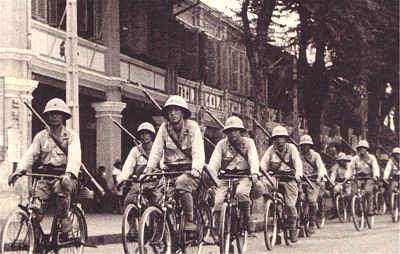
La infantería ciclista tenía un tratamiento diferente al de la infantería normal ya que se organizaba en unidades más pequeñas, generalmente del tamaño menor al de una división. El tamaño idóneo pasa su uso fue el de un batallón. Durante la invasión de China en 1937 los japoneses hicieron un uso extensivo de este medio de transporte utilizando más de 50.000 soldados equipados con bicicletas. Las dificultades inherentes al teatro de operaciones en el Pacifico propició el uso de estas unidades. Durante la campaña japonesa de 1941 desde Malasia hasta Singapur se dependió en gran medida de estas unidades en el avance. En ambas localizaciones las bicicletas permitieron un transporte rápido y flexible para la infantería que sorprendió a los defensores. En el caso japonés, además del propio transporte para la infantería, propició un desahogo a la industria japonesa del motor al precisar menos camiones, barcos de transporte o combustible para movilizar sus fuerzas. Las fuerzas japonesas lograron moverse más rápidamente que las tropas aliadas en retirada aun utilizando estos medios motorizados. También su uso facilitó ataques por la retaguardia de las defensas enemigas.

Otro de los ejércitos que utilizó ampliamente este medio de transporte para su infantería fue el Ejército finlandés, sobre todo durante la Guerra de Continuación y la Guerra de Laponia. Los batallones Jaeger, destacamentos ligeros y regimientos orgánicos utilizaban bicicletas para facilitar su movilidad. Durante la ofensiva contra Rusia en 1941 fueron los batallones ciclistas los que encabezaron el asalto. La 1º Brigada Jaeger fue reforzada con un batallón acorazado y otro anticarro siendo una fuerza ofensiva de gran movilidad dónde la red de carreteras era muy limitada. Entre 1942 y 1944 las bicicletas pasaron a formar parte del equipamiento a nivel de regimiento mejorando la movilidad de las unidades. En el verano de 1944 facilitó la movilidad de las unidades, tanto en el frente como en la retaguardia para desplegar reservas y organizar contraataques. En otoño cuando Finlandia cambió de bando los batallones Jaeger encabezaron la ofensiva contra los alemanes en Laponia. La Wehrmacht también utilizó este tipo de infantería a nivel de batallón bajo la designación de Radfahr-Bataillonen. Estas unidades se pudieron ver desde el inicio de la contienda y durante todo el conflicto. Las unidades de Volksgrenadier, creadas en el otoño de 1944, tuvieron como reserva móvil unidades ciclistas debido a la escasez de medios motorizados y combustible. 

Los Aliados, por su parte, también utilizaron la bicicleta pero en un ámbito mucho más limitado. Las unidades paracaidistas estaban equipadas con bicicletas plegables para otorgarles más movilidad tras el asalto aéreo. Otro de los empleos de este medio de locomoción fue el de vehículo para los mensajeros detrás de las líneas enemigas.

British cycle commandos before D-Day

Fuentes:
LEISER, R. “Hundert Jahre Radfahrer-Truppe (100 Years of Bicycle Troops” 1991
FITZPATRICK, J. “The Bicycle In Wartime: An Illustrated History Brassey's Inc. 1998

English version

The bicycle infantry had a different treatment than normal infantry as it was organized into smaller units, usually less than the size of a division. The ideal size was passing use of a battalion. During the invasion of China in 1937 the Japanese made extensive use of this means of transport using more than 50,000 soldiers equipped with bicycles. The difficulties inherent in the theater of operations in the Pacific led to the use of these units. During the Japanese campaign of 1941 from Malaysia to Singapore it was depended heavily on these units in advance. In both locations the bikes provided a fast and flexible infantry transport surprised defenders. In the Japanese case, besides the own transport for infantry, it led to an outpouring of the Japanese motor industry to require fewer trucks, boats and fuel transportation to mobilize their forces. Japanese forces managed to move faster than the Allied troops retreating even using these motorized means. Also it uses facilitated attacks from the rear of the enemy defenses.

Japanese bike infantry

Another armies widely used this means of transport for their infantry was the Finnish Army, especially during the Continuation War and Lapland War. The Jaeger battalions, regiments and organic light detachments used bicycles to facilitate their mobility. During the offensive against Russia in 1941 were battalions cyclists who led the assault. The 1st Jaeger Brigade was reinforced with an armored battalion and one anti-tank still a highly mobile offensive force where the road network was very limited. Between 1942 and 1944 bicycles became part of the equipment to regimental level improving the mobility of the units. In the summer of 1944 he facilitated the mobility of units, both in the front and the rear to deploy reserves and organize counterattacks. In autumn when Finland switched sides Jaeger battalions led an offensive against the Germans in Lapland. The Wehrmacht also used this type of infantry battalion level under the designation Radfahr-Bataillonen. These units could be seen from the start of the race and throughout the conflict. Volksgrenadier units, created in the fall of 1944, had as a mobile reserve units cyclists due to the shortage of fuel and motorized means.

The Allies, meanwhile, also used the bike but in a much more limited scope. The paratroopers units were equipped with folding bikes to give them more mobility after the air assault. Another job of this means of transport was the vehicle for couriers behind enemy lines.


Sources:
LEISER, R. “Hundert Jahre Radfahrer-Truppe (100 Years of Bicycle Troops” 1991
FITZPATRICK, J. “The Bicycle In Wartime: An Illustrated History Brassey's Inc. 1998

martes, 10 de noviembre de 2015

8. U-Flottille


 Historia de la 8. U-Flottille

U-475

A mediados del verano de 1944 los U-Boote se desplegaron para operar en el Golfo de Finlandia. Inicialmente llegaron el U-481, U-748 y U-1193, todos ellos submarinos del Type VIIc, que comenzaron sus patrullas a finales de junio. En julio se les unieron otros 7 U-Boote más (U-242, U-250, U-348, U-370, U-475, U-479 y U-679) mientras que agosto se sumaron otros 3 más (U-717, U-745 y U-1001). De este modo en agosto de 1944 había un total de 13 U-Boote operando en el Golfo de Finlandia. La base desde donde operaban se localizaba en Kotka bajo el mando de uno de los comandantes de los submarinos más condecorados, Fregattenkapitän Albrecht Brandi. Los comandantes de los U-Boote se encontraban en un entorno operativo totalmente diferente al que estaban acostumbrados. En lugar de grandes áreas de aguas profundas que ahora operaban en aguas poco profundas confinados, infestadas de minas y buques antisubmarinos ligeros. Las áreas operativas de los barcos alemanes estaban al este de la línea Huovari-Narvi-Seiskari y Narva Bay. Las patrullas duraron por lo general dos días y no más de cuatro U-Boote estaban de patrulla al mismo tiempo.

Los U-Boote alemanes no encontraron objetivos dignos de sus torpedos ya que se enfrentaban a lanchas de madera de 60 toneladas de desplazamiento caza-submarinos denominadas lanchas MO o MTB. El U-679 se acercó a la bahía de Vyborg el 14 de Julio pero fue detectado desde la isla de Ruonti a gran distancia y de inmediato varias lanchas MO se lanzaron sobre el U-679. El comandante alemán no se atrevió a sumergirse en aguas tan poco profundas y decidió enfrentarse a las lanchas soviéticas con las armas de cubierta. El MTB TK-57 lanzó un torpedo contra el U-Boot pero pasó por delante del submarino alemán. Sin embargo un impacto de artillería alcanzó la torre del U-679 matando a 3 hombres de la tripulación. Un segundo torpedo fue lanzado pero también erró el objetivo pasando de largo. Finalmente el U-679 fue salvado de sus atacantes por las baterías costeras finlandesas situadas en Ristniemi.

Al día siguiente el U-475 atacó con dos torpedos al MO-304 provocándole daños en su casco y tuvo que ser remolcado a puerto para evitar su hundimiento. El 28 de julio el U-370 fue atacado con cargas de profundidad respondiendo al ataque con el lanzamiento de algunos de sus torpedos. En el ataque el MO-107 fue alcanzado pero pudo ser remolcado a puerto. El 30 de julio el U-370 fue hundido por el ataque del MO-105, las cargas de profundidad lanzadas por la lancha soviética a una profundidad de 25-30 metros arrancaron la parte superior de la sala de máquinas. El comandante y otros cinco hombres más de la tripulación lograron escapar desde la torre del submarino pero fueron hechos prisioneros. Los restos del U-370 fueron investigados por los soviéticos descubriendo algunos secretos como el torpedo acústico T5 “Zaunkönig” o la máquina criptográfica Enigma.

Tras la pérdida del U-250 los U-Boote restantes fueron trasladados a la bahía de Narva para operar desde allí. En esta nueva ubicación se las ingeniaron para hundir varios barcos ligeros pero a menudo fueron atacados por lanchas, unidades navales ligeras e incluso aviones de ataque a tierra Ilyushin Il-2 Sturmovik. El 6 de septiembre de 1944 los U-Boote perdieron sus bases en territorio finlandés y en la costa de Estonia el día 20 teniendo que retroceder a tierra continental. Después de estas fechas los U-Boote operaron de vez en cuando en el Golfo de Finlandia y el Golfo de Botnia hasta el finales de 1944.

  
Fuentes:
NIESTLE, A. “German U-Boot losses during World War II ” Naval Institute Press 1998
BLAIR, C. “Hitler´s U-Boat war” Random House, 1998
WYNN, K. “U-Boat operations of the Second World War” Naval Institute Press 1998
U-Histoia

English version

By midsummer 1944, the U-boats were deployed to operate in the Gulf of Finland. Initially came the U-481, U-748 and U-1193, all of the Type VIIC submarine, which began its patrols in late June. In July they were joined by another 7 more U-boat (U-242, U-250, U-348, U-370, U-475, U-479 and U-679) while August joined other 3 more (U -717, U-745 and U-1001). Thus in August 1944 there were a total of 13 U-boats operating in the Gulf of Finland. The base from which was located in Kotka operated under the command of one of the most decorated commanders of submarines, Fregattenkapitän Albrecht Brandi. The commanders of the U-boats were in a completely different operating environment to which they were accustomed. Instead of large deepwater areas now operating in shallow confined waters, infested with mines and light anti-submarine ships. The operational areas of the German ships were east of the Huovari-Narvi-line Seiskari and Narva Bay. Patrols usually lasted two days and no more than four U-boats were on patrol at the same time.

German U-boats found no worthy objectives of its torpedoes and who faced wooden boats 60 tons displacement submarine-hunting boats called MO or MTB. The U-679 approached the Bay of Vyborg on July 14 but was detected from the island of Ruonti a great distance and immediately MO several boats were launched on U-679. The German commander did not dare to dive into such shallow waters and decided to confront the Soviet boats with deck guns. The MTB TK-57 fired a torpedo against the U-Boot but passed the German submarine. However an impact artillery tower reached 679 U-killing 3 crewmen. A second torpedo was launched but also missed the target passing by. Finally the U-679 was saved from his attackers by the Finnish coastal batteries located in Ristniemi.

The next day the U-475 attacked with two torpedoes at MO-304 causing damage to her hull and had to be towed to port to prevent its collapse. On July 28, the U-370 was attacked with depth charges responding to the attack with the launch of some of its torpedoes. In the attack the MO-107 was hit but could be towed to port. On July 30, the U-370 was sunk by the attack of the MO-105, depth charges dropped by the Soviet boat at a depth of 25-30 meters ripped the top of the engine room. The commander and five other men of the crew managed to escape from the tower of the submarine but were captured. The remains of U-370 were investigated by the Soviets discovered some secrets as acoustic torpedo T5 "Zaunkönig" or the cryptographic Enigma machine.

After the loss of U-250 U-boats remaining were transferred to the Narva Bay to operate from there. In this new location they managed to sink several light boats but were often attacked by boats, naval units and even light ground attack aircraft Ilyushin Il-2 Sturmovik. On September 6, 1944 U-boats lost their bases in Finnish territory and coast of Estonia on 20 having to go back to the mainland. After this time the U-boat operated occasionally in the Gulf of Finland and Gulf of Bothnia to the end of 1944.


Sources:
NIESTLE, A. “German U-Boot losses during World War II ” Naval Institute Press 1998
BLAIR, C. “Hitler´s U-Boat war” Random House, 1998
WYNN, K. “U-Boat operations of the Second World War” Naval Institute Press 1998

martes, 20 de octubre de 2015

Mecenazgo


Mecenazgo y patrocinio


El mecenazgo es un tipo de patrocinio que se otorga a artistas, literatos o científicos, a fin de permitirles desarrollar su obra. Ese apoyo, aunque se presente como desinteresado, pues el que lo otorga no exige a sus beneficiarios ningún tipo de devolución o réditos económicos; sí que proporciona una remuneración de carácter íntimo. Esto es, el placer estético, moral o intelectual, o la satisfacción de la vanidad, además de una operación de relaciones públicas que puede llegar a ser muy útil, por cuanto justifica su posición social y mejora su reputación. En otras ocasiones, cuando el mecenazgo incluye el encargo de la obra y no se limita a una genérica protección a la actividad del patrocinado, puede determinar en gran medida el proceso creativo y la ejecución de la obra. Históricamente ha representado una forma importante de sostenimiento de la producción artística, al permitir el desarrollo de obras no orientadas a su circulación mercantil (mercado del arte).

Repasando brevemente el desarrollo histórico del mecenazgo, la práctica totalidad del Arte antiguo es resultado directo de los encargos realizados por el poder político y religioso. Sin embargo, a finales del siglo I a. C., en la Roma de Augusto, un particular llamado Cayo Cilnio Mecenas cobró tanta fama como protector de las artes que su nombre pasó a designar tal función social hasta nuestros días. Durante el largo periodo de la Alta Edad Media el mecenazgo recayó casi en exclusiva en la Iglesia dado su monopolio de las actividades intelectuales. No fue hasta la Baja Edad Media cuando se experimentó un florecimiento del mecenazgo civil, ya fuese por parte de familias aristocráticas, instituciones políticas o monarquías autoritarias en formación.

El mecenazgo moderno apareció en el Renacimiento dónde los artistas recibían un pago inmediato por las obras terminadas que se les había encargado además de ser admitidos en el círculo de confianza de sus poderosos patrocinadores. Gracias a estos entornos se fue perfilando un tipo ideal de artista universal, humanista, que define la época. La vinculación de un mecenas con estos artistas geniales, que adquirían una inmensa fama incluso en plena juventud, aportaba prestigio social, político y evidentes beneficios a los que lo ejercían, con lo que el mecenazgo se convirtió en una práctica extendida. Era habitual que los escritores realizaran una dedicatoria a los personajes que les habían apoyado, o de los que esperaban conseguir apoyo y protección. Por ejemplo, Cervantes realiza dedicatorias al Conde de Lemos, que extendió su mecenazgo a muchos otros autores del Siglo de Oro español. La Edad Contemporánea significó una transformación radical de la relación intrínseca entre público y artista. El entorno institucional y académico pensionaba a los jóvenes artistas que juzgaban prometedores; mientras que se fue gestando un entorno alternativo entre los "rechazados". Marchantes y coleccionistas,  como el caso de Ambroise Vollard, pasaron a ser los personajes más influyentes. En el contexto intelectual de las vanguardias, ciertos personajes integrados en ellas se caracterizaron por su capacidad de proteger a unos u otros artistas, siendo considerados como verdaderos mecenas.

En la actualidad, los mecenazgos son realizados por organizaciones, tanto públicas y privadas, para la realización de diversos proyectos, como a diversos deportistas de la actualidad que no cuentan con los medios económicos para realizar su actividad de forma personal. Esto es lo que se podría considerar hoy en día como el mecenazgo contemporáneo. Esto no debe confundirse con el patrocinio propio de la publicidad, si bien ambas acciones pueden resultar similares. Actualmente la esponsorización es una actitud netamente comercial y publicitaria, que se cataloga como un servicio, con fines comerciales concretos.

Desde el día de hoy, Guerra Abierta, ofrece la posibilidad de ser objeto de vuestro mecenazgo y protección. ¿Cómo hacerlo?, es muy sencillo, tan sólo pinchando en el enlace “donar” (en la parte derecha de la pantalla) y realizando una aportación voluntaria del valor que queráis. Como reconocimiento a vuestro mecenazgo, cada mes se sorteará libros, militaría, reproducciones, maquetas o incluso lotes de objetos relacionados con la Historia militar de todos los tiempos. Para comenzar esta singladura del mecenazgo se sorteará entre los mecenas de este mes una Cruz de Hierro de segunda clase sin marcar el 20 de noviembre.


Englih version

Patronage is a type of sponsorship is given to artists, writers and scientists, to enable them to develop their work. This support, although presented as disinterested, as the giver does not require its beneficiaries any refund or economic returns; it does provide an intimate compensation. That is, the aesthetic pleasure, moral or intellectual, or the satisfaction of vanity, and a public relations operation that can be very useful, because it justifies their social position and improving its reputation. On other occasions, when the patronage including the commissioning of the work and is not limited to a generic protection sponsored activity may largely determine the creative process and the execution of the work. It has historically represented an important form of support for artistic production, to enable the development of works not aimed at their commodity circulation (art market).

Briefly reviewing the historical development of sponsorship, the whole practice of ancient art is a direct result of orders made by the political and religious power. However, in the late first century. C., in the Rome of Augustus, a particular named Gaius Maecenas gained much fame as protector of the arts that his name came to refer such a social function to this day. During the long period of the Middle Ages patronage he fell almost exclusively in the Church since its monopoly of intellectual activities. It was not until the late Middle Ages when a budding civil patronage, either by aristocratic families, political institutions or authoritarian monarchies experienced in training.


Cayo Cilnio Mecenas


The modern patronage appeared in the Renaissance where artists received an immediate payment for completed work that had been entrusted to them in addition to being admitted to the inner circle of his powerful sponsors. Thanks to these environments was outlining an ideal type of universal artist, humanist, which defines the time. Linking a patron with these great artists, who acquired an immense fame even in his youth, brought social, political and obvious benefits to those who exercised, bringing the patronage became a widespread prestige. It was common for writers perform a dedication to the characters who had supported them, or hoping to get support and protection. For example, Cervantes makes dedications to Conde de Lemos, who extended her patronage to many other authors of the Spanish Golden Age. Contemporary Age meant a radical transformation of the intrinsic relationship between public and artist. The institutional and academic environment pensioned young artists who judged promising; while it started developing an alternative setting between "rejected". Dealers and collectors, as the case of Ambroise Vollard, became the most influential. In the context of the avant-garde intellectual, certain characters embedded in them they were characterized by their ability to protect one or the other artists being considered true patron.

Currently, the patronage are made by organizations, both public and private, for the realization of various projects, as many athletes today do not have the financial means to carry out its activities personally. This is what could be considered today as contemporary patronage. This should not be confused with self-sponsorship advertising, although both actions can be similar. Currently the sponsorship is a purely commercial and advertising attitude, which is classified as a service, with specific commercial purposes.

From today, War Open, offers the possibility of being subjected to your patronage and protection. How do?, is very simple, just clicking on the "donate" (on the right side of the screen) and making a voluntary contribution of the value you want. In recognition of your patronage, monthly books, militaria, reproductions, models or batches of objects related to the military history of all time will be drawn. To begin this journey of patronage will be drawn among the patrons of this month an Iron Cross Second Class unmarked on 20 November.