Buscar este blog

viernes, 5 de julio de 2013

Experten alemanes: Viktor Bauer


Oberst Viktor Bauer


Viktor Bauer nació el 19 de septiembre de 1915 en Löcknitz y en 1936 se unió a la Luftwaffe con el rango de Fahnenjunker. Tras completar su entrenamiento como piloto fue destinado al I./JG 2 y trasladado en marzo de 1940 al 2./JG 77 dónde participaría en la campaña de Francia. Fue en este escenario dónde logró su primera victoria al derribar sobre Bélgica el 15 de mayo un caza Hurricane de la RAF cerca de Brügge. Una victoria más se anotó antes de terminar la campaña de Francia al derribar otro Hurricane cerca de Cambrai el 18 de mayo, esta vez adscrito al 1./JG 77.

También participó en la Batalla de Inglaterra y en noviembre de 1940 estaba sirviendo en la 9./JG 3. Tras los combates las victorias de Bauer ascendían a tres. El 5 de febrero de 1941 reclamó una victoria más al dar cuenta de un Hurricane de la RAF que cayó en el Canal de La Mancha convirtiéndose, a la postre, en su última victoria lograda en el Frente del Oeste.

Durante un breve periodo de tiempo Bauer fue nombrado Staffelkapitän del 9./JG 3 tras la invasión de Rusia. En junio de 1941 logró derribar un total de 15 aparatos soviéticos, incluyendo 5 bombarderos SB-2 derribados el 26 de junio. En julio logró aumentar su cuenta personal al derribar otros 17 aparatos enemigos, incluyendo otros 5 bombarderos DB-3 abatidos el 12 de julio (victorias 26 a 30). El 23 de julio Bauer resultó mal herido durante un combate aéreo contra bombarderos soviéticos cuando su Bf 109 F-4 (W.Nr. 8987) fue alcanzado por el fuego defensivo de estos. Logró realizar un aterrizaje de emergencia pasando en un hospital el resto del año. Con 36 victorias en su haber fue acreedor de la Ritterkreuz el 30 de julio.


Bauer no regresó al combate hasta febrero de 1942 alcanzado las 40 victorias el 18 del mismo mes y su número 50 el 4 de abril. El 22 de mayo despachó a cuatro cazas I-16 con lo que alcanzó las 60 victorias acreditadas. Durante julio de 1942 fue uno de los pilotos más exitosos al sumar otras 33 victorias, en cinco ocasiones derribó cuatro aparatos enemigos en un solo día y en otras dos ocasiones fueron cinco los derribados por los cañones de Bauer. El 9 de agosto logró su victoria número 106 al derribar un bombardero Su-2 cerca de Stalingrado pero un día más tarde su Bf 109 F-4 (W.Nr. 13 241) fue alcanzado por fuego enemigo resultado herido en la acción. Tras realizar un nuevo aterrizaje de emergencia y después de recuperarse de sus heridas fue nombrado Staffelkapitän del Ergänzungs-Jagdgruppe Ost. El 1 de julio de 1943, con el rango de Major, fue nombrado Gruppenkommandeur de la misma unidad y puesto que no abandonó hasta el 4 de noviembre de 1944. El 1 de diciembre de ese mismo año, con el rango de Oberst, fue nombrado Kommodore del EJG 1. Bauer logró un registro final de 106 victorias, 102 de ellas contra los soviéticos incluyendo la destrucción de 27 Il-2 Sturmovik en 400 misiones de combate.
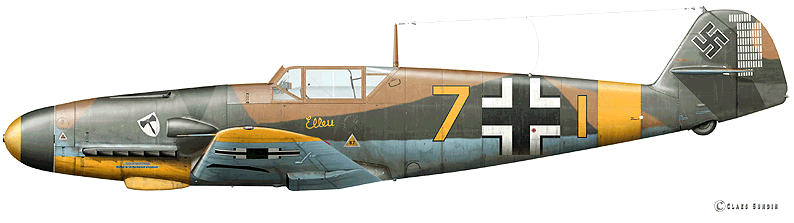
Bf 109 F-4 (WNr 13325) "7 amarillo" pilotado por el Oberleutnant Viktor Bauer, Staffelkapitän 9./JG 3, Shchigry,Rusia, 26 junio de 1942

Fuentes:
BERGSTRÖM, C. “Black Cross, Red Star” Pacifica Military History, 2001
BERGSTRÖM, C. “Stalingrad – The Air Battle: 1942 through January 1943” Midland Publications, 2007
MUSCIANO, W. “Messerschmitt Aces”  Tab Books, 1989
WEAL, J. “Bf 109 Aces of the Russian Front.” Osprey, 2001
WEAL, J. “More Bf 109 Aces of the Russian Front.” Osprey, 2007

English version

Viktor Bauer was born on September 19, 1915 in Löcknitz and in 1936 joined the Luftwaffe with the rank of Fahnenjunker. After completing his pilot training he was assigned to I./JG 2 and moved in March 1940 to 2./JG 77 where to participate in the campaign in France. It was here where got his first win by downing over Belgium on 15 May 1 at RAF Hurricane fighter near Bruges. Another victory was scored before the end of the French campaign to bring down another Hurricane near Cambrai on 18 May, this time attached to 1./JG 77.

He also participated in the Battle of Britain in November 1940 and was serving in the 9./JG 3. After fighting Bauer victories amounted to three. On February 5, 1941 claimed a victory over the account of a Hurricane of the RAF who fell in the English Channel became, ultimately, in his last victory achieved in the Western Front.

Bf 109 F-4 (WNr 13325) "Yellow 7", Oberleutnant Viktor Bauer, Staffelkapitän 9./JG 3, Millerovo, Russia, 16 July 1942
 

For a short time Bauer was named Staffelkapitän of the 9./JG 3 after the invasion of Russia. In June 1941 managed to shoot down a total of 15 Soviet aircraft, including 5 SB-2 bombers shot down on June 26. In July managed to extend their personal account to shoot down enemy aircraft 17 others, including 5 other DB-3 bombers killed on July 12 (victories 26-30). On July 23, Bauer was badly injured during an air combat against Soviet bombers when his Bf 109 F-4 (W.Nr. 8987) was hit by defensive fire these. He managed to make an emergency landing in a hospital passing the rest of the year. With 36 victories to his credit was the recipient of the July 30 Ritterkreuz.

Bauer did not return to combat until February 1942 reached 40 wins 18 of the same month and the number 50 on April 4. On May 22, dispatched four fighters I-16 thus reached 60 victories credited. During July 1942 was one of the most successful drivers to add another 33 victories, five times four enemy aircraft shot down in one day and on two other occasions five were shot down by the guns of Bauer. On August 9, achieved his 106th victory by downing a bomber Su-2 near Stalingrad but one day later his Bf 109 F-4 (W.Nr. 13 241) was hit by enemy fire wounded in action. Following an emergency landing, and again after recovering from his wounds he became the Ergänzungs-Jagdgruppe Staffelkapitän Ost. The July 1, 1943, with the rank of Major, was appointed Gruppenkommandeur the same unit and since he did not abandon until November 4, 1944. On 1 December the same year, with the rank of Oberst, was named Kommodore of EJG 1. Bauer achieved a final record of 106 victories, 102 of them against the Soviets, including the destruction of 27 Il-2 Sturmovik in 400 combat missions.

Bf 109 F-4 'Yellow 7' flown by Oberleutnant Viktor Bauer, Staffelkapifan 9./JG 3 'Udet', March 1942

Sources:
BERGSTRÖM, C. “Black Cross, Red Star” Pacifica Military History, 2001
BERGSTRÖM, C. “Stalingrad – The Air Battle: 1942 through January 1943” Midland Publications, 2007
MUSCIANO, W. “Messerschmitt Aces”  Tab Books, 1989
WEAL, J. “Bf 109 Aces of the Russian Front.” Osprey, 2001
WEAL, J. “More Bf 109 Aces of the Russian Front.” Osprey, 2007

miércoles, 3 de julio de 2013

Sukhoi Su-2


Sukhoi Su-2


El Sukhoi Su-2 se puede considerar como un diseño marginal del británico FaireyBattle que entró en servicio a principios de 1941 y no participó en la Guerra de Invierno contra Finlandia. El Su-2 era un derivado del ANT-51 y fue designado inicialmente como BB-1 durante sus primeras fases de pruebas realizando su primer vuelo el 25 de agosto de 1937. El aparato recibió diversas motorizaciones para mejorar sus prestaciones, inicialmente fue equipado con un motor M-87 sustituidos más tarde por un M-88 y finalmente por el M-88B con el que alcazaba los 512 Km/h. Los conceptos tácticos básicos cambiaron rápidamente durante los dos primeros años de la guerra debido a los nuevos conceptos introducidos por el Ejército alemán. Amplias formaciones de rápidos cazas monoplazas apoyaban el avance alemán en el verano de 1941 asestando un duro golpe a la VVS-RKKA (Fuerza Aérea Soviética). A pesar de la mejora sufrida con su ultima motorización (M-88B) los Su-2 resultaron extremadamente vulnerables a la acción de la caza enemiga debido al escaso armamento defensivo. Además, su torreta trasera era de accionamiento manual lo que reducía considerablemente su efectividad.

En el momento de la invasión alemana, en junio de 1941, unos 100 Su-2 estaban operativos con la Frontovaya Aviatsya (el resto con otras unidades de la VVS-RKKA) pero muchos de ellos fueron derribados por el fuego antiaéreo y la acción de la Jagdwaffe. Esto se unió al pobre nivel de entrenamiento de los pilotos soviéticos convirtiendo al Su-2 en un arma poco útil durante las primeras fases de la guerra y dejó al Ejército soviético sin aviones de ataque a tierra hasta que se intensificase la producción del Il-2m3. Aceptando un alto porcentaje de pérdidas los Su-2 fueron sobrecargados de bombas y cohetes para aumentar el daño causado de los pocos aviones que lograsen alcanzar su objetivo. Durante las primeras fases de la invasión se perdieron 222 Su-2 por diversas causas. Más tarde apareció un nuevo modelo, rediseñado por completo, denominado Su-6 pero finalmente ambos fueron abandonados a mediados de 1942 a favor del Il-2m3, Pe-2 y Tu-2. En total se completaron 910 aparatos. Los aparatos supervivientes fueron relegados a labores de segunda línea, entrenamiento y reconocimiento.
 

Fuentes:
ENZO, A. “World War II Airplanes Volume 2” 1976
SHAVROV, V. “Istoriia konstruktskii samoletov v SSSR, 1938–1950” Mashinostroenie, 1994

English version

The Sukhoi Su-2 can be considered as a marginal design of the British Fairey Battle that entered service in early 1941 and did not participate in the Winter War against Finland. The Su-2 was derived from the ANT-51 and was initially designated as BB-1 during the early stages of conducting tests its first flight on August 25, 1937. The device received several engines to improve its performance, was initially equipped with M-87 engine later replaced by an M-88 and finally by the M-88B with which fortress the 512 Km/h. The basic tactical concepts changed rapidly during the first two years of the war because of the new concepts introduced by the German Army. Large formations of fighters fast cars supported the German advance in the summer of 1941 dealing a blow to the VVS-RKKA (Soviet Air Force). Despite improved engine suffered his last (M-88B) the Su-2 were extremely vulnerable to enemy fighter action due to poor defensive armament. Also, its rear turret was manually operated thus greatly reducing their effectiveness.

At the time of the German invasion in June 1941, some 100 Her-2 were operating with Aviatsya Frontovaya (the rest with other units of the VVS-RKKA) but many of them were shot down by flak and action the Jagdwaffe. This joined the poor level of Soviet pilot training making the Su-2 in a useless weapon during the early stages of the war and the Soviet Army left no ground attack aircraft until intensify the production of Il-2m3 . Accepting a high percentage of the Su-2 losses were overloaded with bombs and rockets to increase the damage of the few planes who managed to achieve their goal. During the early stages of the invasion 222 Her-2 lost for various reasons. Later came a new model, completely redesigned, called Su-6, but eventually both were abandoned in mid-1942 in favor of the Il-2m3, Pe-2 and Tu-2. A total of 910 completed devices. The devices survivors were relegated to second-line duties, training and reconnaissance.


Sources:
ENZO, A. “World War II Airplanes Volume 2” 1976
SHAVROV, V. “Istoriia konstruktskii samoletov v SSSR, 1938–1950” Mashinostroenie, 1994

martes, 2 de julio de 2013

Tauchpanzer III


Tauchpanzer III


El Tauchpanzer III era un carro de combate destinado a proporcionar apoyo en los asaltos anfibios. Entre julio y octubre de 1940 se transformaron un total de 168 PzKpfw III a su nuevo cometido como Tauchpanzer. De este lote, 8 eran PzKpfw III Ausf E de mando y 160 entre los modelos Ausf F, G y H. Algunos de ellos recibieron un armamento mejorado sustituir sus cañones de 37 mm por los KwK 38 L/42 de 50 mm ya que estos vehículos deberían enfrentarse a los carros de combate británicos mejor blindados que los franceses.

Estos carros debían ser capaces de sumergirse de 8 a 15 metros para lo cual se le proporcionaron selladuras para todas las aberturas del vehículo. También recibió protección contra la corrosión en sus partes vulnerables en contacto directo con el agua del mar así como en la torreta y el cañón. La tripulación y el motor recibían oxígeno a través de un tubo flexible sostenido por un flotador, mientras que una válvula aseguraría la evacuación de los gases de escape. Las pruebas realizadas en las aguas de la isla de Sylt (bajo el mando del General Reinhardt) demostraron la viabilidad del proyecto y que estos vehículos serían capaces de alcanzar sus objetivos en la futura invasión de Inglaterra.

Tras caer en el olvido el plan de invasión de Inglaterra, los Tauchpanzer III tomaron parte en la invasión de Rusia (18º Panzerdivision) el 22 de junio de 1941 con el cruce del río Bug en Patulin. Estos vehículos se agruparon.  


Fuentes:
JENTZ, T. “Panzerbefehlswagen Ausf.D1, E, H, J, K und development & production from 1935 to 1943, Pnazer Tracts 3-4”
“PzKpfw.III in action” Signal,  

English version

The Tauchpanzer III was a tank designed to provide support in amphibious assaults. Between July and October 1940 a total of 168 transformed PzKpfw III to his new role as Tauchpanzer. Of this lot, 8 were PzKpfw III Ausf E and 160 control between models Ausf F, G and H. Some of them were better armament replace its 37 mm cannon KwK 38 L/42 by 50 mm as these vehicles would face the British tanks better armored than the French.

These cars should be able to dive from 8 to 15 meters which was provided with seals to all openings of the vehicle. He also received corrosion protection in vulnerable parts in direct contact with sea water and in the turret and cannon. Engine crews and receiving oxygen via a flexible tube supported by a float, whereas a valve ensure the evacuation of exhaust gases. Tests conducted in the waters off the island of Sylt (under the command of General Reinhardt) demonstrated the feasibility of the project and that these vehicles would be able to achieve its goals in the future invasion of England.

After being forgotten plan invasion of England, the Tauchpanzer III took part in the invasion of Russia (18th Panzer Division) on June 22, 1941 with the Bug river crossing in patulin. These vehicles were grouped.


 Panzerkampfwagen III Tauchpanzer. Pz. Rgt 35 / I Abteilung / 2ª kompanie / 2º Zug

Sources:
JENTZ, T. “Panzerbefehlswagen Ausf.D1, E, H, J, K und development & production from 1935 to 1943, Pnazer Tracts 3-4”
“PzKpfw.III in action” Signal,  

viernes, 28 de junio de 2013

Montaje Schürzen ayer y hoy


Montaje Schürzen ayer y hoy


La instalación del montaje Schürzen se mostró muy eficaz desde el principio para contrarrestar los efectos de los proyectiles de carga hueca contra el blindaje. El montaje original del sistema Schürzen fue introducido en el verano de 1943 y estaba compuesto por dos hileras en “L”. Una fila estaba montada en el casco a nivel y la otra, creando un segundo carril, justo por debajo de la parte superior de la superestructura. A pesar de su eficacia, sobre todo teniendo en cuenta su coste, los aliados occidentales no lo tuvieron en cuenta siendo los soviéticos los que asimilaron sus enseñanzas. En algunos de sus carros de combate muestra un rudimentario Schürzen de malla (similar al Schürzen Thoma o Drahtgeflecht Schürzen) durante los combates por Berlín dada la masificación de los Panzerfaust.

Tras la contienda el montaje Schürzen cayó en desuso a pesar de que los sistemas anticarro para la infantería continuaron con su mortífero desarrollo. Con la aparición del blindaje reactivo parecía que los carros de combate estaban a salvo de sistemas de armamento como los ubicuos RPG soviéticos. La primera gran prueba para el blindaje reactivo para los occidentales llegó con la invasión y posterior ocupación de Irak.


PzKpfw IV Ausf J con Schürzen Thoma

Las continuas emboscadas que sufrían los vehículos blindados norteamericanos se veían sometidos a fuego de RPG que penetraban fácilmente su blindaje causando multitud de bajas. Así mismo también se demostró que un simple escudo blindado para las ametralladoras de defensa cercana de los vehículos eran tan necesarias ayer como hoy día ya que sus sirvientes eran abatidos por francotiradores. Estos escudos ya fueron instalados en los cañones de asalto alemanes StuG pero, una vez más, se olvidaron sus enseñanzas tras la guerra. Los vehículos estadounidenses fueron equipados con un sistema similar al Schürzen Thoma o Drahtgeflecht Schürzen, una malla estrecha que protege a los vehículos de las cabezas huecas utilizadas por los RPG. Los últimos 500 soldados estadounidenses abandonaron Irak en diciembre de 2011 pero continuaron con sus operaciones en Afganistán, dónde se pueden ver a sus blindados protegidos de nuevo con el Schürzen de malla.

Todo el mundo pudo comprobar como este sencillo sistema protegía a los vehículos de los devastadores efectos de los lanzadores RPG, pero pocos o ningún ejército ha hecho nada al respecto. Esto se ha podido comprobar actualmente durante la guerra en Siria dónde sus carros de combate y vehículos de transporte BMP han sido destruidos por los RPG. A pesar del blindaje reactivo los T-62 y T-72 gubernamentales han sufrido muchas pérdidas durante los dos años de conflicto a manos de los terroristas que plagan su territorio hasta que han recordado las enseñanzas pasadas recuperando, una vez más, el sistema alemán Schürzen, tanto sólido como de malla.


English version

Schürzen Mount Installation was very effective from the beginning to counter the effects of hollow charge projectiles against armor. The original assembly Schürzen system was introduced in the summer of 1943 and consisted of two rows in "L". A row was mounted on the hull at the other, creating a second track, just below the top of the superstructure. Despite its effectiveness, especially considering its cost, the Western Allies had in mind not being the Soviets who assimilated his teachings. In some of his chariots Schürzen shows a rudimentary mesh (similar to Thoma Schürzen or Drahtgeflecht Schürzen) during the battles for Berlin given the mass of the Panzerfaust.

After the war Schürzen assembly fell into disuse despite antitank system for infantry continued their deadly development. With the emergence of reactive armor seemed that tanks were safe from weapons systems such as the ubiquitous Soviet RPG. The first big test for reactive armor for Westerners arrived with the invasion and subsequent occupation of Iraq.


The continuous ambushes suffered by U.S. armored vehicles were subjected to fire RPG that easily penetrated its armor causing many casualties. Furthermore it was also shown that a simple armored shield for close defense guns of the vehicles were much needed day yesterday and today as their servants were killed by snipers. These shields have already been installed in German StuG assault guns but, once again, forgot his teachings after the war. U.S. vehicles were equipped with a system similar to Thoma or Drahtgeflecht Schürzen Schürzen a narrow mesh protects airheads vehicles used by the RPG. The last 500 American soldiers left Iraq in December 2011 but continued operations in Afghanistan, where they can see their armored back protected with mesh Schürzen.

Everyone could see how this simple system for vehicles protected from the devastating effects of RPG launchers, but few or no army has done nothing about it. This has been proven during the war now in Syria where their tanks and BMP vehicles were destroyed by RPG. Despite the reactive armor T-62 and T-72-governmental organizations have suffered many losses during the two years of conflict at the hands of terrorists that plague their territory until they remembered the past teachings recovering once again, the German system Schürzen, either solid or mesh.


 BMP with Schürzen solid

jueves, 27 de junio de 2013

Fairey Battle

Fairey Battle


El Fairey Battle tiene en su honor haber derribado el primer aparato alemán de la RAF durante la Segunda Guerra Mundial. El artillero trasero de uno Battle del Sqn. 88 Advanced Air Striking Force logró derribar un Messerschmitt Bf 109 E sobre Francia el 20 de septiembre de 1939. Pero antes de todo eso y como es lo normal el Fairey Battle nació de las mesas de diseño volando por primera vez el 10 de marzo de 1936. Se trataba de un aparato monoplano en voladizo de ala baja con tren de aterrizaje retráctil y cabinas cerradas para sus tres tripulantes. La motorización corría a cargo de un motor Rolls-Royce Merlin.

El Fairey Battle significó un gran avance con respecto a los modelos anteriores, Hawker Hart y Hind, biplanos de cabina abierta a los que iba a sustituir. Su fabricación en masa fue aprobada para satisfacer las necesidades del programa de expansión de la RAF a finales la década de los 30. A pesar de todo los avances aeronáuticos experimentados en los años inmediatamente anteriores al estallido de la contienda provocaron que el Battle fuese un aparato lento y vulnerable, sobre todo por la velocidad máxima de 386 Km/h que le impedía escapar de sus perseguidores.


Su armamento tampoco ayudaba mucho ya que tan solo disponía de tan solo de dos ametralladoras Browning 7´7 mm, una en tiro de fuga. A pesar de todo se había firmado un contrato y en 1938 la RAF disponía de 13 escuadrones equipados con él. Al estallar la guerra 10 de estos escuadrones fueron enviados a Francia para prestar su apoyo. Los Battle se involucraron con fiereza en la lucha tanto es así que las primeras victorias de la RAF fueron anotadas por estos bombarderos el 12 de mayo de 1940. Ese día se efectuó un ataque contra los puentes de Maastricht para detener el avance alemán. Una formación de 5 Battle del Squadron nº 12 se lanzaron en esta misión pero fueron destruidos todos gracias al certero fuego de la Flak y a los Bf 109 del I./JG 27. Las pérdidas sufridas precipitaron su salida del servicio activo para convertirse más tarde en un entrenador avanzado y objetivo aéreo para prácticas de tiro en el Reino Unido y Canadá en el marco del Plan de Entrenamiento Aéreo de la Commonwealth. En total se completaron 2.185 aparatos entre 1937 y 1940, muchos de ellos manufacturados por Austin Motors, sirviendo en las Fuerzas Aéreas de Australia, Bélgica, Sudáfrica y Turquía.


Fuentes:
GIFFORD, S. “Lost Battles: The Carnage of May 10 to May 16, 1940” Air Enthusiast, No. 109, January/February 2004, pp. 18–25. Stamford, Lincs, UK: Key Publishing.
HUNTLEY, I. “Fairey Battle, Aviation Guide 1” SAM Publications, 2004
MARCH, D. “British Warplanes of World War II” Aerospace, 1998
MASON, F. “The British Bomber Since 1914” Putnam Aeronautical Books, 1994
TAYLOR, J. “Combat Aircraft of the World from 1909 to the present” Putnam's Sons, 1969

English version

The Fairey Battle is in his honor to have shot down the first German unit of the RAF during the Second World War. The one rear gunner Battle of Sqn. 88 Advanced Air Striking Force managed to shoot down a Messerschmitt Bf 109 E on France on September 20, 1939. But before all that, and as usual the Fairey Battle was born on the drawing boards the first flight March 10, 1936. It was a device cantilever monoplane with low wing retractable landing gear and enclosed cabs for its three crew. The engine ran by a Rolls-Royce Merlin engine.

The Fairey Battle was a great improvement over previous models, Hawker Hart and Hind, open cockpit biplanes those who would replace. Its mass production was passed to address the needs of the expansion program of the RAF at the end the decade of the 30. Despite all the advances experienced aviation in the years immediately preceding the outbreak of the war caused the Battle was a slow and vulnerable device, especially for the maximum speed of 386 Km/h that prevented escape his pursuers.


RAF No. 218 Squadron Fairey Battles over France, c. 1940

His arms did not help much as only available only two 7'7 mm Browning machine guns, shot one in flight. Yet it had signed a contract in 1938 13 RAF squadrons equipped available to him. When war broke out 10 of these squadrons were sent to France to lend their support. The Battle fiercely engaged in the fight so much so that the first RAF victories were scored by these bombers on May 12, 1940. That day an attack was made against the Maastricht bridges to stop the German advance. A lineup of 5 Battle of No. 12 Squadron were launched in this mission but all were destroyed due to fire accurate Flak and Bf 109 of I./JG 27. The losses precipitated his departure from active duty to become a coach later advanced aerial target for target practice in the UK and Canada in the framework of the Commonwealth Air Training. A total of 2,185 completed devices, many of them manufactured by Austin Motors, serving in the air forces of Australia, Belgium, South Africa and Turkey.


 Vickers K cockpit


Sources:
GIFFORD, S. “Lost Battles: The Carnage of May 10 to May 16, 1940” Air Enthusiast, No. 109, January/February 2004, pp. 18–25. Stamford, Lincs, UK: Key Publishing.
HUNTLEY, I. “Fairey Battle, Aviation Guide 1” SAM Publications, 2004
MARCH, D. “British Warplanes of World War II” Aerospace, 1998
MASON, F. “The British Bomber Since 1914” Putnam Aeronautical Books, 1994
TAYLOR, J. “Combat Aircraft of the World from 1909 to the present” Putnam's Sons, 1969

miércoles, 26 de junio de 2013

Hallazgo de Grasa.


Hallazgo de grasa de la II Guerra Mundial


El 18 de enero de 2013 se hallaron cuatro grandes trozos de grasa originarias de la II Guerra Mundial en la costa oriental de Escocia. Aún se desconoce su procedencia exacta pero lo que parece evidente que pertenece a algún buque de guerra de la Royal Navy hundido durante la guerra. La grasa se había preservado en barriles de madera que terminaron por pudrirse en el agua, aunque los trozos de grasa conservaban aún su forma original. Al llegar a la costa aves y perros dieron cuenta de parte de esta preciada grasa.

A pesar de que pudiera parecer algo totalmente raro este hallazgo no es la primera vez que víveres de la II Guerra Mundal aparecen en las costas escocesas. Algo similar ocurrió hace 60 años, a principios de los años 40 cuando otros barriles de grasa quedaron varados en la costa, según cuenta Angus McHard, un residente local. Algunos barriles se encontraban sellados y fueron utilizados por la población civil.

Fuente: RT

English version

On January 18, 2013 were found four large pieces of fat originating in the Second World War in the east coast of Scotland. Although its exact origin is unknown but it seems evident that belongs to any warship sunk the Royal Navy during the war. The fat was preserved in wooden barrels ended up rotting in the water, but the chunks of fat still retained its original form. Upon reaching the shore birds and dogs realized this precious part of fat.

Although it might seem totally weird this finding is the first time that supplies Mundal War II appear on the Scottish coast. Something similar happened 60 years ago, in the early 40s when other fat barrels were stranded on the coast, she says Angus McHard, a local resident. Some barrels were sealed and were used by civilians.

Source: RT

martes, 25 de junio de 2013

Ju 88 C


Junkers Ju 88 C


La versión del Junkers Ju 88 C iba a constituirse como una versión de cazabombardeo añadiendo pilones externos para las armas y un potente armamento en el morro del aparato, aunque conservaba las características básicas de la versión A. El morro de la versión C se construyó en material sólido eliminándose el acristalamiento de las versiones anteriores y la posición de defensa ventral que estaba bajo el compartimento de la tripulación. Mantuvo la sección de cola original de la versión anterior. A la postre esta nueva versión desarrollaría labores de caza nocturna.

El primer modelo en desarrollar este nuevo cometido fue el Ju 88 C-2, basado en el A-1, y estaba armado con un cañón MG FF de 20 mm y tres ametralladoras MG 17 de 7´92 mm, todo ello instalado en el nuevo morro sólido. Los primeros ejemplares fueron enviados al Zerstörerstaffel del KG 30, unidad que sería renombrada como II./NJG 1 en julio de 1940.

Posteriormente aparecería el modelo C-4 con algunos cambios respecto a los anteriores modelos de la serie C. Fue utilizado como caza pesado y avión de reconocimiento armado. Se incrementó de envergadura y se instalaron motores Junkers Jumo 211F-1 o J-1. El armamento de proa era igual al Ju 88 C-1 pero se añadieron dos cañones MG FF de 20 mm instalados en la góndola de bombardeo. Estos cañones podían ser reemplazados por cámaras fotográficas para misiones de reconocimiento. El tren de aterrizaje fue reforzado para soportar el aumento de peso, tanto por el equipo y armamento como el blindaje. 

Junkers Ju 88C-6b

Tras la aparición del C-6 Zerstörer hizo su aparición el C-6b que incorporaba el radar FuG 202 Lichtenstein para la interceptación nocturna. Los cuatro primeros ejemplares de esta serie fueron probados a principios de 1942 por el NJG 1. Las pruebas fueron exitosas de modo que se ordenó su producción. En octubre de 1943 las versiones anteriores fueron actualizados mediante la instalación de los nuevos sistemas de radar.

Un pequeño número de ejemplares de la serie C recibieron un tratamiento especial para sus morros sólidos para parecerse a los bombarderos de la serie A. Esta modificación consistía en camuflar el morro sólido como si fuese uno acristalado para atraer a los cazas aliados a un ataque frontal dónde eran recibidos por el armamento pesado instalado en el morro sólido. Esta táctica resultó inicialmente muy efectiva provocando fuertes pérdidas entre los cazas aliados. 

 Ju 88 C-2


Fuentes:
DRESSEL, E. “Bombers of the Luftwaffe” DAG Publications, 1994
NOVARRA, H. “Die Ju 88 und ihre Folgemuster” Motorbuch Verlag, 1987
MACKAY, R. “Junkers Ju 88” Crowood Press, 2002

English version

The version of the Junkers Ju 88 C would be constituted as a fighter-bomber version adding external pylons for weapons and a powerful weapon in the nose of the aircraft, while retaining the basic features of version A. The nose of the C version was built in eliminating solid glazing previous versions and ventral defensive position which was under the crew compartment. He kept the original tail section the previous version. Ultimately this new version work night fighter develop.

The first model to develop this new role was the Ju 88 C-2, based on the A-1, and was armed with a 20 mm MG FF cannon and three MG 17 machine guns of 7.92 mm, all installed on the new solid nose. The first copies were sent to Zerstörerstaffel of KG 30, which would be renamed unit II./NJG 1 in July 1940.

Appear later model C-4 with a few changes over previous models in the series C. It was used as a heavy fighter and armed reconnaissance aircraft. Increased major and settled Junkers Jumo 211F engines-1 or J-1. Bow armament was equal to Ju 88 C-1 but added two MG FF cannons of 20 mm installed in the nacelle of bombardment. These guns could be replaced by cameras for reconnaissance missions. The landing gear was reinforced to withstand the weight gain, both the equipment and weapons and armor.


After the appearance of the C-6 Zerstörer made ​​his appearance on C-6b incorporating FuG 202 Lichtenstein radar for night interception. The first four specimens of this series were tested in early 1942 by NJG 1. The tests were so successful that production was ordered. In October 1943 previous versions were upgraded by installing new radar systems.

A small number of copies of the series C received special treatment to their noses to resemble solid bombers Series A. This modification was to camouflage the solid nose as if he were one glass to attract fighters allied to a frontal attack where they were greeted by the big guns installed in the nose solid. This tactic was very effective initially causing heavy losses from Allied fighters.


Sources:
DRESSEL, E. “Bombers of the Luftwaffe” DAG Publications, 1994
NOVARRA, H. “Die Ju 88 und ihre Folgemuster” Motorbuch Verlag, 1987
MACKAY, R. “Junkers Ju 88” Crowood Press, 2002

viernes, 21 de junio de 2013

Experten alemanes: Rudolf Müller


Feldwebel Rudolf Müller

Rudolf Müller nació el 21 de noviembre de 1920 en Frankfurt am Main y se unió al Ejército sirviendo en una unidad de señales. En 1940 fue transferido a la Luftwaffe dónde recibió el entrenamiento necesario para convertirse en piloto. En agosto del año siguiente fue transferido del Ergänzungsgruppe/JG 77, basado en Rumania, al 1./JG 77 que operaba en el norte de Noruega. Fue en este nuevo destino dónde reclamó su primera victoria al derribar un caza soviético I-16 el 12 de septiembre de 1941.

En marzo de 1942 el 1./JG 77 fue redesignado como 6./JG 5 mantiendo su área de actuación. El 23 de abril Müller logró derribar 5 cazas Hurricane (llegados a Rusia gracias al Programa de Préstamo y Arriendo) soviéticos. En abril logró derribar un total de 15 aparatos enemigos, 12 de ellos Hurricane. En mayo sumó otras  victorias más, 12 de ellas nuevamente sobre los Hurricane, elevando su cuenta personal hasta las 38 victorias. El 30 de mayo de 1942 derribó, según algunas fuentes, al as soviético Podpolkovnik Boris Safanov (15 victorias más 14 compartidas) en un combate sobre el convoy PQ-16. 

Bf 109 F 'Yellow 3' flown by Feldwebel Rudolf Muller, 6./JG 5, September 1942

 Dos Hurricane más derribados el 17 de junio le sirvieron para alcanzar las 40 victorias recibiendo dos días más tarde la Ritterkreuz por su servicio y ya con 46 victorias en su haber. En agosto logró 16 victorias más, incluyendo la número 50 lograda el 4 de agosto, un Hurricane. Durante el mes de septiembre logró sumar otras 18 victorias más a su palmarés, 7 de ellas logradas el 27 de septiembre. La victoria número 500 del 6./JG 5 la logró Müller el 13 de marzo siendo su victoria personal número 92 y, a la postre, última de su carrera.

El 19 de abril Müller lideraba una schwarm Messerschmitt Bf 109 G-2/R6 de la 6./JG 5 recibieron la misión de escoltar un grupo de cinco Junkers Ju 87 D Stuka. Cerca de la estación de ferrocarril de la línea Polyarnyi Krug se enzarzaron con unos 30 o 40 aparatos pertenecientes al 760º IAP y 2º GuIAP que los interceptaron. El Bf 109 G-2/R6 (W.Nr. 14810 “3 amarillo”) de Müller también resultó alcanzado por las ráfagas el as soviético Mladshii Leitenant Nikolai Bokii (14+1) y tuvo que realizar un aterrizaje de emergencia en el lago Bolschoje. Algunas horas más tarde fue capturado por soldados soviéticos. El destino de Müller es incierto, algunas fuentes lo sitúan en un campo de prisioneros en Murmansk en 1947, sin embargo nunca fue repatriado. Otras fuentes afirman que resultó muerto entre octubre y noviembre de 1943 cuando trataba de escapar de un campo de prisioneros. Todas la victorias de Müller fueron en el Frente Oriental incluyendo al menos 35 cazas Hurricane.

 Bf 109 F 'Yellow 3' flown by Feldwebel Rudolf Muller, 6./JG 5, September 1942

Fuentes:
BERGSTRÖM, C. “Black Cross, Red Star” Pacifica Military History, 2001
WEAL, J. “Bf 109 Aces of the Russian Front.” Osprey, 2001
WEAL, J. “More Bf 109 Aces of the Russian Front.” Osprey, 2007
MUSCIANO, W. “Messerschmitt Aces”  Tab Books, 1989
GIRBIG, W. “Jagdgeschwader 5: The Luftwaffe s JG 5 Eismeerjager in World War II” Schiffer, 2012

English version

Rudolf Müller was born on November 21, 1920 in Frankfurt am Main and joined the Army serving in a signals unit. In 1940 he was transferred to the Luftwaffe where he received the necessary training to become a pilot. In August of the following year was transferred from Ergänzungsgruppe/JG 77, based in Romania, 1./JG 77 operating in northern Norway. It was in this new destination where claimed his first win by downing a Soviet fighter I-16 on September 12, 1941.

In March 1942 the 1./JG 77 was redesignated 6./JG 5 mantiendo its operating area. The Müller April 23 Hurricane fighters managed to shoot down five (arrivals to Russia through the Lend-Lease Program) Soviets. In April managed to shoot down a total of 15 enemy aircraft, including 12 Hurricane. In May scored other victories, 12 of them back on the Hurricane, raising his personal account to 38 victories. The May 30, 1942 dropped, according to some sources, the Soviet ace Boris Podpolkovnik Safanov (15 plus 14 shared victories) in a battle on the convoy PQ-16.


Bf 109G-2/R6 'Yellow 3' flown by Feldwebel Rudolf Muller, 6../JG 5, March 1943

Two more Hurricane shot down on June 17 helped him to reach 40 wins getting two days later the Ritterkreuz for your service and already with 46 victories to his credit. In August had 16 victories, including the number 50 achieved on 4 August, a Hurricane. During the month of September managed to add another 18 victories to his resume, including 7 achieved on 27 September. The 500th victory of 6./JG 5 was achieved on 13 March Müller being his personal victory number 92 and, ultimately, the last of his career.

On April 19 Müller led a Messerschmitt Bf 109 G-2/R6 schwarm the 6./JG 5 received the mission to escort a group of five Junkers Ju 87 D Stuka. Near the railway station Polyarnyi line Krug became involved with a 30 or 40 aircraft belonging to 760° IAP and 2nd GuIAP that intercepted. The Bf 109 G-2/R6 (W.Nr. 14810 "3 yellow") of Müller also was hit by gusts Soviet ace Nikolai Leitenant Mladshii Bokii (14 +1) and had to make an emergency landing in the lake Bolschoje. Some hours later he was captured by Soviet soldiers. Müller's fate is uncertain, some sources place him in a prison camp in Murmansk in 1947, however it was never repatriated. Other sources claim that was killed between October and November 1943 while trying to escape from a prison camp. Müller All the victories were on the Eastern Front, including at least 35 Hurricane fighters.


 Messerschmitt Bf 109 G-2/R6 "3 yellow" piloted by Feldwebel Rudolf Muller, 6./JG 5, March 1943

Sources:
BERGSTRÖM, C. “Black Cross, Red Star” Pacifica Military History, 2001
WEAL, J. “Bf 109 Aces of the Russian Front.” Osprey, 2001
WEAL, J. “More Bf 109 Aces of the Russian Front.” Osprey, 2007
MUSCIANO, W. “Messerschmitt Aces”  Tab Books, 1989
GIRBIG, W. “Jagdgeschwader 5: The Luftwaffe s JG 5 Eismeerjager in World War II” Schiffer, 2012