Buscar este blog

lunes, 11 de junio de 2012

Los orígenes de la Luftwaffe.

Los orígenes de la Luftwaffe.


El 28 de junio de 1919 se firmó el Pacto de Versalles dando origen a un nuevo “ejército” de la Republica de Weimar reducido a 100.000 hombres y con la aviación relegada al empleo civil. A pesar de estas restricciones unos 200 pilotos militares continuaron ligados al Reichswehr (Ejército alemán). Ya en 1920, tan solo un año después de la firma del tratado, el Ministerio de Defensa creó una formación secreta cuya misión sería la defensa aérea del Reich. También se creó, dentro del Heereswaffenamt (Departamento de Armamento del Ejército) una oficina de investigación aeronáutica que contaba con buenos profesionales como Hugo Sperrle o Albert Kesselring.

A medida que avanzaba el siglo veinte los vencedores comenzaron a levantar algunos vetos sobre Alemania, así en mayo de 1922 se permitió la fabricación de aviones de uso exclusivamente civil. Estos aparatos tenían fuertes restricciones como en el peso, potencia o velocidad, sin embargo estas imposiciones fueron abolidas en 1926. Un año antes de esta abolición los alemanes comenzaron a constituir academias de vuelo por todo el territorio alemán con el apoyo financiero del Ejército y de ellas saldrían los que serían los primeros pilotos de la Luftwaffe. Uno de los muchos acuerdos firmados entre Alemania y Rusia tuvo como referente al mundo aeronáutico. Así el 15 de abril de 1925 se firmó un tratado mediante el cual se permitía el uso conjunto de la base aérea de Lipelsk (a 320 Km de Moscú) a los pilotos, observadores aéreos y personal técnico de ambos países hasta 1933. En estos campos se realizaron pruebas sobre diversos aparatos como los Dornier Do 11, Heinkel He 45 o los aparatos holandeses Fokker D-XIII.

 Hlera de Bf 109 B-2 del II./JG 132

La Luftwaffe no hubiera tenido éxito sin el apoyo de las compañías aeronáuticas que comenzaron su singladura a partir de los años 20. A lo largo de esta década nacieron las grandes compañías que habría de poblar los cielos de Europa con sus aparatos como Junkers (1920), Heinkel y Dornier (1922), Focke Wulf (1924) y la famosa Bayerische Flugzeugwerke, padre del Messerschmitt Bf 109 en 1926. Tras la firma del Acuerdo del Acero de París en 1928 se creó la Deutsche Lufthansa bajo la dirección de Erhard Milch. Tan solo un año antes de la firma de este tratado el Alto Mando del Reichswehr iniciaba los proyectos para el desarrollo de una fuerza aérea con una dotación prevista de 15 grupos entre cazas y bombarderos. Para lograr sus objetivos tuvieron que recurrir a las asociaciones civiles aeronáuticas como la DLV (Deutscher Luftfahrtverband) la cual cedería sus siglas a la DeutscherLuftsportverband, verdadero embrión de la futura Luftwaffe.

Ante la importancia que estaban cobrando las fuerzas aéreas en octubre de 1929 el NSDAP creo en las SA (Secciones de Asalto) de Essen la primera unidad aérea bajo el nombre de Fliegersturm Herman Goring. Este solo fue el primero de una larga lista que en 1931 se fusionaron con la nueva designación de Flieger SA. Antes de la total sustitución de las formaciones de las SA a las nuevas SS, estas últimas también tenías sus propios cuerpos aéreos desde 1932 a razón de una por cada región.

En enero de 1933 Hitler ascendió al poder y el NSDAP creo el Cuerpo de Vuelo Nacionalsocialista (NSFK) absorbiendo las funciones del Flieger SA. El 2 de febrero de ese mismo año Hermann Goring fue nombrado Comisario Estatal de aviación, para el 5 de mayo ya estaba al frente del nuevo Ministerio del Aire. Erhard Milch, antiguo dirigente de la Lufthansa, fue nombrado secretario del nuevo ministerio y propulsó la creación de diversos departamentos dentro del ministerio. Por otro lado, la sociedad alemana se veía llamada por la creciente afición aeronáutica surgiendo la Asociación Alemana de Deportes Aéreos (DLV) a la que se unieron los Fliegerstrum de las unidades paramilitares. Al mando de esta nueva sociedad se puso al capitán Bruno Loerzer (as de la I Guerra Mundial) quién la dividió en dos ramas, un civil dedicada a la promoción de la aviación y otra secreta denominada Fliegerschaft. Esta última dependía directamente del Ministerio del Aire y estaba compuesta en gran medida por oficiales y suboficiales del Reichswehr, cuyo entrenamiento había sido perfeccionado en el campo de aviación de Lipelsk. Para 1933 se había constituido el primer grupo de caza y a finales de ese mismo año se contaba con una escuadrilla auxiliar de bombarderos.

M

Al año siguiente, 1934, se formó la 1º Fliegerdivision mientras que en 1935 cuando Hitler anunció la creación de las Fuerzas Aéreas del III Reich ya se contaba con 34 unidades operativas, cada una contaba de 15 a 20 aparatos y estaban distribuidos por 23 aeródromos distribuidos por la geografía alemana. A fin de equipar esta fuerza emergente se optó por la transformación de aparatos civiles ya existentes como los Junkers Ju 52/3m o los Junkers Ju 86 a un nuevo desempeño militar como transportes o bombarderos. En cuanto al nuevo caza no se tenían tantas opciones y se decidió equipar al biplano Heinkel He 51 con ametralladoras en tiro de caza para que desempeñase dicho rol, al menos de manera provisional. Posteriormente este robusto aparato sirvió como apoyo cercano a las unidades terrestres con una dotación de bombas bajo el fuselaje. También aparecieron en 1935 las primeras unidades de defensa de la artillería antiaérea, Flakartillerie o Flak y diversas unidades menores.

Fuente:
ORMEÑO, J. “Messerschmitt Bf 109. El cazador de la Luftwaffe

English versión

On June 28, 1919 signed the Treaty of Versailles gave rise to a new "army" of the Weimar Republic reduced to 100,000 men and aviation relegated to civilian employment. Despite these restrictions some 200 military pilots remained linked to the Reichswehr (German Army). In 1920, just one year after the signing of the treaty, the Ministry of Defence established secret training whose mission would be the air defense of the Reich. It also created within the Heereswaffenamt (Armament Department of the Army) an office of aeronautical research had good people like Hugo and Albert Kesselring Sperrle.

As the twentieth century progressed the victors began to lift some bans on Germany, and in May 1922 allowed the manufacture of civil aircraft use only. These devices were heavy and the weight restrictions, power or speed, but these impositions were abolished in 1926. A year before that abolishing the Germans began to establish flight schools across Germany with the financial support of the Army and they would come out that would be the first pilots of the Luftwaffe. One of the many agreements signed between Germany and Russia had as regards the world of aviation. Thus the 15 April 1925 a treaty was signed which allowed the joint use of the airbase Lipelsk (320 km from Moscow) to pilots, air observers and technical staff from both countries until 1933. These fields were tested on various devices including Dornier Do 11, Heinkel He 45 or devices Dutch Fokker D-XIII.


 Dornier Do 11

The Luftwaffe would not have succeeded without the support of aeronautical companies that began its journey from the 20's. Throughout this decade gave birth to the big companies that would populate the skies over Europe with their equipment as Junkers (1920), Heinkel and Dornier (1922), Focke Wulf (1924) and Bayerische Flugzeugwerke famous, father of the Messerschmitt Bf 109 in 1926. Following the signing of the Paris Steel was established in 1928 Deutsche Lufthansa under the direction of Erhard Milch. Just a year before the signing of this treaty Reichswehr high command initiated the projects for the development of an air force with a planned strength of 15 groups between fighters and bombers. To achieve its objectives had to resort to civil aviation associations such as DLV (Deutscher Luftfahrtverband) which will provide your initials to DeutscherLuftsportverband, true embryo of the future Luftwaffe.


Heinkel He 45

Given the importance they were charging the Air Force in October 1929 the NSDAP believe in SA (Sections Assault) from Essen the first air unit under the name of Herman Goring Fliegersturm. This was just the first of a long list that in 1931 merged with the new designation of Flieger SA. Before the complete replacement of the formation of the new SS SA, the latter also had their own air corps since 1932 at a rate of one per region.

In January 1933 Hitler came to power and created the NSDAP National Socialist Flying Corps (NSFK) absorbing the functions of Flieger SA. On 2 February the same year Hermann Goring was appointed State Commissioner of Aviation for the May 5 and was in charge of the new Air Ministry. Erhard Milch, former head of Lufthansa, was appointed secretary of the new ministry and propelled the creation of various departments within the ministry. In addition, German society was seen by the growing hobby called emerging aeronautical the German Air Sports (DLV) that joined the Fliegerstrum paramilitary units. In command of this new society was the captain Bruno Loerzer (as World War I) who divided it into two branches, one dedicated to promoting civil aviation and a secret known Fliegerschaft. The latter reported directly to the Air Ministry and was composed largely of officers and noncommissioned officers of the Reichswehr, whose training had been perfect in Lipelsk airfield. By 1933 it had been the first group game and later that same year had an auxiliary squadron of bombers.

The following year, 1934, formed the 1st Fliegerdivision while in 1935 when Hitler announced the creation of the Air Forces of the Third Reich already had 34 operational units, each had 15 to 20 aircraft and were distributed by 23 airfields distributed by German geography. To equip this emerging force opted for the transformation of existing civil aircraft like the Junkers Ju Ju 52/3m or 86 to a new military performance as transports or bombers. As for the new fighter were not so many options and decided to equip the Heinkel He 51 biplane with machine guns shooting game for it to play that role, at least temporarily. Later this robust unit served as close support to ground units with an allocation of bombs under the fuselage. They also appeared in 1935 the first units of antiaircraft defense, Flakartillerie or Flak and various smaller units.


Source:
ORMEÑO, J. “Messerschmitt Bf 109. El cazador de la Luftwaffe

domingo, 10 de junio de 2012

Ostketten y Winterketten

Orugas especiales para los Panzer.
Ostketten y Winterketten


El primer invierno en el Frente Oriental mostró a la Wehrmacht lo duro y complicado que sería operar, tanto con la nieve como con la rasputitsa (deshielo). Esta última provocaba un barro tan denso que atascaba a casi todo vehículo, salvándose solo los provistos de orugas y aún así sus movilidad se veía muy dificultada. La ausencia casi por completo de cualquier cosa remotamente parecida a las carreteras asfaltadas convertía las pistas de tierra en verdaderos cenagales intransitables. Los que más sufrieron estas inclemencias fueron los vehículos de suministros, tanto a motor como los de tiro.

Las peculiaridades del clima ruso hacía que se diesen dos periodos de rasputitsa, una en primavera y otra en otoño. La primera, en primavera, se extendía entre 4 y 6 semanas mientras que la de otoño comenzaba a finales de septiembre y principios de octubre (norte y centro) y a mediados de octubre en el sur prolongándose otras 4 semanas. Esto hacía que, al menos, 10 semanas los caminos y pistas rusas se convirtiesen en un cenagal que se tragaba vehículos, caballos y hombres con un hambre voraz. 


Los carros de combate medio alemanes (PzKpfw III y PzKpfw IV) tenían unas orugas más estrechas que sus homólogos soviéticos, como el T-34, lo que dificultaba su movilidad en nieve o barro. La solución para mejorar su movilidad pasaba por instalarle unas orugas más anchas sin embargo el tren de rodaje no admitía unas orugas más anchas. Ante este problema se decidió la instalación de unas orugas especiales que aumentaban su superficie de contacto con el suelo.

En el segundo invierno ruso, 1942-43, se introdujo la Winterketten que aumentaba la superficie en 18 cm y fue conocida como “pico de pato”. Se instalaban como una extensión sobre los eslabones normales haciendo que aumentase la superficie de contacto con el suelo. Sin embargo estos eslabones generaban mucha tensión y provocaba frecuentes roturas en ellos. Esta rotura se podía arreglar de modo rápido mediante un eslabón normal, pero era un serio problema que sucediese en pleno combate. A pesar de todo el Winterketten tenía un excelente diseño al que solo se le podía achacar este defecto, también un impacto de un anticarro ligero podía inmovilizar al carro de combate. Las Winterketten son reconocibles por la forma triangular de las extensiones. Fueron utilizados por los PzKpfw III, IV y StuG III aunque también se pueden ver en otro derivados de los PzKpfw IV, como es el caso del Hummel, Hornise, etc.

Estos defectos se solventaron con la introducción de la Ostketten en el siguiente invierno, 1943-44, que introducía un punto de articulación extra con las uniones reforzadas. Con estas modificaciones se solventaron los problemas de movilidad, sobre todo durante la época de la rasputitsa. A diferencia de las anteriores estas no tienen esa característica forma triangular en las extensiones. Igual que la Winterketten también se instalaron en los mismo vehículos y cuando se ven imágenes de los PzKpfw IV se asemejan a las utilizadas por los Panther.


Fuentes:
MICHULEC, R. “Panzers In The East - (2) Decline And Defeat 1943-1945Concord, 1999


English version

The first winter on the Eastern Front to the Wehrmacht was hard and complicated it is to operate both with the snow with rasputitsa (melting). The latter caused a mud so thick that stuck to almost any vehicle, saving only the provisions of caterpillars and their mobility still looked very difficult. Almost completely lack of anything remotely like paved roads turned into dirt tracks impassable quagmires true. Those who suffered most from these setbacks were supply vehicles, both motor and the shooting.

The peculiarities of the Russian climate made it should give rasputitsa two periods, one in spring and autumn. The first, in spring, lay between 4 and 6 weeks as the fall beginning in late September and early October (north and center) and mid-October in the south extending another 4 weeks. This made at least 10 weeks Russian roads and tracks were to become a quagmire that swallowed vehicles, horses and men with a ravenous appetite.


The half German tanks (PzKpfw III and PzKpfw IV) had a narrower track than their Soviet counterparts, as the T-34, which hindered their mobility in snow or mud. The solution to improve their mobility by putting on a track going wider but the chassis did not allow a wider track. Faced with this problem it was decided to install a special track increasing its contact surface with the ground.

In the second Russian winter, 1942-43, was introduced which increased the surface Winterketten in 18 cm and was known as "duck bill". Were installed as an extension on the normal link would increase the surface making contact with the ground. However, these links generated much tension and caused frequent breaks in them. This break could be arranged so quickly through a link normal, but it was a serious problem that happen in combat. Despite all the Winterketten had an excellent design that you could only blame this defect, also an impact of a light anti-tank could immobilize the tank. The Winterketten are recognizable by the triangular shape of the extensions. Were used by the PzKpfw III, IV and StuG III but also may be derived from another PzKpfw IV, as is the case of Hummel, Hornise, etc.


Winterkette, the bottom of a Ostkette

These defects were overcome with the introduction of Ostketten in the following winter, 1943-44, introducing an extra hinge point reinforced joints. With these modifications were overcome mobility problems, especially during the time of the rasputitsa. Unlike the earlier they do not have that characteristic triangular shape in the extensions. Like the Winterketten also settled in the same vehicle and when viewing images of the PzKpfw IV resemble those used by Panther.

Sources:
MICHULEC, R. “Panzers In The East - (2) Decline And Defeat 1943-1945Concord, 1999

sábado, 9 de junio de 2012

Aeródromos de la IIGM: Bonis y Ruru Bay


Aeródromo Bonis y Ruru Bay


Los vehículos fueron asignados a la guarnición (4º Mar del sur) en Wakayama el 26 de junio de 1943. Transportados desde Japón a Rabaul y uno de ellos fue transportado en el Bunsan Maru a Tarlena en septiembre de 1943 y la unidad fue desplegada al norte de Bougainville. En julio de 1944 los carros de combate fueron asignados a la 38º Brigada Mixta Independiente.

Tras el desembarco estadounidense en Torokina los japoneses ocultaron cuidadosamente sus carros de combate con gran éxito hasta que a principios de marzo de 1945 se intentó su traslado a lo largo de la carretera norte de la costa.

El 3 de marzo fueron localizados a las 10:05 por un par de cazas F4U del 18º Sqdn. RNZAF que patrullaban la zona de Ruri Bay. A pesar de no estar equipados con bombas atacaron a los vehículos hasta que se les unió otro F4U equipado con bombas y descubrieron un tercer carro. Avanzado el día los vehículos fueron atacados por 7 aparatos, el tercer carro no se había movido de su sitio y fue alcanzado de lleno haciendo explosión las municiones almacenadas en su interior. 

 
Durante la mañana del 4 de marzo de 1945 los carros de combate ocultos en la selva fueron trasladados pero uno de ellos fue localizado por un CAC Boomerang a ultima hora de la tarde, a pesar de estar muy bien camuflado bajo los árboles. Tan pronto como se recibió la noticia 3 F4U del 18º Sqdn. despegaron para destruirlo. Ya oscurecido alcanzaron la zona pero el piloto de reconocimiento marcó el lugar con una bengala.

El último carro de combate fue atacado en la mañana del 5 de marzo, atacado por 9 F4U del mismo escuadrón. Dos de las bombas lanzadas casi lograron un impacto directo destruyendo la torreta y arrancando dos de sus portezuelas.

A pesar de todo, solo un carro de combate se perdió en el ataque, probablemente un Type 89, más al norte que había sido ubicado como posición fija y abandonado en el mes de mayo cuando la unidad se trasladó a Numa.


Fuentes:
MAURER, M. “Air Force Combat Units Of World War II”. Maxwell AFB, Office of Air Force History, 1983
Strategic Atolls, Tuvela and the Second World War
MUELLER, R. “Active Air Force Bases within the United States of America on 17 de September 1982” Office of Air Force History, 1989
RAVENSTEIN, C.A.Air Force Combat Wings lineage and Honors Histories 1947-1977” Office of Air Force History, 1984
Pacificwrecks


English version

The vehicles were assigned to the garrison (4th South Sea) in Wakayama on June 26, 1943. Transported from Japan to Rabaul and one of them was transported to the burner Tarlena Maru in September 1943 and the unit was deployed north of Bougainville. In July 1944 the tanks were assigned to the 38th Independent Mixed Brigade.

After the American landing Torokina carefully hid the Japanese tanks with great success until early March 1945 transfer was attempted along the north coast road.

On March 3 were located at 10:05 for a couple of F4U fighters of the 18th Sqdn. RNZAF patrolling the Ruri Bay area. Despite not being equipped with bombs attacked the vehicles until they were joined by another F4U equipped with bombs and discovered a third car. Later in the day the vehicles were attacked by seven aircraft, the third car had not moved from its place and was hit squarely exploding ammunition stored inside.


On the morning of March 4, 1945 the tanks hidden in the jungle were taken but one of them was found by a CAC Boomerang late in the afternoon, despite being very well camouflaged under trees. As soon as he received the news 3 F4U's 18th Sqdn. launched to destroy it. Already reached the area but obscured the reconnaissance pilot marked the spot with a flare.

The last tank was attacked on the morning of March 5, 9 F4U attacked by the same squadron. Two of the bombs dropped almost got a direct hit destroying the turret and ripping two of its doors.

Yet, only one tank was lost in the attack, probably a Type 89, further north than had been placed as a fixed position and left in the month of May when the unit moved to Numa.

 Type 89 Yi-Go near of Ruru Bay

Sources:
MAURER, M. “Air Force Combat Units Of World War II”. Maxwell AFB, Office of Air Force History, 1983
Strategic Atolls, Tuvela and the Second World War
MUELLER, R. “Active Air Force Bases within the United States of America on 17 de September 1982” Office of Air Force History, 1989
RAVENSTEIN, C.A.Air Force Combat Wings lineage and Honors Histories 1947-1977” Office of Air Force History, 1984
Pacificwrecks

jueves, 7 de junio de 2012

"Valle de la muerte". (Letonia)


En busca de los últimos del 
Valle de la muerte

 
La expedición fue en mayo de 2001, en una zona de duros combates entre el Ejército Rojo y la Wehrmacht. En las excavaciones se hallaron los restos de 7 soldados soviéticos. Aún entre los densos bosques de esta zona se pueden encontrar restos de la batalla esparcidos por el suelo; cascos, municiones, restos de armas... Muchos soldados soviéticos cayeron aquí, a miles, y se encuentran mezclados con los caídos alemanes.

Muchas expediciones han tenido como objetivo estos bosques y solo durante el último año han logrado encontrar 38 soldados soviéticos todos pertenecientes a la 8º División de la Guardia, también conocida como Panfilov. Los restos se encuentran a escasa profundidad, casi en la misma superficie. Se encontró un soldado aún con un cable de tensión en sus manos. Muchos de los soldados han sido saqueados imposibilitando su identificación, incluso se han llevado sus cráneos en muchos de los casos.

Muchos de los equipos de búsqueda letones no son más que aficionados al tema que pasan su tiempo en el bosque. Los extranjeros que se aventuran por esos bosques no dan un paso sin su detector de minas, ya que fueron muy usasdas en las posiciones defensivas. En la búsqueda, los extranjeros (4 británicos) se quedaron sorprendidos al encontrar cajas de munición, de proyectiles de mortero aún con su pintura original intacta. Uno de ellos, el periodista Chris McDermott dijo "Me siento triste cuando veo estos restos en Rusia, como los soldados alemanes. Llegaron a un lugar desconocido para encontrar la muerte. La única alegría es participar en un acto noble, encontrar a estos hombres y darles un entierro adecuado."


English version

The expedition was in May 2001, in an area of heavy fighting between the Red Army and the Wehrmacht. In the excavations found the remains of Soviet soldiers 7. Even among the dense forests of this area can be found scattered remains of the battle on the ground, helmets, ammunition, weapons remains ... Many Soviet soldiers fell here, thousands, and are mixed with the fallen Germans.

Many expeditions have been targeting these forests and only during the last 38 years have failed to find Soviet soldiers all belonging to the 8th Division of the Guard, also known as Panfilov. The remains are found at shallow depth, about the same surface. A soldier was found even with a cable strain on your hands. Many soldiers have been looted their identification impossible, even their skulls have been in many cases.

Many Latvians search teams are only subject enthusiasts who spend their time in the woods. Foreigners who venture into these forests do not take a step without his mine detector, as they were very usasdas in defensive positions. In the search, foreigners (4 British) were surprised to find boxes of ammunition, mortar shells with its original paint still intact. One of them, journalist Chris McDermott said, "I feel sad when I see these remains in Russia as German soldiers. Came to a place unknown to his death. The only joy is to participate in a noble act, to find these men and give them a proper burial "


miércoles, 6 de junio de 2012

Autoblinda 41


Autoblinda 41 – AB 41


El AB 41 fue uno de los mejores blindados italianos de la contienda y operó en prácticamente en todos los frentes. Su producción comenzó en 1941 y utilizaba en gran medida las experiencias y algunos componentes del anterior Autoblinda AB 40. Uno de los aspectos que se revisaron en primer momento fue su armamento pues el AB 40 estaba armado con dos ametralladoras y ahora el AB 41 gozaría de un cañón automático Breda M35 de 20 mm, una ametralladora coaxial de 8 mm y otra más en la parte posterior del bastidor.

La torreta empleada en este nuevo AB 41 era muy similar a la empleada en el Fiat L6/40. Al igual que muchos carros de combate y blindados italianos de la época disponía de un blindaje remachado que si bien era más sencillo en su construcción y necesitaba mano de obra menos cualificada, tenía más peligro para la tripulación. Para su cometido gozaba de tracción 4x4 con dirección para las cuatro ruedas para mejorar su movilidad por terreno desigual, sin embargo, este sistema resultó ser problemático.


La ruedas de repuesto se encontraban situadas en los laterales del vehículo, colgadas en una posición que le permitían girar libremente en un eje. De este modo el AB 41 podía superar obstáculos verticales al rodar sobre las dos ruedas de repuesto. Para la vigilancia ferroviaria algunos AB 41 fueron equipados con ruedas que les permitiese transitar por las vías de tren recibiendo la denominación de AB 41 Ferroviaria. También recibieron la señalización necesaria, faros extras, areneros y defensas para retirar obstáculos en las vías. Estos vehículos especiales fueron ampliamente utilizados en la zona de los Balcanes dónde la actividad partisana era muy fuerte.  


En cuanto su automoción, disponía de seis marchas adelante y cuatro marchas atrás en un motor Fiat SPA disel V6 de 120 cv. Tenía un puesto de conducción adicional en la parte trasera, similar al SdKfz 231 alemán. Su chasis resultó robusto y fiable por lo que fue empleado para la camioneta AS 42 Camionetta Sahariana. Su principal escenario de actuación fue la cuenca del Mediterráneo; norte de África, Balcanes, Italia, Hungría y Frente del Este.

A pesar de ser un buen vehículo la escasa capacidad productiva italiana jugó en su contra completándose tan solo 550 vehículos. Con las experiencias de combate sobre la mesa se decidió potenciar el proyecto del AB 41 empezando por su armamento. La elección más lógica fue el cañón anticarro de 47 mm, bajo la denominación de AB 43, sin embargo estos planes se truncaron debido al armisticio de septiembre de 1943. Estos vehículos dispondrían de un motor 108 PS

Una vez firmada la salida de Italia de la guerra las fuerzas alemanas presentes en el país tomaron el control y defensa del territorio italiano. Como muchos otros vehículos italianos el AB 41 fue puesto de nuevo en combate ya que unos 57 de ellos fueron capturados y se continuó con su fabricación completándose 120 vehículos más. Bajo el servicio alemán recibió el nombre de Panzerspähwagen AB 41 201(i)


Fuentes:
BISHOP, C. “The Encyclopedia of Weapons: From World War II to the Present Day” Thunder Bay Press, 2006
CHAMBERLAIN, P. &  DOYLE, H. “Encyclopedia Of German Tanks Of World War Two. The Complete Illustrated Dictionary of German Battle Tanks, Armoured Cars, Self-Propelled Guns and Semi-Track 1933-1945” Sterling, 1999
McNAB, C. & TREWHITT, P. “Fighting Vehicles of the World: Over 550 Tanks and AFV’s of the World” 2004

English version

AB 41 was one of the best Italian armored strife and operated in virtually all fronts. Production began in 1941 and used the experience greatly and some components of the former Autoblinda AB 40. One aspect that was initially revised in their weapons as the AB 40 was armed with two machine guns and now the AB 41 would enjoy a Breda M35 automatic gun of 20 mm, 8 mm coaxial machine gun and another in the rear of the frame.

The turret used in this new AB 41 was very similar to that used in the Fiat L6/40. Like many tanks and armored Italians of that time had a riveting armor that while it was more simple in construction and needed less skilled labor, was more danger to the crew. For its role enjoyed 4x4 with four-wheel steering to improve mobility on uneven ground, however, this system proved to be problematic.


The spare wheels were on the sides of the vehicle, hanging in a position that allowed him to freely rotate on an axis. Thus the AB 41 could overcome vertical obstacles when rolling on the two spare wheels. For monitoring railway some AB 41 were equipped with wheels that allowed them to travel on the train tracks receiving the name of AB 41 Railway. They also received the necessary signaling, extra lights, sandboxes and defenses to remove obstacles on the tracks. These special vehicles were widely used in the Balkans where partisan activity was very strong.

As the automotive, had six forward and four reverse gears in a V6 diesel engine Fiat SPA 120 hp. He had a driving position further in the rear, similar to the SdKfz 231 German. His frame was robust and reliable so that the truck was used to AS 42 Camionetta Saharan Africa. Its main scene of action was the Mediterranean, North Africa, Balkans, Italy, Hungary and the Eastern Front.


Despite being a good vehicle limited productive capacity Italian played against completing just 550 vehicles. With combat experience on the table decided to enhance the project AB 41 beginning with its weaponry. The logical choice was the 47 mm antitank gun, under the name of AB 43, however these plans were cut short due to the September 1943 armistice. These vehicles would have a motor 108 PS

After leaving Italy signed the war the German forces in the country took control and defense of Italy. Like many other Italian cars AB 41 was put back in combat since about 57 of them were captured and continued to manufacture 120 vehicles completing more. Under the German service was called Panzerspähwagen AB41 201(i)


Panzerspähwagen AB-41, 278º Div. Infantería, Lonigo, Italia, 1944

Sources:
BISHOP, C. “The Encyclopedia of Weapons: From World War II to the Present Day” Thunder Bay Press, 2006
CHAMBERLAIN, P. &  DOYLE, H. “Encyclopedia Of German Tanks Of World War Two. The Complete Illustrated Dictionary of German Battle Tanks, Armoured Cars, Self-Propelled Guns and Semi-Track 1933-1945” Sterling, 1999
McNAB, C. & TREWHITT, P. “Fighting Vehicles of the World: Over 550 Tanks and AFV’s of the World” 2004

martes, 5 de junio de 2012

PzKpfw 38(t)

Panzerkampfwagen 38(t)
(SdKfz 140)


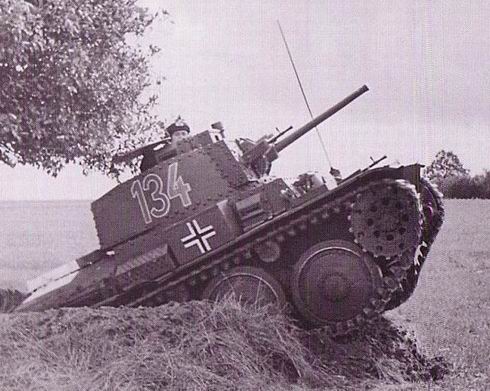
Fue el mejor carro de combate que desarrollaron los checoslovacos pero irónicamente no fue utilizado por ellos. Entró en producción en 1.938 aprovechando las experiencias del LT-35 convirtiéndose en el producto de mayor éxito de la industria armamentística checoslovaca. El vehículo, en diversas variantes, se exportó a países como Suecia, Irán, Persia, Perú o Suiza dando muestras de sus buenas características. El 23 de marzo de 1.939 entregaron a los británicos dos ejemplares para que fueran evaluados en Inglaterra (Lulworth) pero tras esta evaluación los técnicos británicos afirmaron que el vehículo era similar a sus carros de crucero, el informe final criticaba injustificadamente al vehículo checo decidiendo finalmente no comprarlo.

Al igual que sucediera con el LT-35, la ocupación alemana incautó un total de 150 LT-38 del lote inicial y se impartieron órdenes de completar el resto de vehículos pedidos en la factoría de CKD. Al final pasaron al servicio alemán bajo la designación PzKpfw 38(t) SdKfz 140, convirtiéndose en uno de los vehículos más importante de la Panzerwaffe. Su producción se mantuvo hasta junio de 1.942 y sirvió con los aliados de los alemanes durante mucho más tiempo, Rumania disponía de 50, Eslovaquia 90, Bulgaria 10 y Hungría 102 vehículos.


El PzKpfw 38(t) es el último de los denominados panzer ligeros que prestaron servicio en la batalla de Kursk. El armamento principal del vehículo consistía en el cañón de origen checo Skoda A7 de 37 mm que recibió el nombre de KwK 37(t) para el servicio en el ejército alemán, y 1 o 2 ametralladoras de 7´92 mm.

En total se fabricaron un total de 1.414 PzKpfw 38(t) ya que era un vehículo fiable y de muy fácil mantenimiento convirtiéndolo en una adquisición muy atractiva. Participaron en la invasión de Polonia en 1.939 integrando sus carros la dotación de la 3º Leichte Division, en Noruega con el XXXI Cuerpo de Ejército, en Francia[1] y los Balcanes integrando la 8º Panzerdivision. Durante la ofensiva alemana en la operación Barbarroja se alinearon un total de 651 PzKpfw 38(t) en las Panzerdivisionen[2]. El Ausf A fue la versión estándar; mientras que el Ausf B incorporaba granadas fumígenas. Más tarde aparecería el Ausf E que dispuso de un blindaje doblado mediante el empernado de una placa de 25 mm al frente y 15 mm en los laterales del carro. El Ausf G fue el último modelo cuyo bastidor fue utilizado en exclusiva para cureñas autopropulsadas.


Al igual que su hermano menor, el PzKpfw 35 (t), conforme se fue retirando del cometido de primera línea se distribuyeron cantidades de estos carros ligeros entre los aliados rumanos, húngaros, italianos y eslovacos. Estas fuerzas aceptaron con cierto agrado estas nuevas incorporaciones ya que solían estar escasos de medios blindados y el PzKpfw 38 (t) constituía un carro obsoleto pero muy fiable. 

El bastidor de este excelente vehículo era muy atractivo en cuanto a su utilización para diversos cometidos dada su fiabilidad y fácil mantenimiento. Así surgieron diversos modelos especiales basados en su robusto bastidor; vehículo de exploración, Aufklärungspanzer 38(t) con la torreta del SdKfz 222, cazacarros en la serie Marder III y el Hetzer. Lanzallamas como el Flammpanzer 38(t), artillería autopropulsada, Bison o Grille; vehículo antiaéreo Flakpanzer 38 (t), transporte de munición Munitionsschlepper 38(t), para tendido de cortinas de humo (PzKpfw 38(t) mit Nebel Ausrastung), vehículos de recuperación (Bergerpanzer 38), etc.

Principales características técnicas del PzKpfw 38 (t)
Características técnicas
PzKpfw 38 (t)
Tripulación
4
Motor
Praga EPA de 125 hp
Peso
10´5 ton
Velocidad máxima
42 Km/h
Armamento principal
1x KwK 37 (t) L/47 de 37 mm
Blindaje
25 mm
Fabricante
CKD
Munición
90 proyectiles de 37 mm y 2.700 de 7´92 mm
Unidades construidas
1.414
Autonomía
250 Km carretera / 160 Km campo traviesa


Tras ser desmontados muchos carros de combate PzKpfw 38(t) sobraron muchas torretas blindadas que pronto serían utilizadas en armar las líneas defensivas alemanas en la denominada “Fortaleza Europa”. De este modo se instalaron 351 torretas de PzKpfw 38(t) en casamatas costeras y líneas defensivas del interior[3].


Fuente:

English version

It was the best battle tank developed by the Czechs but ironically was not used by them. Went into production in 1938 building on the experiences of the LT-35 becoming the most successful product of the Czechoslovak arms industry. The vehicle, in several variants, was exported to countries like Sweden, Iran, Persia, Peru and Switzerland showing signs of its good features. On 23 March 1939 the British handed over two copies to be evaluated in England (Lulworth) but after this examination, British technicians said the vehicle was similar to their cars cruise the final report unjustifiably criticized Czech car finally deciding not buying it.

As was the case with the LT-35, the German occupation seized a total of 150 LT-38 initial batch and were given orders to complete the other vehicles in the factory orders CKD. At the end passed into German service under the designation PzKpfw 38 (t) SdKfz 140, becoming one of the most important vehicles Panzerwaffe. Its production was maintained until June 1942 and served with the allies of the Germans for much longer, Romania available 50, Slovakia 90, Bulgaria 10 Hungary 102 vehicles.


The PzKpfw 38 (t) is the last of the so-called light panzer who served in the Battle of Kursk. The main armament of the vehicle was in the barrel of Czech origin Skoda 37 mm A7 was named KwK 37(t) for service in the German army, and 1 or 2 machine guns of 7'92 mm .

In total, produced a total of 1,414 PzKpfw 38 (t) as it was a dependable and easy to maintain making it a very attractive acquisition. Participated in the invasion of Poland in 1939 by integrating its cars the provision of the 3rd Division Leichte in Norway with the XXXI Corps in France and the Balkans integrating the 8th Panzer Division. During the German offensive in Operation Barbarossa lined up a total of 651 PzKpfw 38 (t) in Panzerdivisionen. The Ausf A was the standard version, while incorporating the Ausf B smoke grenades. Appear later Ausf E arranged in a folded shielding by bolting a 25 mm plate of 15 mm at the front and the sides of the carriage. The Ausf G was the last model whose frame was used exclusively for self-propelled carriages.

Like his younger brother, the PzKpfw 35 (t), as they retreated from the frontline role of these amounts were distributed among the allies light trucks Romanians, Hungarians, Italians and Slovaks. These forces agreed with some welcome these new additions as they used to be scarce and the armor means PzKpfw 38(t) was an obsolete but very reliable car.

The frame of this excellent vehicle was very attractive in terms of their use for various tasks given its reliability and easy maintenance. So were several special models based on its robust frame; exploration vehicle, Aufklärungspanzer 38(t) with turret SdKfz 222, Marder III tank destroyer in the series and Hetzer. Flamethrower as Flammpanzer 38(t), self-propelled artillery, Bison and Grille, anti-aircraft vehicle Flakpanzer 38(t), transportation of ammunition Munitionsschlepper 38(t), for laying smoke screens (PzKpfw 38(t) mit Ausrastung Nebel) recovery vehicles (Bergerpanzer 38), and so on.

After being dismantled many tanks PzKpfw 38 (t) armored turrets were left many soon to be used in arming the German defensive lines in the so-called "Fortress Europe". This will set up 351 towers PzKpfw 38 (t) in coastal bunkers and defensive lines the interior.


Source:


[1] Con la 6º, 7º y 8º Panzerdivision.
[2] Prestaron servicio en la 6º, 7º, 8º, 12º, 19º y 20º Panzerdivision.
[3] Se instalaron 75 en Noruega, 20 en Dinamarca, 9 en la zona oeste del Atlántico, 25 en Italia, 150 en el suroeste de Europa y 78 en fortificaciones en el este.