Buscar este blog

martes, 25 de marzo de 2014

Cohetes RS-82 y RS-132


Cohete soviético RS-82 y RS-132


A principios de los años treinta el equipo liderado por Georgy Langemak comenzaron a trabajar en el desarrollo de los cohetes RS-82 y RS-132. Los calibres elegidos, 82 y 132 mm, correspondían a la necesidad de utilizar los cohetes ya existentes de 24 mm que podían ser encajados en el nuevo diseño. La primera prueba se realizó en noviembre de 1929 y en 1937 se refinó el diseño del RO-82 para ser empleado desde aviones para atacar objetivos terrestres.

Ya durante la Gran Guerra se utilizaron cohetes para atacar posiciones enemigas, sobre todo los cohetes Le Prieur y los utilizados por los biplanos Halberstadt D.II alemanes. Por su parte los soviéticos no los emplearían hasta agosto de 1939 durante la Batalla de Khalkin Gol, cuando un grupo de Polikarpov I-16 bajo el mando del capitán N. Zvonarev usaron cohetes RS-82 contra aparatos japoneses. En la acción derribaron un total de 16 cazas y 3 bombarderos. Durante la Guerra de Invierno otro grupo de seis bombarderos Tupolev SB también utilizó los cohetes, pero en este caso el RS-132 y contra objetivos terrestres.

RS-82

Los primeros estudios sobre los cohetes RS demostraron que cuando eran disparados a 500 metros solo impactaban al blanco (un carro de combate) menos del 1´1% de los 186 cohetes RS-82, esta cifra aumentaba hasta el 3´7% cuando se atacaba una columna acorazada. El RS-132 no alcanzó mejores éxitos, de 134 cohetes disparados ninguno logró alcanzar al blanco durante las pruebas. Su actuación en combate no se esperaba mejores perspectivas ya que usualmente se disparaba a distancias mayores que las utilizadas en las pruebas. Para complicar aún más las cosas el RS-82 necesitaba un impacto directo para provocar daños en el blindaje de vehículos ligeros alemanes, las explosiones cercanas no provocaban daños. El RS-132 podía destruir carros de combate medios si se lograba un impacto directo pero no causaba daños si no era así ni en vehículos blindados. Con todos estos datos sobre la mesa se determinó que solo serían efectivos al ser disparados en salvas y contra objetivos grandes. A pesar de todo los RS-82 y RS-132 fueron empleados ampliamente por la Aviación soviética durante la II Guerra Mundial. Los Ilyushin Il-2 también recibieron este armamento en instalaciones de hasta 24 cohetes.

Entre sus variantes aerotransportadas podemos encontrar los de alto explosivo, RS-82 y RS-132; cohetes perforantes, BRS-82 y BRS-132; fragmentación ROFS-132 y M-13 (RS-132 con motor BM-13) para los Il-2.

 RS-82

Fuente:
GORDON, Y. “Soviet/Russian Aircraft Weapons Since World War Two Midland Publishing, 2004

English version

In the early thirties the team led by Georgy Langemak began working on the development of the RS-82 and RS-132 rockets. The elect, 82 and 132 mm, sizes corresponded to the need to use existing 24 mm rockets that could be embedded in the new design. The first test was conducted in November 1929 and in 1937 the design of the RO-82 was refined to be used by aircraft to attack ground targets.

Even during the Great War missiles were used to attack enemy positions, especially Le Prieur rockets and used by German Halberstadt D.II biplanes . For their part, the Soviets would use until August 1939 during the Battle of Gol Khalkin, when a group of Polikarpov I-16 under the command of Captain N. Zvonarev used RS-82 rockets at Japanese planes. The action broke down a total of 16 fighters and 3 bombers. During the Winter War another group of six Tupolev SB bombers also used rockets , but in this case the RS-132 and against ground targets.

Early studies showed that the RS when rockets were fired at 500 meters only impacted the target (a tank) less than 1.1% of the 186 rockets RS-82, this figure had increased to 3'7% when attacked an armored column. The RS-132 did not reach greatest hits, fired 134 rockets none managed to achieve the target during testing. His performance in combat is no better prospects expected since barreling usually higher than those used in testing distances. To further complicate things the RS-82 needed a direct impact to damage the armor of German light vehicles nearby explosions caused no damage. The RS-132 could destroy cars means a direct impact combat if they could but did not cause damage if not well or armored vehicles. With all this information on the table was determined that would be effective only to be fired in salvos and against large targets. Despite all the RS-82 and RS-132 were used extensively by Soviet aviation during World War II. The Ilyushin Il-2 also received this armament installations up to 24 rockets.

Its airborne variants can find high explosive, RS-82 and RS-132; piercing rockets, BRS-82 and BRS-132; fragmentation ROFS-132 and M-13 (RS-132 motor BM-13) for Il-2.

 YaK-1 with RS-82 rockets.

 Il-2 with RS-132 rockets.

Source:
GORDON, Y. “Soviet/Russian Aircraft Weapons Since World War Two Midland Publishing, 2004

jueves, 20 de marzo de 2014

Cañón italiano 65/17


Cannone da 65/17


El cañón italiano Cannone da 65/17 Mod. 13 de 65 mm fue utilizado principalmente por las unidades de montaña del Ejército italiano. Esta pieza de artillería entró en servicio en 1913 con la designación oficial de Cannone da 65/17. Debido a las unidades a las que iba a estar destinado el diseño del cañón resultó muy ligero para facilitar su despliegue en terrenos montañosos. El tubo del cañón, de 17 calibres de longitud, solo le permitía hacer disparos de baja trayectoria. La cureña también era de diseño sencillo, con un solo brazo de arrastre y de montura sólida con ruedas con radios para el tiro de caballos o mulos. Para su transporte podía ser desmontado en cinco partes que facilitaba su transporte en terreno desigual. El cañón alcazaba un peso de 560 Kg con una longitud de cañón de tan solo 1´1 metro. Sus proyectiles pesaban 4.3 Kg que podían ser lanzados a 6´8 Km de distancia, su alcance máximo efectivo.

Tras ser aceptado por el Ejército italiano el cañón entró en servicio en 1913 sirviendo durante la Gran Guerra. En la década de 1920 fue distribuido en otras unidades de infantería debido a su peso liviano y gran facilidad para operar con él en condiciones adversas. En 1935 se le equipó con un escudo blindado plegable para proteger a su dotación del fuego enemigo. Fue muy apreciado por la infantería y a pesar de su calibre ligero y a su edad sirvió también durante la Segunda Guerra Mundial como cañón de apoyo cercano. También se utilizó en el norte de África como cañón anticarro, en ocasiones montados sobre un camión para mejorar su movilidad en el campo de batalla. 


Fuentes:
CHANT, C. “Artillery of World War II” MBI, 2001
HOGG, I. “Twentieth Century ArtilleryAmber Books, 2000

English version

The Italian Cannone da barrel 65/17 Model 13 65 mm was used mainly by mountain units of the Italian Army. This piece of artillery entered service in 1913 with the official designation Cannone da 65/17. Because the units that would be aimed cannon design was very light for easy deployment in mountainous terrain. The gun barrel of 17 calibers long, only allowed to do low trajectory shots. The carriage was also simple in design, with one trailing arm and solid frame with spoked wheels for the team of horses or mules. For transportation could be disassembled into five parts that facilitated transport on uneven ground. The fortress cannon weighing 560 kg with a barrel length of only 1'1 meter. His shells weighing 4.3 kg that could be thrown at 6.8 Km away, its maximum effective range.

After being accepted by the Italian Army cannon went into service in 1913 serving in the Great War. In the 1920s it was distributed in other infantry units because of their light weight and ease to operate it under adverse conditions. In 1935 it was fitted with a folding armored shield to protect his crew from enemy fire. I was very appreciated by the infantry and despite its lightweight size and age also served during World War II as close support gun. Was also used in North Africa as anti-tank gun, sometimes mounted on a truck to improve their mobility in the battlefield.


Fuentes:
CHANT, C. “Artillery of World War II” MBI, 2001
HOGG, I. “Twentieth Century ArtilleryAmber Books, 2000

martes, 18 de marzo de 2014

Modificaciones del Sherman M4A2


Modificaciones en la producción del Sherman: M4A2


La configuración del casco del M4A2 era de soldadura, aprobado en diciembre de 1941, y estaba equipado con un motor GM 6-71 diesel. La protección de la transmisión era de tres piezas atornilladas. Disponía de periscopios para la visión del conductor y copiloto, situados en la parte delantera del vehículo. La suspensión corría a cargo del sistema VVSS (Vertical Volute Spring Suspension). Tanto el casco como en la torre se soldador planchas de seguridad para proteger a la tripulación y la munición almacenada. Esta versión del Sherman estaba armada con un cañón M3 de 75 mm, con el mantalete de la versión M4A1 y una ametralladora de 12´7 mm coaxial. A partir de junio de 1944 el cañón de 75 mm fue reemplazado por el más potente M1A2 de 76 mm montado en una torreta T26 o T23. A finales de año también se cambió la suspensión, siendo reemplazadas por otras horizontales HVSS (Horizontal Volute Spring Suspension) M4A2 (76) HVSS.

Esta versión del Sherman fue utilizado para la exportación, sobre todo a Gran Bretaña y a Rusia, en todas sus versiones. También algunos de ellos fueron enviados a las unidades de los Marine ya que su motor no era muy apreciado por las unidades del Ejército.


Fuentes:
CHAMBERLAIN, P. “British and American tanks of World War II” Arco, 1984
ZALOGA, S. “M4 (76 mm) Sherman Medium tank 1943-65” Osprey, 2003
ZALOGA, S. “El carro medio Sherman” Osprey, 1999

English version

The configuration of the M4A2 hull Weld was approved in December 1941, and was equipped with a GM 6-71 diesel engine. Transmission protection was three pieces screwed. Available for viewing periscopes driver and co-driver at the front of the vehicle. The suspension was provided by the VVSS system (Vertical Volute Spring Suspension). Both the town and the tower soldering irons security to protect the crew and ammunition stored. This version of the Sherman was armed with a 75 mm gun M3, with the M4A1 version shield and 12'7 mm coaxial machine gun. From June 1944 the 75 mm gun was replaced by the more powerful of M1A2 76 mm mounted on a T26 or T23 turret. At year's end the suspension was also changed, being replaced by horizontal HVSS (Horizontal Volute Spring Suspension) M4A2 (76) HVSS.

This version of the Sherman was used for export, mainly to Britain and Russia, in all its versions. Also some of them were sent to the Marine units since its engine was not appreciated by Army units.

Sherman M4A2 Viena, 1945

Sources:
CHAMBERLAIN, P. “British and American tanks of World War II” Arco, 1984
ZALOGA, S. “M4 (76 mm) Sherman Medium tank 1943-65” Osprey, 2003
ZALOGA, S. “El carro medio Sherman” Osprey, 1999

martes, 11 de marzo de 2014

Inventarío del 303º BG “Hell´s angels” (XII)


Inventarío del 303º BG “Hell´s angels” (XII)

ARTHUR C. WAY CREW - 360th BS B-17F #42-5483 Red Ass 360BS (PU-F) (crew assigned 360BS: 22 July 1942 - photo: 17 July 1943)

Probablemente sea el Bomb Group más famoso de la II Guerra Mundial y todo un referente para el Nose art de los bombarderos aliados. Fue uno de los primeros Grupos que llegó a Inglaterra y el B-17 “Hell´s angels” fue el primero de la unidad en completar sus 25 misiones en junio de 1943. El B-17F 41-24605 “Knock-out Dropper” sería el primer bombardero de la USAF en Inglaterra en completar 50 y después 75 misiones de combate. El grupo fue disuelto el 16 de junio de 1952. A continuación se muestra una relación de este arte que lucieron los B-17 del Hell´s angels”.

Bomb Group is probably the most famous World War II and a reference to the Nose Art by Allied bombers. He was one of the first groups that came to England and the B-17 "Hell's Angels" was the first unit to complete his 25 missions in June 1943. The B-17F 41-24605 "Knock-out Dropper" is the first USAF bomber in England after completing 50 and 75 combat missions. The group was dissolved on June 16, 1952. Below is a list of this art that wore the B-17's "Hell's Angels."

B-17 “Lady Luck” (aka “Bob's Boudoir & Shad Rack”)

B-17F 360BS (PU-J) 42-5434. Otro ejemplo de tail art. Asignado al 303º BG "Hell´s angels" el 6 de marzo de 1943, se desconoce el número de misiones realizadas y fue retirado por fatiga (war weary) el 26 de septiembre de ese mismo año.

B-17F 360BS (PU-J) 42-5434. Another example of tail art. Assigned to the 303rd BG "Hell's Angels" on March 6, 1943, the number of missions is unknown and was removed by fatigue (war weary) on September 26 of that year.


B-17 “Red Ass” (aka “The Devil Himself”)

B-17G 360BS (PU-F) 42-5483. Asignado al 303º BG "Hell´s angels" el 7 de marzo de 1943. Tras realizar 9 misiones de combate fue derribado el 29 de noviembre sobre Bremen.

B-17G 360BS (PU-F) 42-5483. Assigned to the 303rd BG "Hell's Angels" on March 7, 1943. After making nine combat missions was shot down on November 29 on Bremen.


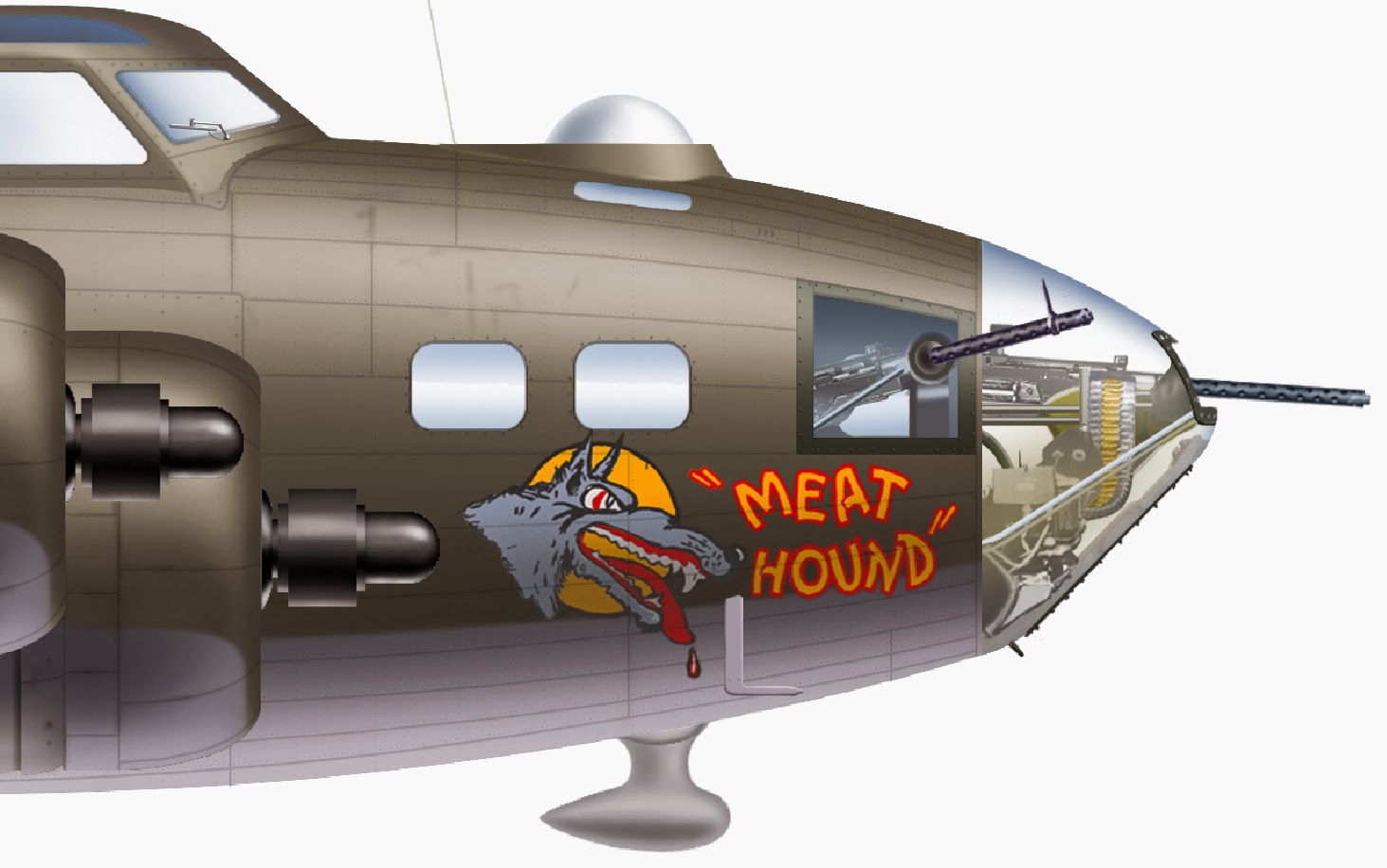
B-17 “Meat Hound”

B-17G 358BS (VK-K & Q) 42-29524. Asignado al 303º BG "Hell´s angels" el 2 de marzo de 1943. Se estrelló el 1 de noviembre de 1944.

B-17G 358BS (VK-K & Q) 42-29524. Assigned to the 303rd BG "Hell's Angels" on March 2, 1943. It crashed on November 1, 1944.


B-17 “Two Beauts”

B-17F 358BS (VK-H) 42-29573. Asignado al 303º BG "Hell´s angels" el 6 de marzo de 1943. Tan solo realizó 4 misiones hasta que el 31 de marzo de 1943 chocó en el aire contra otro aparato.

B-17F 358BS (VK-H) 42-29573. Assigned to the 303rd BG "Hell's Angels" on March 6, 1943. Just did 4 missions until March 31, 1943 collided in midair with another device.


Fuentes/Sources:
MAURER, M. “Air Force Combat Units Of World War II.” Maxwell, 1983
FLEMMING, S. “Flying with the Hell's Angels” Honoribus Press, 1991
FREENY, W. “The First 300 Hell's Angels, 303rd Bombardment Group (H). United States Army Air Forces” Batsford, 1944
O´NEILL, B. “303rd Bombardment Group” Osprey, 2003
SMART, V. “The Original Hell's Angels: The 303rd Bombardment Group of World War II” Arcadia Publishing, 2001

martes, 4 de marzo de 2014

Aeródromos de la IIGM: Tongatabu


Aeródromos de Tongatabu 
(Tonga Tabu)


Ubicado cerca de Nuku'alofa (Nuku'alofa). También conocido como campo de aviación de Tonga Tabu”. Fue construido por el 1º Batallón de Construcción de la Marina de los EE.UU., con la asistencia y mano de obra proporcionada por la 147º División de Infantería del Ejército

Unidades basadas en Tongatabu
13th AF, 347th FG, 68th FS (P-39, P-40) Oct 3 - Oct 28 1942 a New Caledonia
7th AF 58th FG, 68th FS (P-40) de Amberly May 16, 1942 - finales de Oct. 1943
RNZAF 15 Squadron (21 x P-40E y P-40K) Oct. 27, 1943 - ?

Engineers used this Japanese roller to complete the half finished runway shown in the lower photo, taken shortly after the Marines landed on Guadalcanal. Note the profusion of bomb holes.

Fuentes:
MAURER, M. “Air Force Combat Units Of World War II”. Maxwell AFB, Office of Air Force History, 1983
Strategic Atolls, Tuvela and the Second World War
MUELLER, R. “Active Air Force Bases within the United States of America on 17 de September 1982” Office of Air Force History, 1989
RAVENSTEIN, C.A. “Air Force Combat Wings lineage and Honors Histories 1947-1977” Office of Air Force History, 1984
Pacificwrecks

English version

Located near Nuku'alofa (Nuku'alofa). Also known as airfield Tonga Tabu. "It was built by the 1st Battalion Construction of U.S. Navy, with the assistance and labor provided by the 147th Infantry Division of the Army

Units based on Tongatabu
13th AF, 347th FG, 68th FS (P-39, P-40) October 3 to October 28, 1942 in New Caledonia
7th AF 58th FG, 68th FS (P-40) Amberly May 16, 1942 - end of Oct. 1943
RNZAF 15 Squadron (21 x P-40E and P-40K) Oct. 27, 1943 -?


Sources:
MAURER, M. “Air Force Combat Units Of World War II”. Maxwell AFB, Office of Air Force History, 1983
Strategic Atolls, Tuvela and the Second World War
MUELLER, R. “Active Air Force Bases within the United States of America on 17 de September 1982” Office of Air Force History, 1989
RAVENSTEIN, C.A. “Air Force Combat Wings lineage and Honors Histories 1947-1977” Office of Air Force History, 1984
Pacificwrecks

viernes, 28 de febrero de 2014

Camuflaje de la Nachtjagd


Esquemas miméticos de la Nachtjagdgeschwader.


Los primeros Bf 110 empleados por la NJG 1 cuando se originó la Nachtjagd eran aparatos prácticamente convencionales, con simples modificaciones en sus marcas y repintados de negro. Posteriormente los compañeros del Bf 110, los Dornier y los Junkers Ju 88 también recibieron su  pintura negra pensando que el negro favorecería el camuflaje para este tipo de misiones nocturnas. Sin embargo se observó que no era tan eficaz como se había pensado en un principio cambiando más tarde a un juego de tonos grises y blancos, uno de los más populares fue un esquema en dos tonos de gris (RLM 75 y 76) con las cruces nacionales huecas. A pesar de este cambio la Nachtjagd mantuvo el color negro de sus aparatos hasta 1943.

A partir de 1943 los esquemas miméticos para la Nachtjagd cambiaron al comprobar que el color negro no era el más adecuado. Los tonos se hicieron más claros combinándose las distintas tonalidades de gris e incluso blanco como ya se ha mencionado (RLM 74/75/76). Los costados del fuselaje recibían una combinación de moteado RLM 74 y 75. Una versión más sencilla de este esquema se vio cuando aparecieron los Do 217, el RLM 74 fue eliminado quedando todo el aparato en RLM 75. Sin embargo oficiales como el Major Günther Radusch no estaban plenamente convencidos de que este esquema fuese el idóneo. Ante la duda sobre el esquema se optó por probarlos operacionalmente, unos Do 217 con este esquema ligero junto con los Ju 88 C pintados de negro (Hauptmann Hans-Joachim Jabs), sin embargo los resultados de dicha prueba se perdieron. Los aparatos quedaban con un acabado moteado, manchado o incluso complicados garabateados. A pesar de esta cierta complejidad en los esquemas miméticos aún había aparatos con esquemas de los Zerstörer destinados al combate diurno en las filas de la Nachtjagd. Los colores RLM 74, 75 y 76 fueron empleados en los camuflajes hasta que a finales de agosto de 1944 el RLM 74 fue eliminado oficialmente de los esquemas. A pesar de ello muchas fotografías de la época revelan que el RLM 74 continuó siendo usado a nivel de unidad y en otras modificaciones.


Para las misiones de largo alcance en territorio enemigo o intrusión el aparato se pintaba totalmente de negro tapando incluso la insignia nacional. Esta práctica dio muy buenos resultados a la 1./NJG 2 que ocultaba sus insignias e incluso la identificación de su Staffel a miradas indiscretas.

Desde finales de 1944 los colores incluidos para el camuflaje de los cazas nocturnos se ampliaron, incluyendo el RLM 75, 81, 82 y 83 sobre el RLM 76 que servía de color base. Estas combinaciones también fueron complicados moteados (Wellenmuster) que ya se mantuvieron hasta el final de la contienda.

Ju 88 G-6 was the plane of 6./NJG 2, Vechta, Eelde, Germany 1945.
Camouflage: RLM77/RLM75. 

Fuentes:
HINCHLIFFE, P. “Luftkrieg bei Nacht 1939-1945” Motorbuch Verlag, 1998
SCUTTS, J. “German night fighter aces of World War 2” Osprey, 1998
SCUTTS, J. “Luftwaffe night fighter units 1939-45” Osprey, 1978
GRIEHL, M. “Nightfighters over the Reich ” Greenhill, 1997
GEBHARD, A. “Geschichte der Deutschen Nachtjagd. 1917-1945” Motorbuch, 1995

English version

The first Bf 110 employees by NJG 1 when the Nachtjagd were practically originated conventional devices, with simple changes to their brands and repainted black.  Subsequently mates Bf 110, the Dornier and Junkers Ju 88 also received their black paint think the black camouflage to favor this type of night missions. However be noted that it was not as effective as was originally thought later changing to a set of grays and whites , one of the most popular was a scheme in two shades of gray ( RLM 75 and 76) with crosses hollow nationals. Despite this change the Nachtjagd kept the black color of your appliances until 1943.

From 1943 mimetic schemes for Nachtjagd moved to find that the black color was not the best. The tones are made ​​by combining the various lighter shades of gray or even white as already mentioned (RLM 74/75/76). Fuselage sides receiving a combination of spotted RLM 74 and 75. A simpler version of this scheme was appeared when the Do 217, the RLM 74 was eliminated leaving the entire apparatus in RLM 75 . No official yet as Major Günther Radusch were not fully convinced that this was the ideal scheme. When in doubt about the scheme opted to try operationally Do a 217 with this lightweight scheme along with the Ju 88 C painted black (Hauptmann Hans-Joachim Jabs ) , but the results of that test were lost. The devices were finished with a mottled, spotted or even scribbled complicated. Despite this complexity in some mimetic schemes still had diagrams of appliances intended Zerstörer day combat in the ranks of the Nachtjagd. The RLM 74, 75 and 76 colors were used in camouflage until the end of August 1944 the RLM 74 was officially removed from the schemes. However many period photographs reveal that remained RLM 74 used at the unit level and other modifications.

For long-range missions in enemy territory or intrusion apparatus was painted entirely black covering even the national insignia. This practice was very successful to 1./NJG 2 hid their badges and even identifying his Staffel to prying eyes.

Since late 1944 colors including camouflage for night fighters were expanded, including the RLM 75, 81, 82 and 83 on the RLM 76 which served as base color. These combinations were also spotted complicated (Wellenmuster) already maintained until the end of the war.


 Bf 110 C


Sources:
HINCHLIFFE, P. “Luftkrieg bei Nacht 1939-1945” Motorbuch Verlag, 1998
SCUTTS, J. “German night fighter aces of World War 2” Osprey, 1998
SCUTTS, J. “Luftwaffe night fighter units 1939-45” Osprey, 1978
GRIEHL, M. “Nightfighters over the Reich ” Greenhill, 1997
GEBHARD, A. “Geschichte der Deutschen Nachtjagd. 1917-1945” Motorbuch, 1995

martes, 25 de febrero de 2014

Semioruga M2

Semioruga estadounidense M2


El precursor de los semiorugas estadounidenses fue el vehículo de origen francés Citroën-Kégresse, que fue evaluado por el US Ordnance Department. La rama de caballería del US Army encontró deficiencias en los vehículos blindados sobre ruedas de reconocimiento ya que en terreno blando o con lluvia estos se quedaban atascados por su propio peso.

En 1938 la White Motor Company comenzó con los trabajos para un nuevo vehículo  y para ello utilizó la parte trasera de un semioruga T9 y lo añadió a un M3 Scout Car. Esta combinación dio origen al semioruga T7. A pesar de las expectativas creadas el vehículo estaba falto de potencia y quedó en un segundo plano hasta que en 1939 el Ejército estadounidense emitió unas órdenes para proveer a sus unidades de artillería de un tractor con el objetivo de dotar de mayor movilidad a estas unidades. Como respuesta, al T7 se le instaló un nuevo motor más potente junto con otros cambios menores dando origen al Half Track Scout Car T14.

M2 at Fort Benning, Georgia, 1942. Note the shorter hull compared to the M3s (left and background) and hinged doors of ammunition compartments in the side armor.

Al año siguiente, 1940, el vehículo fue estandarizado como semioruga M2. El alto mando norteamericano vio el potencial que tenía este vehículo para ser usado para dar movilidad a la infantería mecanizada. Sin embargo se requería un vehículo más grande lo que originó el M3 posteriormente. A finales de 1940 ya se habían emitido órdenes para la producción, tanto del M2 como del M3, fabricados por Autocar Company, White and Diamond-T. Los primeros vehículos fueron recibidos por el Ejército ya en 1941. Por su parte el M2 fue destinado a proporcionar movilidad al obús de 105 mm, transporte para escuadras de ametralladoras y unidades de reconocimiento. En este último caso fue una solución transitoria a la espera de la aparición de vehículos especializados.

Entre 1942 y 1943 los M2 y M3 recibieron unas modificaciones en el tren de rodaje, transmisión y estiba, entre otros cambios menores. La producción final del M2 totalizó 13.500 vehículos, incluyendo sus variantes, siendo muchos de ellos enviados a otros países como con el Programa de Préstamo y Arriendo. Una empresa más, Harvester Company, se unió a su fabricación, siendo un vehículo similar al M2, denominándose como M9 y del que se completaron un total de 3.500 unidades.

Tras su llegada a los campos de batalla en 1941 sirvió en Filipinas, norte de África y en Europa. Alrededor de unos 800 M2 y M9 fueron enviados a Rusia mediante el programa de Préstamo y Arriendo mientras que otros ellos fueron enviados a los aliados de América del Sur. Estos vehículos fueron modernizados en varias ocasiones con el objetivo de alargar su vida operativa, tanto fue así que Nicaragua había recibido un pequeño lote de 10 semiorigas M2 para la Guardia Nacional en 1942 y se vieron en acción durante la revolución acaecida en 1978-1978. Por su parte Argentina donó sus M9 a Bolivia en 2006


Fuentes:
JANDA, P. “Half-Track vol.I. Aj-Press, 2009
MESKO, J. “M3 Half-tracks in Action Squadron/Signal, 1996
ZALOGA, S. “M3 Infantry Half-Track 1940-73Osprey, 2004

English version

The precursor of American halftracks was the vehicle of French origin Citroën-Kégresse, which was evaluated by the U.S. Ordnance Department. The branch of the U.S. Army cavalry found deficiencies in wheeled armored reconnaissance vehicles and in soft ground or rain these be stuck by its own weight.

In 1938, the White Motor Company began work for a new vehicle and it used the back of a halftrack T9 and added it to a M3 Scout Car This combination gave rise to semioruga T7. Despite the expectations the vehicle was underpowered and was on the back burner until 1939 the U.S. Army issued some orders to provide their artillery units of a tractor with the aim of enhancing the mobility of these units. In response, the T7 is installed a more powerful new engine along with other minor changes giving rise to Half Track Car Scout T14.

The following year, 1940, the vehicle was standardized as M2 halftrack. The U.S. high command saw the potential that this vehicle had to be used to give mobility to mechanized infantry. However a larger vehicle which caused the M3 subsequently required. In late 1940 had already issued orders for the production of both the M2 and the M3, manufactured by Autocar Company, White and Diamond-T. The first vehicles were received by the Army since 1941. Meanwhile the M2 was designed to provide mobility to 105 mm howitzer, transportation machine gun squads and reconnaissance units. In the latter case a transient was awaiting the appearance of specialized vehicle solution.

Between 1942 and 1943 the M2 and M3 were some modifications to the chassis, transmission and stowage, among other minor changes. The final production of the M2 totaled 13,500 vehicles, including its variants, many of them being sent to other countries such as the Lend-Lease program. One more company Harvester Company, joined manufacture, being a vehicle similar to M2, M9 and denominating as a total of 3,500 units were completed.

After his arrival to the battlefield in 1941 he served in the Philippines, North Africa and Europe. About 800 M2 and M9 were sent to Russia by the Lend-Lease program while others were sent to the allies in South America. These vehicles were modernized several times in order to prolong its operational life, so much so that Nicaragua had received a small batch of 10 Half-tracks M2 for the National Guard in 1942 and saw action during the revolution in 1978-1978. Meanwhile Argentina donated his M9 to Bolivia in 2006


Sources:
JANDA, P. “Half-Track vol.I. Aj-Press, 2009
MESKO, J. “M3 Half-tracks in Action Squadron/Signal, 1996
ZALOGA, S. “M3 Infantry Half-Track 1940-73Osprey, 2004

jueves, 20 de febrero de 2014

ZiS-2


Cañón anticarro soviético ZiS-2


Desde el departamento de Artillería se emitió una orden a principios de 1940 para que V.G. Grabin diseñase una pieza anticarro más potente de las que hasta el momento se disponía en el arsenal soviético. Por aquellos años muchos diseñadores estaban influenciados por la teoría de los carros de combate multitorretas y finalmente el departamento de desarrollo se vio influenciado por la propaganda alemana que hablaba de un carro de combate multitorretas experimental, el NBFZ. A este carro de combate se le atribuía un blindaje frontal muy pesado que en realidad no tenía. Para el diseño del nuevo cañón anticarro se tomó como referencia el blindaje del KV-1 soviético, entre 40 y 75 mm, determinándose un calibre de 57 mm como el calibre óptimo para acometer estos medios acorazados. La velocidad y la masa del proyectil perforante le permitía alcanzar la suficiente energía  cinética como para penetrar hasta 90 mm de blindaje al mismo tiempo que mantenía el peso del arma lo suficientemente ligero y pequeño como para ser transportar y ocultar fácilmente. Sin embargo no todo iban a ser ventajas y la adopción de este calibre nuevo obligaba a la fabricación desde cero. El ZiS-2 tenía un alcance máximo de 8.400 metros y gozaba de un grado de elevación de +25º a -5º. Gracias al calibre elegido podía efectuar hasta 25 disparos por minuto.

El desarrollo comenzó en mayo de 1940 y a principios del año siguiente fue designado como cañón anticarro ZiS-2 de 57 mm (mod.1941). La producción dio comienzo el 1 de junio de 1941 pero el 1 de diciembre de ese mismo año la producción fue paralizada por los comisarios N. N. Voronov y G. L. Govorov. La explicación aportada por ellos era que los proyectiles perforaban el blindaje de los carros alemanes pero sin hacer mucho daño en su interior. Otros argumentos fueron el elevado coste por cañón y problemas para la producción de sus proyectiles. Para esas fechas se habían completado 371 cañones. Las líneas de producción cambiaron para fabricar el cañón anticarro ZiS-3 de 76´2 mm mientras que el hueco dejado por el ZiS-2 fue ocupado por cañones de 45 mm junto con los ZiS-3. Esta pieza era capaz de vérselas con cualquier carro de combate alemán hasta finales de 1942.

Con la aparición de los grandes felinos alemanes (Tiger I y Panther) cambió la balanza a favor de los alemanes. Los cañones anticarro soviéticos de 45 mm mod.1942 solo podían penetrar el lateral del Panther a distancias poco recomendables para sus artilleros mientras que el más pesado ZiS-3 solo podía anotarse la victoria contra el lateral y el mantalete del cañón. Contra el Tiger I el ZiS-3 solo era efectivo contra el flanco y a distancias inferiores a 300 metros. Se hacía necesaria la entrada en servicio de una pieza de artillería anticarro más potente y el 15 de junio de 1943 se reactivó la producción del ZiS-2, mod.1943. Hasta finales de 1945 se fabricaron un total de 9.645 unidades más.


Fuentes:
SHUNKOV, V. N. “The Weapons of the Red Army”, Mn. Harvest, 1999
ZALOGA, S. “Soviet Tanks and Combat Vehicles of World War Two”, Arms and Armour Press, 1984
KOLL, CH. “Soviet Cannon - A Comprehensive Study of Soviet Arms and Ammunition in Calibres 12.7mm to 57mm” Austria: Koll. 2009

English version

From the Ordnance Department issued an order in early 1940 for VG Whoever designed Grabin more powerful of which was available so far in the Soviet arsenal antitank piece. In those years many designers were influenced by the theory of combat multiturreted carts and finally the development department was influenced by the German propaganda that spoke of a shopping experimental multiturreted combat, NBFZ. In this chariot was attributed a heavy frontal armor I actually had not. For the design of new anti-tank gun was taken as reference shield Soviet KV-1, between 40 and 75 mm, determining a caliber 57 mm caliber as the optimal means to address these battleships . The speed and mass of the projectile piercing allowed achieve sufficient kinetic energy to penetrate 90 mm ​​of armor while keeping the weight light enough and small enough to be transported and easily hidden weapon. But not everything would be advantages and adoption of this new caliber required to manufacture from scratch. The ZIS-2 had a maximum range of 8,400 meters and enjoyed a degree of elevation of +25° to -5°. With the gauge choice could carry up to 25 rounds per minute.

Development began in May 1940 and early the following year was appointed as ZIS-2 anti-tank gun of 57 mm (Mod.1941). Production began on June 1, 1941 but on 1 December of the same year, production was paralyzed by the commissioners N. N. Voronov and G. L. Govorov. The explanation given by them was that the bullets pierced the armor of German tanks but without doing much damage inside. Other arguments were the high cost per barrel and production problems for their missiles. By this time it had completed 371 guns. Production lines changed to make the anti-tank gun ZIS-3 76.2 mm while the gap left by the ZIS-2 was occupied by 45 mm cannon along with ZIS-3. This part was able to deal with any German tank until the end of 1942.

With the emergence of the big German cats (Tiger I and Panther) changed the balance in favor of the Germans. The Soviet anti-tank guns of 45 mm mod.1942 could only penetrate the side of a Panther unsavory distances to their gunners while the heavier ZIS-3 could only the win against the side of the canyon and
gun mantlet. Against Tiger I ZIS-3 was the only effective against the lower edge and 300 meters distances. The commissioning of a piece of more powerful anti-tank artillery and June 15, 1943 the production of the ZIS-2 was reactivated Mod.1943 was needed. Until the end of 1945 a total of 9,645 units were produced more.


Sources:
SHUNKOV, V. N. “The Weapons of the Red Army”, Mn. Harvest, 1999
ZALOGA, S. “Soviet Tanks and Combat Vehicles of World War Two”, Arms and Armour Press, 1984
KOLL, CH. “Soviet Cannon - A Comprehensive Study of Soviet Arms and Ammunition in Calibres 12.7mm to 57mm” Austria: Koll. 2009

martes, 18 de febrero de 2014

PzKpfw III Ausf J


Panzerkampfwagen III Ausf J
(5cm KwK L/60)


El PzKpfw III Ausf J (5cm KwK 39 L/60) entró en producción a instancias de Hitler para potenciar al PzKpfw III con un cañón más largo. Esta inquietud había surgido tras la caída de Francia y como consecuencia de los enfrentamientos con los carros de combate franceses que estaban más blindados. Inicialmente se optó por el 5cm L/42 que, a la postre, se demostrarían aún escasos de potencia para vérselas con los carros de combate rusos.

Si quitamos el cambio de cañón ambos modelos de PzKpfw III Ausf J son idénticos. Al ser más grande el cañón su capacidad de almacenar proyectiles descendió de 99 (en el L/42) a 84 (con el L/60). Cierto número de vehículos con el cañón corto se rearmaron con el nuevo cañón cuando se tuvo oportunidad.

El PzKpfw III Ausf J con el cañón largo de 5cm demostró buenas cualidades contra los carros de combate británicos y norteamericanos en el norte de África. Sin embargo en el Frente Oriental, contra los T-34 y KV-1 tenía más dificultades en batirlos y se encontraba en inferioridad en cuanto a cañón ya que estos montaban cañones de 76´2 mm. La producción con el nuevo L/60 comenzó en diciembre de 1941, en total se completaron 1.549 PzKpfw III Ausf J entre marzo de 1941 y julio de 1942.


Fuentes:
ORMEÑO, J. “Panzerkampfwagen III. El pequeño veterano de la Wehrmacht” Serga, nº 47
PERRET, B. “Panzerkampfwagen III. Mediun tank 1936-1944” Osprey, 1999
GANDER, T. “Tanks in detail 7: PzKpfw III Ausf A to N” Ian Allan, 2004
PARADA, G. “PzKpfw III Ausf J/L/M” Kagero, 2010

English version

The PzKpfw III Ausf J (5cm KwK 39 L/60) went into production at the behest of Hitler to power the PzKpfw III with a longer barrel. This concern had emerged after the fall of France and as a result of clashes with French tanks were more shielded. We initially chose the 5cm L/42 that, ultimately, would prove still scarce power to deal with Russian tanks.

If we remove barrel change both models of PzKpfw III Ausf J are identical. Being largest cannon projectiles ability to store dropped from 99 (in the L/42) to 84 (with the L/60). A number of vehicles with the short barrel rearmed with the new gun when it had the opportunity.

The PzKpfw III Ausf J with the 5cm long barrel showed good qualities against British tanks and American in North Africa. However, in the Eastern Front against the T-34 and KV-1 had more difficulty in beating them and was in inferiority regarding these mounted cannon and 76.2 mm guns. Production with the new L/60 began in December 1941, a total of 1,549 completed PzKpfw III Ausf J between March 1941 and July 1942.


Sources:
ORMEÑO, J. “Panzerkampfwagen III. El pequeño veterano de la Wehrmacht” Serga, nº 47
PERRET, B. “Panzerkampfwagen III. Mediun tank 1936-1944” Osprey, 1999
PARADA, G. “PzKpfw III Ausf J/L/M” Kagero, 2010