Buscar este blog

martes, 21 de octubre de 2014

Sd.Kfz 250/7


Sd.Kfz 250/7 Leichter Schützenpanzerwagen
(80 mm Granatwerfer Wagen)


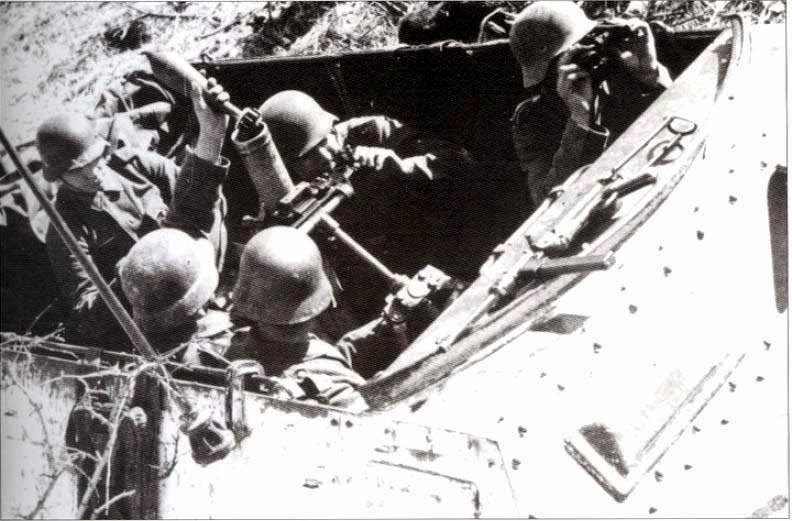
El Sd.Kfz 250/7 fue construido en los dos modelos disponibles del vehículo básico Sd.Kfz 250, el Ausf A y el Ausf B. El objetivo de este vehículo era el de poder transportar y disparar desde su interior el mortero pesado Granatwerfer 34 de 80 mm, además de todo el equipo necesario. En las unidades equipadas con este vehículo se encontraban otros vehículos de apoyo especializados que operaban junto con él. Para el jefe de la sección de morteros se encontraba el Gruppenfuehrerfarzeug, con una tripulación de cinco hombres y con una ametralladora MG 34 o MG 42 para su defensa cercana. Esta ametralladora contaba con un escudo blindado (Panzerschild) para proteger al tirador del fuego enemigo.

Los Sd.Kfz 250/7 equipados con los morteros GrW 34 tenían una tripulación de cuatro hombres y recibieron la designación de Truppfuehrerfahrzeugen. Para su autodefensa contaba con una ametralladora MG 42 de 7´92 mm en un brazo articulado en la parte trasera del vehículo. Por último encontramos el Munitionsfahrzeug, un Sd.Kfz 250 destinado al municionamiento de los morteros. Tenía una tripulación de cinco hombres y estaba equipado también con una ametralladora frontal con escudo blindado para su autodefensa. Este vehículo podía transportar 66 proyectiles de 80 mm para el mortero.

Las tres subvariantes tenían instaladas la base del mortero en el suelo del habitáculo trasero así como otra base para usar el mortero fuera del vehículo. También disponían de equipos de radio para su comunicación con el batallón. El Sd.Kfz 250/7 Granatwerfer Wagen disponía de un periscopio Richtaufsatz 34 para apuntar a sus objetivos. En las últimos vehículos construidos este periscopio se descartó sustituyéndose por una línea vertical negra en el bloque de visión del conductor que servía para apuntar el mortero hacía su objetivo. En estos casos la puntería corría a cargo del conductor del vehículo, que apuntaba el morro en la dirección en la que se iba a disparar el mortero. En el interior del vehículo había también una línea blanca pintada en el borde trasero, encima de la puerta de acceso, que se usaba para alinear el mortero con las estacas de puntería.


Fuentes:
PERRET, B. “Autoametralladoras alemanas.
Osprey
KÖGEL, M. “Total Detail SdKfz 250 Alt - Neu Archive Part 2". Total Detail publications Ltd.
FORTY, J. “Sdkfz 250/1 To 250/12 Armoured Halftrack”, Miltary Vehicles in Detail 1
UWE F. & RIEGER, K. “Schützenpanzerwagen. Squadron/Signal.
De SISTO, F. “German Half-Tracks Of World War Two (Concord series #976)
LEDWOCH, J. “SdKfz 250 Wydawnictwo Militaria Nº019

English version

The Sd.Kfz 250/7 was built in two basic models available vehicle Sd.Kfz 250, the Ausf A and Ausf B. The purpose of this vehicle was to be able to carry and shoot from inside the heavy mortar Granatwerfer 34 80 mm, along with all necessary equipment. On units equipped with this vehicle other specialized support vehicles operating with him were. For the head of the section of mortars Gruppenfuehrerfarzeug was with a crew of five men and a MG 34 or MG 42 machine gun for close defense. This gun had an armored shield (Panzerschild) to protect the shooter from enemy fire.

The Sd.Kfz 250/7 equipped with GrW 34 mortars had a crew of four men and received the designation of Truppfuehrerfahrzeugen. For self-defense MG 42 had a 7.92 mm machine gun on an articulated in the rear of the vehicle arm. Finally found the Munitionsfahrzeug a Sd.Kfz 250 ordnance intended for mortars. It had a crew of five men and was also equipped with a front armored gun shield for self-defense. This vehicle could carry 66 rounds of 80 mm mortar.

The three sub-variants were based mortar installed on the floor of the rear compartment and another base to use the mortar out of the vehicle. They also had radio equipment for communication with the battalion. The Sd.Kfz 250/7 available Wagen Granatwerfer a Richtaufsatz 34 periscope to target. In the last vehicles built this periscope was discarded and replaced by a black vertical line in the block driver vision that served to point the mortar to their target. In these cases the aim was the responsibility of the driver of the vehicle, the nose pointing in the direction he was going to fire the mortar. Inside the vehicle also had a white line painted on the rear edge, above the gateway, which was used to align the mortar aiming stakes.


Sources:
PERRET, B. “Autoametralladoras alemanas. Osprey
KÖGEL, M. “Total Detail SdKfz 250 Alt - Neu Archive Part 2". Total Detail publications Ltd.
FORTY, J. “Sdkfz 250/1 To 250/12 Armoured Halftrack”, Miltary Vehicles in Detail 1
UWE F. & RIEGER, K. “Schützenpanzerwagen. Squadron/Signal.
De SISTO, F. “German Half-Tracks Of World War Two (Concord series #976)
LEDWOCH, J. “SdKfz 250 Wydawnictwo Militaria Nº019

lunes, 20 de octubre de 2014

Blackburn Skua


Blackburn B-24 Skua


El Blackburn B-24 Skua fue diseñado conforme a las especificaciones (O.27/34) para un aparato de caza y bombardeo en picado. Estaba construido totalmente en metal rompiendo con el clásico armazón metálico recubierto de tela para los aparatos destinados para Royal Navy. También fue el primero en disponer de flaps, tren de aterrizaje retráctil y hélice de paso variable. Para lograr el contrato con la Royal Navy tuvo que competir con diseños de Avro, Boulton Paul, Hawker y Vieckers.

El 9 de febrero de 1937 realizó su primer vuelo el prototipo, que estaba fabricado en duraluminio y recibió la designación de Skua Mk.I. Este prototipo tenía un morro más corto, ala recta y estaba equipado con un motor Bristol Mercury IX de 840 cv de potencia. Se tuvo que recurrir a otra planta motriz ya que estos motores estaban reservados para los bombarderos Bristol Blenheim de modo que se optó por un motor radial Bristol Perseus XII enfriado por agua. El modelo final destinado a la fabricación en serie tan sólo podía alcanzar una velocidad máxima de 225 Km/h y desarrollaba una tasa de ascensión muy pobre. Este modelo disponía de alas tipo gaviota con las puntas de las alas inclinadas hacia arriba. Para su uso en los portaaviones sus alas eran también plegables para ahorrar espacio. También disponía de un gancho bajo la cola para facilitar el frenado al aterrizar. Al carecer de equipo de radio tenía un telégrafo inalámbrico de tipo morse para su comunicación que era operado por el copiloto, en la parte posterior de la cabina, que hacía también labores de navegante.

El Skua estaba armado con cuatro ametralladoras de Browning de 7,7 mm instaladas en las alas y una ametralladora Lewis para su autodefensa. En las misiones de bombardeo se le equipaba con una bomba de 227 Kg perforante/antiblindaje, adosada al fuselaje aunque se podía sustituir esa carga por dos o cuatro bombas incendiarias Cooper de 10 Kg bajo las alas.
 

Al estallar la Segunda Guerra Mundial se habían formado un total de 21 Squadrons equipados con Blackburn B-24 Skua. El primer avión alemán derribado en la guerra se produjo el 26 de septiembre de 1939, cuando un Skua derribó un hidroavión Dornier Do 18. El 10 de abril de 1940 una formación de 16 Skuas de 800º y 803º Sqn. lograron hundir al crucero alemán Königsberg que se encontraba anclado en el puerto de Bergen. También participaron en la campaña de Noruega mientras que los Skuas del 801º Sqn. participaron en la cobertura aérea de Dunkerque en la evacuación. Sobre sus playas se enfrentaron a los Ju 87 Stuka y Bf 109 E sufriendo pérdidas a manos de los cazas alemanes. Entre sus defectos estaba la ausencia de depósito de combustible auto-sellante de modo que cuando este era alcanzado el aparato estallaba en llamas.

Tras estas acciones el Skua cayó en declive mientras que Blackburn Aircraft no era capaz de satisfacer las demandas de fabricación del Almirantazgo, además, los Messerschmitt Bf 109 eran muy superiores. Finalmente se suspendió su fabricación en 1941. En las unidades, el Skua fue sustituido paulatinamente por Fairey Fulmar y Hawker Sea Hurricane. Al final de la guerra tan sólo quedaba un Skua en servicio en el 776º Sqn.


Fuentes:
SMITH, P. “Skua!: The Royal Navy´s Dive-Bomber” 2006
WILLS, M. “Blackburn Roc & Skua” 2007

English version

The Blackburn B-24 Skua was designed according to the specifications (O.27 / 34) for a game apparatus and dive bombing. It was made ​​entirely of metal breaking classic metal frame covered with fabric for equipment intended for Royal Navy. It was also the first to have flaps, retractable landing gear and variable pitch propeller. To achieve the contract with the Royal Navy had to compete with Avro designs, Boulton Paul, Hawker and Vieckers.

On February 9, 1937 first flew the prototype, which was made ​​of duralumin and received the designation of Skua Mk.I This prototype had a shorter nose, straight wing and was equipped with Bristol Mercury IX engine of 840 horsepower. We had to use another power plant because these engines were reserved for the Bristol Blenheim bombers so we chose a Bristol Perseus XII radial engine water cooled. The final model to mass production could only reach a maximum speed of 225 Km/h developed a very poor rate of climb. This model had gull wing type with wingtips tilted upwards. For use on aircraft carriers were also folding wings to save space. It also had a hook under the tail to aid braking on landing. Lacking radio had a wireless telegraph morse type for communication that was operated by the passenger in the rear of the cabin, which also did work as a navigator


The Skua was armed with four machine guns Browning 7.7 mm installed in the wings and a Lewis machine gun for self-defense. In bombing missions he was equipped with a 227 kg bomb piercing/anti-armor, attached to the fuselage although you could replace that charge two or four firebombs Cooper 10kg under the wings.

At the outbreak of World War II had formed a total of 21 Squadrons equipped with Blackburn B-24 Skua. The first German aircraft shot down in the war took place on September 26, 1939, when a Skua shot down a Dornier Do 18 seaplane The April 10, 1940 a formation of 16 Skuas and 803º 800th Sqn. managed to sink the German cruiser Königsberg which was anchored in the port of Bergen. They also participated in the campaign in Norway while the Skuas 801º Sqn. participated in the air cover for the evacuation of Dunkirk. On its beaches faced the Ju 87 Stuka and Bf 109 E suffering losses at the hands of the German fighters. Among the defects was the absence of tank fuel self-sealing so that when the device was achieved burst into flame.

Following these actions, the Skua fell into decline while Blackburn Aircraft was not able to meet the demands of manufacturing Admiralty also the MesserschmittBf 109 were much higher. Finally suspended in 1941 in manufacturing units, the Skua was gradually replaced by Fairey Fulmar and Hawker Sea Hurricane. At the end of the war there remained only one service in the Skua 776º Sqn.


Sources:
SMITH, P. “Skua!: The Royal Navy´s Dive-Bomber” 2006
WILLS, M. “Blackburn Roc & Skua” 2007

jueves, 16 de octubre de 2014

Junkers Ju 87 A


Junkers Ju 87 A Stuka

Ju 87 A-1

El Ju 87 A Stuka (Sturzkampfflugzeug, o bombardero en picado) se puede distinguir del resto de modelos gracias a sus amplios “pantalones” del tren de aterrizaje. Sin embargo tiene más características propias de los modelos iniciales, el radiador frontal es relativamente pequeño y rectangular, la antena era doble situada sobre la parte posterior de la cabina en forma de V que en modelos posteriores sería sustituida por una varilla simple.

Los tres primeros prototipos se iniciaron en 1934, disponían de una deriva doble vertical y con motores Rolls-Royce Kestrel. Durante las pruebas de picado realizadas en 1935 pero la unidad de cola del aparato se desprendió estrellándose contra el suelo. Con la destrucción de este primer prototipo los trabajos se centraron en el segundo, que introdujo la sección de cola clásica y propulsado por un motor Junkers Jumo 210A. Las pruebas de este prototipo y el tercero, aún mejorado más, provocó un pedido inicial de 10 Junkers Ju 87 A-0 que estaban equipados con motores Jumo 210Ca. El Ju 87 A-0 entró en servicio en la primavera de 1937 con un motor Junkers Jumo 210 pero en el resto de modelos se cambió el motor (en el Ju 87 A-1 el Jumo 210 Ca y en el Ju 87 A-2 el Jumo 210 Da). Con la introducción del Ju 87 A-1 comenzó a reemplazar los biplanos Henschel Hs 123 de las unidades de ataque al suelo con mayor celeridad. Al menos tres Ju 87 A-1 fueron enviados a la Legión Cóndor que combatía en la Guerra Civil Española para su evaluación en combate. La producción de la serie A finalizaría en 1938 con un total de 262 aparatos fabricados.

El armamento de la serie A consistía en una pareja de ametralladoras MG 17 (7´92 mm) instaladas en la alas y otra más en la parte posterior de la cabina para su autodefensa. La carga de bombas se reducía a 250 Kg mientras que este peso aumentaba hasta 500 Kg para misiones cercanas, la bomba era transportada bajo el motor en una estructura tubular. La serie A solo entró en combate en la Guerra Civil española donde adquirió una gran experiencia y probó equipos como el control de automático de bombardeo.


Fuentes:
MURAWSKI, M. J., “Junkers Ju 87, vol. I, II y III” Kagero, Monografie.
ERFURTH, H. “Junkers Ju 87 black cross”.
GRIEHL, M. “Junkers Ju 87 Stuka”. Airdoc 005

English version

The Ju 87 A Stuka (Sturzkampfflugzeug or dive bomber) can be distinguished from other models because of the big "pants" landing gear. However it has more characteristic features of the initial models, the front heater is relatively small and rectangular, double antenna was located on the back of the V-shaped cabin in subsequent models would be replaced by a single rod.

The first three prototypes began in 1934, they had a double vertical drift and Rolls-Royce Kestrel engines. During tests conducted in 1935 chopped tail unit but the unit came off crashing to the ground. With the destruction of this first prototype work concentrated on the second, which introduced the classic tail section and powered by a Junkers Jumo 210A. Testing of this prototype and the third, still more improved, caused an initial order for 10 Junkers Ju 87 A-0 that were equipped with Jumo 210Ca. The Ju 87 A-0 entered service in the spring of 1937 with Junkers Jumo 210 engine but the other models the engine was changed (in the Ju 87 A-1 Ca Jumo 210 and the Ju 87 A-2 the Jumo 210 Da). With the introduction of the Ju 87 A-1 began to replace the Henschel Hs 123 biplanes units attack the ground more quickly. At least three Ju 87 A-1 were sent to the Condor Legion fighting in the Spanish Civil War for evaluation in combat. The production of the series A would end in 1938 with a total of 262 devices manufactured.

The armament of the series A consisted of a pair of MG 17 machine guns (7.92 mm) installed in the wings and one in the back of the cabin for self-defense. The bomb load was reduced to 250 kg while the weight increased to 500 kg for nearby missions, the bomb was transported on the engine in a tubular structure. The A series only saw combat in the Spanish Civil War where he acquired extensive experience and proven equipment such as automatic control bombing.


Ju 87 A-1 in Spain

Ju 87 A-1 of 2./ StG 165, 1937 (Nowi Scans)

Sources:
MURAWSKI, M. J., “Junkers Ju 87, vol. I, II y III” Kagero, Monografie.
ERFURTH, H. “Junkers Ju 87 black cross”.
GRIEHL, M. “Junkers Ju 87 Stuka”. Airdoc 005

miércoles, 15 de octubre de 2014

Camión Mercedes L3000


Camión alemán Mercedes-Benz L3000


El Mercedes-Benz L3000 era un camión muy común 4x2 de 3´1 toneladas de eje trasero profusamente utilizado por la Wehrmacht. Tenía un motor diesel Daimler-Benz OM 65/4 de 4 cilindros y 75 hp de potencia. Junto con el Opel Blitz resultó ser muy fiable con buenos resultados en terreno desigual. El Afrika Korps lo utilizó en grandes cantidades pero también se vieron a lo largo de todo el Frente Oriental.

De este camión aparecieron tres versiones, el L3000, L3000A y L3000S fabricándose entre 1939 y 1943. En este periodo se fabricaron 27.700 camiones de todas sus versiones, cantidad que le convierte en el camión Mercedes-Benz más fabricado durante la contienda.

La última modernización fue la L3000S, que entró en producción desde 1940 hasta 1944. Muchos elementos superfluos fueron omitidos en la producción tardía para abaratar los costes y tiempos de fabricación. Entre ellos se encontraba la eliminación del guardabarros trasero y el parachoques fue sustituido por uno más estrecho y simple. Los faros fueron sustituidos por otros más pequeños. También sirvió como coche cocina de campaña mientras que los Mercedes-Benz L3000S con caja trasera fueron utilizados con bastante frecuencia por las unidades terrestres de la Luftwaffe.


Fuentes:
OSWALD, W. “Kraftfahrzeuge und Panzer der Reichswehr, Wehrmacht und Bundeswehr.” Motorbuch Verlag, 1982
LEPAGE, J.D. “German Military Vehicles of World War II. An Illustrated guide to cars, trucks, half-tracks, motorcycles, amphibious vehicles and others” McFarland & Co Inc, 2007
German WW2 Army Mercedes-Benz Cars and Trucks” Nº 15 & Nº 16

English version

The Mercedes-Benz L3000 was a common truck 4x2 tons axle 3'1 widely used by the Wehrmacht. He had a Daimler-Benz diesel OM 65/4 4-cylinder engine and 75 hp. Along with the Opel Blitz proved highly reliable with good results in uneven terrain. The Afrika Korps used it in large quantities but were also along the entire Eastern Front.

This truck appeared three versions, the L3000, L3000A and L3000S being manufactured between 1939 and 1943 In this period 27,700 trucks of all versions, making it much in the Mercedes-Benz truck manufactured during the war most were manufactured.

The last modernization was the L3000S, which went into production from 1940 to 1944 many superfluous elements were omitted in later production to reduce costs and manufacturing times. These include the elimination of the rear fender and bumper was was replaced and single one narrower. The headlights were replaced by smaller ones. He also served as field kitchen car while Mercedes-Benz L3000S with rear box were used quite frequently by Luftwaffe ground units.


Sources:
OSWALD, W. “Kraftfahrzeuge und Panzer der Reichswehr, Wehrmacht und Bundeswehr.” Motorbuch Verlag, 1982
LEPAGE, J.D. “German Military Vehicles of World War II. An Illustrated guide to cars, trucks, half-tracks, motorcycles, amphibious vehicles and others” McFarland & Co Inc, 2007
German WW2 Army Mercedes-Benz Cars and Trucks” Nº 15 & Nº 16

martes, 14 de octubre de 2014

Destructor clase Tashkent


Destructor soviético clase Tashkent


La clase Tashkent era una serie de destructores soviéticos que debían servir en la Marina de Guerra diseñados justo antes del estallido de la Segunda Guerra Mundial. Debido a muchos avatares tan sólo se completó una unidad, el Tashkent, que fue ordenado bajo el Segundo Plan Quinquenal a la empresa italiana OTO, en Livorno, en 1935.

Se planearon la construcción de 10 destructores que se construirían en Rusia con un diseño ligeramente modificado bajo la designación de Proyecto 48, comenzando la construcción de 4 de ellos. El estallido de la contienda significó que ninguno de ellos fuese terminado. El casco estaba remachado y tenía un castillo de proa elevada con 15 compartimentos. La resistencia de este tipo de construcción no estaba a la altura de un destructor y se revisó para los siguientes 48 navíos de la clase. El puente era cerrado y se ajustó respecto al proyecto original.

El equipo propulsor comprendía dos turbinas que fueron alojadas en dos compartimentos separados con alternancia de salas de calderas que generaban 130.000 hp de potencia. El destructor estaba armado con tres torres gemelas de cañones B-2LM de 130 mm, 2 cañones antiaéreos de 76 mm, 6 cañones antiaéreos de 37 mm, 6 ametralladoras de 12´7 mm, 9 tubos lanzatorpedos en tres montajes triples y 80 minas. El control de incendios se situaba en la parte superior del puente mientras que el control de tiro básico era de fabricación italiana junto con un telémetro situado a popa.

El Tashkent con su armamento final

Los destructores iban a recibir nombres de ciudades aunque tan sólo se completó el destructor Tashkent. Este destructor fue finalizado en mayo de 1939 y aceptado ese mismo año para la Flota del Mar Negro. Fue entregado sin armamento y podía alcanzar los 43 nudos de velocidad durante las pruebas. En 1941 se sustituyeron los cañones simples de 130 mm por los gemelos del mismo calibre. Sirvió con la Flora del Mar Negro luchando en el sitio de Sebastopol realizando 40 viajes de suministro a través del bloqueo alemán. Escoltó 17 transportes y llevó a 19.300 personas, 2.538 toneladas de municiones, alimentos y otros bienes en Sevastopol. Sus baterías antiaéreas lograron derribar 13 aparatos alemanas, sus bombardeos destruyeron 6 cañones de campaña y dañaron un campo de aviación. También logró hundir un barco con uno de sus torpedos. El 28 de junio de 1942 fue atacado por varios Junkers Ju 87 Stuka pero logró alcanzar Novorosiysk. En este puerto se fue a pique el 2 de julio de 1942, Sus torres fueron rescatadas para ser usadas en el destructor Ognevoi

Tashkent  sin armamento

Fuentes:
WHITLEY, M.J. Destroyers of World War 2 Cassell Publishing, 1988
SHIROKORAD, A. “The Ships and Boats of the USSR Navy, The Period of 1939 – 1945

English version

The Tashkent class was a series of Soviet destroyers which were to serve in the Navy designed just before the outbreak of the Second World War. Because many avatars only one unit, the Tashkent, who was ordained under the Second Five-Year Plan to Italy's OTO Livorno, was completed in 1935.

Build 10 destroyers to be built in Russia with a slightly modified design under the designation of Project 48, beginning the construction of 4 of them were planned. The outbreak of the war meant that none of them was completed. The hull was riveting and had a castle high bow with 15 compartments. The strength of this type of construction was not up to a destroyer and was revised for 48 ships of the class. The bridge was closed and adjusted to the original project.

The team comprised two propeller turbines were housed in two separate rooms with alternating boiler generating 130,000 hp compartments. The destroyer was armed with three guns Twin Towers B-2LM 130 mm, 2 anti-aircraft guns of 76 mm, 6 37 mm anti-aircraft guns, six machine guns 12'7 mm, 9 torpedo tubes in three triple mountings and 80 mines. Fire management stood at the top of the bridge while the basic shot control was made ​​in Italy with a rangefinder located aft.

The destroyers were to receive city names if only the destroyer Tashkent was completed. This destroyer was completed in May 1939 and accepted the same year for the Black Sea Fleet. It was delivered without armament and could reach 43 knots during testing. In 1941 the single 130 mm guns were replaced by twin of the same caliber. He served with the Black Sea Flora fighting in the siege of Sebastopol supply making 40 trips through the German blockade. He escorted 17 transport and led to 19,300 people, 2,538 tons of ammunition, food and other goods in Sevastopol. Their air defenses to bring down 13 German machines, their bombing destroyed six field guns and damaged airfield. He also managed to sink a ship with one of its torpedoes. The June 28, 1942 was attacked by several Junkers Ju 87 Stuka but failed to reach Novorosiysk. In this port foundered on July 2, 1942, The towers were salvaged for use in the destructor Ognevoi.


 Tashkent with temporary armament

Sources:
WHITLEY, M.J. Destroyers of World War 2 Cassell Publishing, 1988
SHIROKORAD, A. “The Ships and Boats of the USSR Navy, The Period of 1939 – 1945

viernes, 10 de octubre de 2014

Granada Type 10


Granada japonesa Type 10


La granada de fragmentación Type 10 fue la primera de esta clase en ser distribuida entre las unidades del Ejército Imperial japonés. Sus orígenes se remontan al final de la Guerra Ruso-japonesa (1904-1905) cuando el Ejército comenzó a experimentar con una gran variedad de granadas de mano para producirla en masa. El siguiente escenario dónde los observadores japoneses pudieron ver la evolución de este tipo de armamento fue durante la I Guerra Mundial dónde se iba perfeccionando su uso táctico. La Oficina Técnica del Ejército recibió la orden de desarrollar un proyecto para un lanzagranadas para ser usado con el fúsil Type 38, que era el arma estándar de la infantería japonesa. A pesar del interés despertado el proyecto fracasó por diversas razones, incluyendo las técnicas.

Tras este fracaso la Oficina Técnica se fijó en un diseño alemán de la Gran Guerra para desarrollar su propia granada designándola Type 10. Esta granada se podía lanzar tanto utilizando un fúsil ya que contaba con carga propulsora como lanzarla a mano. El diseño fue muy similar en aspecto a la posterior Type 91, con un cuerpo estriado en forma de piña segmentado ideado para dispersar la fragmentación al explotar. Un casquillo enroscado en la parte inferior del cuerpo permitía la unión entre el cartucho auxiliar con la granada para su uso con el fúsil. La acción de la granada era de retardo de tipo de percusión activado, iniciada al sacar un pasador de seguridad y golpear la parte superior de la tapa. Este retarde oscilaba entre los 7 y 8 segundos. Al utilizarla con un fusil se activaba automáticamente cuando el émbolo se empujaba por el propio lanzamiento. La Type 10 mostró ser imprecisa en este tipo de lanzamiento e incluso explosiones prematuras, además, el retardo sufría una demora que permitía ser devuelta al lanzador.

La granada Type 10 fue sustituida rápidamente entre las unidades de combate por la granada mejorada Type 91. Estuvo en servicio durante la Guerra Chino-japonesa siendo relegada a tareas de señales (bengalas y proyectiles de señales) durante la Segunda Guerra Mundial. 


Fuentes:
ROTTMAN, G. “Japanese Infantryman 1937-1945 Osprey, 2005
US Department of War “Handbook on Japanese Military Forces, TM-E 30-480 (1945)” 1994
Departments of the Army and the Air Force “Japanese Explosive Ordnance, TM 9-1985-4” 1953

English version

The Granada fragmentation Type 10 was the first of its kind to be distributed among the units of the Japanese Imperial Army. Its origins date back to the end of the Russo-Japanese War (1904-1905) when the Army began experimenting with a variety of hand grenades to mass-produce. The following scenario where the Japanese observers could see the evolution of this type of weapon was during World War I where he was perfecting his tactical use. The Technical Office of the Army was ordered to develop a project for a grenade launcher for use with Type 38 rifle, which was the standard infantry weapon of the Japanese. Despite the interest roused the project failed for various reasons, including technical.

After this failure the Technical Office was set in a German design of the Great War to develop their own Granada Granada designating Type 10 This could throw both using a rifle as it had propellant charge as hand throw. The design was very similar in appearance to the later Type 91, with a fluted shaped body designed to disperse segmented pineapple fragmentation to explode. A cap screwed into the lower body allowed the union between the Granada auxiliary cartridge for use with the rifle. The action of the delay Granada was activated type percussion initiated to remove a knock pin and the top of the lid. This slows ranged between 7 and 8 seconds. When used with a rifle is automatically activated when the plunger is pushed by the launch itself. The Type 10 was shown to be inaccurate in this type of release and even premature explosions also delay suffered a delay that allowed be returned to the pitcher.

The Type 10 was replaced quickly Granada between combat units by Granada improved Type 91 was in service during the Sino-Japanese War being relegated to tasks signals (flares and signal rockets) during World War II.


Sources:
ROTTMAN, G. “Japanese Infantryman 1937-1945 Osprey, 2005
US Department of War “Handbook on Japanese Military Forces, TM-E 30-480 (1945)” 1994
Departments of the Army and the Air Force “Japanese Explosive Ordnance, TM 9-1985-4” 1953

jueves, 9 de octubre de 2014

Carro de combate 7TP


Carro de combate polaco 7TP


El diseño de carro de combate 7TP partió del modelo británico Vickers Mk. E de 6 toneladas. A diferencia del modelo británico el 7TP tenía un motor diesel más potente y fiable y estaba armado con un cañón de 37 mm. El blindaje era más espeso alcanzado los 17 mm, en lugar de los 13 mm del modelo británico. La ventilación del vehículo fue también modificado y disponía de equipo de radio para sus comunicaciones. Entre 1935 y la invasión alemana de 1939 se completaron un total de 132 carros de combate, sin contar con los cuatro prototipos para pruebas.

El motor diesel era nuevo en Europa ya que el resto de vehículos contaban con motor de gasolina, sin embargo, fue el carro de combate japonés Tipo 89B I-Go Otsu en ser el primero en el mundo en contar con un motor diesel. Como sucediese con el modelo británico fue producido en dos versiones, una con doble torreta equipada con ametralladoras CKM wz.30 y otra versión con torreta simple armada con un cañón de 37 mm Bofors wz.37. Ambos modelos pasaron al campo de pruebas dónde se demostró que el diseño de dos torretas estaba obsoleto de modo que se abandonó su desarrollo a favor del modelo con torreta simple. Los pocos modelos de torreta doble fabricados se les retiraron ambas para ser sustituidas por una armada con el cañón de 37 mm permaneciendo tan solo 24 7TP de torretas gemelas en servicio por 108 de torreta simple. En 1938 se fabricó un prototipo con blindaje reforzado bajo la designación 9TP pero nunca llegó a entrar en producción aunque este modelo participó posteriormente en la defensa de Varsovia en septiembre de 1939.

El vehículo contaba con un blindaje máximo de 17 mm y alcanzaba un peso de 9´9 toneladas. Tenía una tripulación de tres hombres; comandante, artillero y conductor. El vehículo podía desarrollar una velocidad máxima de 37 Km/h y tenía una autonomía de 150 Km.

Cuando estalló la guerra en septiembre de 1939 todos los 7TP polacos participaron en la defensa nacional, siendo unidos en dos batallones de carros de combate ligeros. Los vehículos restantes, junto con los finalizados durante la campaña, se utilizaron en crear una unidad acorazada improvisada para la defensa de la capital. El 7TP era superior a cualquier carro de combate ligero alemán pero el número disponibles jugó en su contra para cambiar el resultado de la guerra. El 1º Batallón Acorazado, equipado con 49 7TP de torreta simple, estaba encuadrado en el Ejército Prusy, como fuerza de reserva estratégica. Su primera acción de combate fue el 4 de septiembre de 1939 actuando como reserva móvil y para cubrir la retirada de las tropas. El 8 de septiembre se logró detener el avance alemán en el centro pero al día siguiente tuvo que ser retirado a retaguardia. Parte del batallón fue destruido durante la batalla de Głowaczów mientras que el resto de la unidad logró abrirse paso hacia el otro lado del Vístula para unirse al Ejército de Lublin. Después de la Batalla de Tomaszów Lubelski, el 21 de septiembre de 1939, los vehículos restantes fueron destruidos por sus tripulaciones y la unidad se entregó a los alemanes. 


Por su parte, el 2º Batallón, también equipado con 49 carros de combate 7TP, se unió al Grupo Operativo Piotrków del Ejército Lodz entrando en combate por primera vez el 4 de septiembre cerca del río Prudká. Al día siguiente fue la punta de lanza para el asalto contra Piotrków, pero el ataque fracasó sufriendo fuertes pérdidas en combate. Con el objetivo de reagrupar sus fuerzas fue retirado a Varsovia y más tarde a Brześć, donde protegió la movilización de la 60º División de Infantería polaca. El 15 de septiembre volvió a ver acción durante la batalla de Włodawa dónde sufrió fuertes pérdidas debido a los ataques aéreos de la Luftwaffe. Los 7TP supervivientes tuvieron que ser destruidos por sus tripulaciones debido a la falta de combustible. Tras la unión de Rusia en el ataque a Polonia el resto de la unidad cruzó la frontera de Rumania.

Los vehículos supervivientes fueron reunidos en Varsovia para formar dos compañías de carros ligeros para la defensa de la capital. La primera compañía disponía de 11 vehículos equipados con torres gemelas provenientes de una unidad escuela. En las primeras fases del asalto alemán participó en duros combates por el suburbio de Okęcie y el aeropuerto. Sufrió fuertes pérdidas y tuvo que ser retirado del frente el 12 de septiembre dónde sería unido a la segunda compañía. Esta segunda compañía también contaba con 11 7TP armados con cañones de 37 mm, así como un número indeterminado de vehículos blindados de otras clases. Participó con éxito en la defensa de la ciudad de Wola evitando que cayese en manos de la infantería alemana apoyada por vehículos blindados. También fue utilizado para contraataques tácticos, entre otros para el pueblo de Wawrzyszew, donde la compañía logró interrumpir los preparativos alemanes para el asalto. El 15 de septiembre la compañía recibió la orden de formar un grupo de asalto junto con las fuerzas del Ejército de Poznań en retirada tras la batalla de Bzura, al norte de Varsovia. De nuevo la acción de la Luftwaffe causó fuertes pérdidas entre la unidad. Los 7TP restantes fueron utilizados en varios sectores del frente hasta acabar en Varsovia el 27 de septiembre, cuando fueron destruidos por sus tripulaciones.

El cañón de 37 mm del 7TP se mostró capaz de penetrar el blindaje de todos los carros alemanes en servicio (PzKpfw I, PzKpfw II y PzKpfw III), incluyendo al nuevo PzKpfw IV. En contra jugó su escaso blindaje que lo hizo vulnerable a explosiones cercanas.


Fuentes:
MAGNUSKI, J.  Czolg lekki 7TP 7TP Polish Light Tank” Fenix, 1996
RESTAYN, J. “WWII Tank Encyclopaedia, 1939-45” Histoire and Collection, 2008
JONCA, A. “Polish Vickers: Vickers E, 7TP, C6P, C7P (Polish Tracks & Wheels)” MMPBooks, 2011
JONCA, A. “Polish Vickers PT. 2: 7TO, Vickers-7TP, 7TP forced, Vickers 4-Ton AT (Polish Tracks & Wheels)” MMPBooks, 2013

English version

Designing chariot broke the British model 7TP Vickers Mk. E 6 tons. Unlike the British model 7TP had a more powerful and reliable diesel engine and was armed with a 37mm gun. The armor was thicker reached 17 mm instead of 13 mm from the British model. The ventilation of the vehicle was also modified and available to radio communications. Between 1935 and the German invasion of 1939 a total of 132 tanks were completed, not counting the four prototypes for testing.

The diesel engine was new in Europe and the rest of the vehicles had gasoline engine, however, was the Japanese car combat Type 89B I-Go Otsu to be the first in the world to have a diesel engine. As happen with the British model was produced in two versions, one with a double turret equipped with machine guns wz.30 CKM and another version with single turret armed with a 37 mm Bofors cannon wz.37. Both models passed the testing ground where it was shown that the design was obsolete two turrets so that their development was abandoned in favor of the model with single turret. The few models manufactured dual turret were removed to be replaced by both armed with 37 mm cannon only 24 remaining 7TP twin turrets in service for 108 single turret. In 1938 a prototype with reinforced armor under the designation 9TP but never go into production this model but later participated in the defense of Warsaw in September 1939 was manufactured.

The vehicle had a maximum shielding of 17 mm and a weight of 9'9 reached tons. It had a crew of three; commander, gunner and driver. The vehicle could develop a maximum speed of 37 Km/h and had a range of 150 Km.

When war broke out in September 1939 all Polish 7TP participated in national defense, being joined two tank battalions light combat. The remaining vehicles, along with completed during the campaign, were used to create a makeshift armored unit to defend the capital. The 7TP was superior to any car light combat German but the number available played against to change the outcome of the war. The 1st Armoured Battalion equipped with 49 single-turret 7TP, was framed in the Army Prusy as strategic reserve force. His first combat action was the September 4, 1939 and acting as a mobile reserve to cover the withdrawal of troops. On September 8, he managed to stop the German advance in the center but the next day I had to be pulled to the rear. Part of the battalion was destroyed during the Battle of Głowaczów while the rest of the unit managed to break through to the other side of the Vistula to join the Army of Lublin. After the Battle of Tomaszów Lubelski, on September 21, 1939, the remaining vehicles were destroyed by their crews and the unit surrendered to the Germans


Meanwhile, the 2nd Battalion, also equipped with 49 tanks 7TP, joined the Task Force of the Lodz Army Piotrków entering combat for the first time on September 4 near the river Prudká. The next day was the spearhead for the assault against Piotrków, but the attack failed suffering heavy losses in combat. In order to regroup his forces was withdrawn to Warsaw and later Brześć where he protected the mobilization of Polish 60th Infantry Division. On September 15, he again saw action during the Battle of Włodawa where it suffered heavy losses due to the air raids of the Luftwaffe. The 7TP survivors had to be destroyed by their crews due to lack of fuel. Upon binding of Russia in the attack on Poland the rest of the unit crossed the border into Romania.

The surviving vehicles were gathered in Warsaw to form two companies of light tanks to defend the capital. The first company had 11 vehicles equipped with twin towers from a school unit. In the early stages of the German assault was involved in heavy fighting in the suburb and Okecie airport. It suffered heavy losses and had to be withdrawn from the front on September 12, where it would be attached to the second company. This second company also had 11 7TP armed with 37 mm cannons, as well as an unknown number of armored vehicles of other classes. He successfully participated in the defense of the city of Wola avoiding falling into the hands of German infantry supported by armored vehicles. It was also used for tactical counterattacks, among others for the people of Wawrzyszew where the company managed to disrupt the German preparations for the assault. On September 15, the company was ordered to form a group with assault forces retreating Poznań Army after the Battle of Bzura, north of Warsaw. Again the action of the Luftwaffe caused heavy losses among the unit. The remaining 7TP were used in various sectors of the front to finish in Warsaw on 27 September, when they were destroyed by their crews.

The 37mm gun of 7TP proved capable of penetrating the armor of all German cars in service
(PzKpfw I, PzKpfw II and PzKpfw III), including the new PzKpfw IV. Contrary played its little shield that made it vulnerable to nearby explosions.


Sources:
MAGNUSKI, J.  Czolg lekki 7TP 7TP Polish Light Tank” Fenix, 1996
RESTAYN, J. “WWII Tank Encyclopaedia, 1939-45” Histoire and Collection, 2008
JONCA, A. “Polish Vickers: Vickers E, 7TP, C6P, C7P (Polish Tracks & Wheels)” MMPBooks, 2011
JONCA, A. “Polish Vickers PT. 2: 7TO, Vickers-7TP, 7TP forced, Vickers 4-Ton AT (Polish Tracks & Wheels)” MMPBooks, 2013