Buscar este blog

jueves, 17 de octubre de 2013

Mercedes Benz 170 VL (W139)


Mercedes Benz 170 VL (W139)


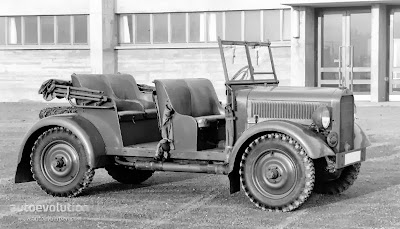
A diferencia del Mercedes Benz 170 VK, el aspecto del VL era menos elaborado asemejándose a un bastidor sin terminar y esto era debido a que se había reducido al vehículo hasta lo más básico; motor, ruedas, volante y asientos. También disponía de un parabrisas que ofrecía una protección mínima contra el barro y otros objetos que pudieran saltar al interior del vehículo durante la conducción. Los guardabarros también fueron modificados haciéndose más anchos que actuaban tanto para esta función como para protección de las ruedas contra el fuego enemigo. Los ejes de las ruedas se estiraron para aumentar la estabilidad del vehículo y el interior fue despojado de todos los instrumentos innecesarios para reducir al máximo los costos tanto de su producción como los de su reparación.


Fuentes:
FRANK, R. “Cars of the Wehrmacht German vehicles in World War II” Schiffer, 2004
FRANK, R. “Mercedes at War (German Trucks & Cars in World War II” Schiffer, 1991

English version

Unlike the Mercedes Benz 170 VK, VL's appearance was less elaborate resembling an unfinished frame and this was because the car had been reduced to the basics, motor, wheels, steering wheel and seats. It also had a windshield that offered minimal protection against mud and other objects that could jump into the vehicle while driving. The fenders were also modified becoming wider acting both for this function as for wheel protection from enemy fire. The wheel axles are stretched to increase vehicle stability and the interior was stripped of all unnecessary tools to minimize the costs of both production such as repair.


Sources:
FRANK, R. “Cars of the Wehrmacht German vehicles in World War II” Schiffer, 2004
FRANK, R. “Mercedes at War (German Trucks & Cars in World War II” Schiffer, 1991

miércoles, 16 de octubre de 2013

Cementerios militares: Bilbao


Cementerio británico en la iglesia de la Trinidad (Bilbao)


En este campo santo se encuentran enterrados 56 soldados Aliados y de la Commonwealth caídos durante la Segunda Guerra Mundial. La mayoría de ellos se encontraban enterrados en otros emplazamientos situados en la costa norte y noroeste española pero su gestión no resultaba sencilla. El traslado lo ejecutó la Commonwealth War Graves Commission al lugar escogido, una parcela dispuesta en la Iglesia de la Trinidad. En dicha parcela también descansan los restos de 7 soldados de la Gran Guerra. En su origen estuvo situado en el centro de la ciudad, a orillas del río Nervión (conocido como “Los siete árboles”) siendo utilizado para súbditos británicos durante la segunda mitad del s.XVIII. No fue hasta la llegada del nuevo cónsul británico a Bilbao, Horace Young, en 1859 cuando se remodeló al encontrarlo en un estado de abandono. A pesar de su voluntad de recuperarlo debido a la escasez de fondos no se pudo llevar a cabo. Parece ser que muchas tumbas se perdieron debido a las frecuentes inundaciones que sufría el campo santo. Tras la concesión al Gobierno Británico por parte de la Corona Española del uso a perpetuidad del solar como cementerio por Real decreto del 31 de diciembre de 1860, el consulado recaudó el dinero suficiente de particulares como para que el Cementerio fuera restaurado.

A principios del siglo veinte la ubicación del cementerio fue cuestionada argumentando posibles problemas de higiene pública y también porque la autoridad portuaria deseaba adquirirlo para sus instalaciones. Finalmente en 1926 se llegó a un acuerdo comprando un solar en la vecina Lujua. Se construyó una capilla protestante, otra católica y una casa para el guarda. Durante el traslado se decidió ampliar el uso del cementerio a enterramientos católicos pero también de la comunidad británica. Las capillas y sus zonas fueron consagradas por el obispo anglicano de Gibraltar y el párroco de Lujua en mayo de 1929. En este cementerio también se pueden encontrar entre otros, alemanes, americanos, españoles, franceses, griegos, irlandeses, noruegos, suecos y suizos.

Fuentes:
War Graves Commission
Iglesia de la Trinidad

English versión

In this cemetery are buried 56 soldiers Allies and Commonwealth who died during the Second World War. Most of them were buried in other locations in the north and northwest Spanish coast but its management was not easy. The transfer was executed by the Commonwealth War Graves Commission at the site chosen, a plot arranged in the Trinity Church. In this plot also the remains of seven soldiers of the Great War. Originally it was located in the city center, on the banks of the Nervion River (known as "The Seven Trees") being used to British subjects during the second half of the eighteenth century. It was not until the arrival of the new British Consul Bilbao, Horace Young, in 1859 when it was remodeled to find it in a state of neglect. Despite their desire to recover due to the shortage of funds could not be carried out. It appears that many graves were lost due to frequent flooding suffered by the cemetery. Following the granting to the British Government by the Spanish Crown in perpetuity use the site as a cemetery by Royal Decree of December 31, 1860, the consulate raised enough money from private to the cemetery was restored.

In the early twentieth century cemetery location was questioned arguing potential public health problems and also because the port authority wanted to buy it for their facilities. Finally in 1926 he agreed to buy a plot in neighboring Lujua. A chapel was built Protestant, a Catholic, and a guard house. During the transfer was decided to extend the use of the cemetery to burials Catholics but also of the British community. The chapels and their areas were consecrated by the Anglican Bishop of Gibraltar and the pastor of Lujua in May 1929. In this cemetery can also be found among others, German, American, Spanish, French, Greek, Irish, Norwegian, Swedish and Swiss.


Sources:
War Graves Commission
Iglesia de la Trinidad

martes, 15 de octubre de 2013

Bombarderos italianos: SM.79


Bombarderos italianos: Savoia-Marchetti SM.79 Sparviero


Nacido como avión comercial para 8 pasajeros en 1934 de tres motores el Savoia-Marchetti SM.79 Sparviero estrenó su nueva condición de bombardero medio con la Regia Aeroautica en 1937, durante la Guerra Civil española. También fue durante esta etapa cuando se probó como avión torpedero con un torpedo de 450 mm anclado bajo el fuselaje. Durante los siguientes tres años se desarrolló la idea del avión de torpedeo adoptándose al SM.79-II para tal fin, con equipos específicos para este tipo de ataques. Cuando Italia entró en la Segunda Guerra Mundial en junio de 1940 los Sparviero equipaban un total de 14 Stormi con base en Italia, Sicilia, Sardia y Libia. Desde entonces estuvieron constantemente en acción contra la navegación aliada, la primera de ellas llevada a cabo por 19 SM.79 de 9º y 46º Stormi contra navíos franceses en la costa Riviera entre el 13 y el 14 de junio.

Durante la invasión alemana de Creta los Sparviero del 92º Gruppo y los del 281º Squadriglia se mantuvieorn muy activos atacando la navegación británica en el Mar Egeo. Tras la captura de Creta la mayoría de estos aparatos fueron enviados a Libia para apoyar las operaciones contra las fuerzas navales de la Royal Navy, sus convoyes en el Mediterráneo central y Malta. Entre los barcos hundidos de la Royal Navy por los SM.79 se encuentran los destructores HMS Husky, HMS Jaguar, HMS Legion y HMS Southwall, mientras que el acorazado HMS Malaya y los portaaviones HMS Indomable y HMS Victorious fueron alcanzados por sus torpedos. La mayoría de estos buques fueron alcanzados durante la operación contra un convoy que zarpó con 14 mercantes rumbo a Malta.

A pesar de ser un avión muy útil el SM.79, al igual que muchos aparatos italianos, sufrió de pobres instalaciones y condiciones de servicio de modo que era raro que incluso la mitad de una unidad estuviera operativa. A pesar de todo el SM.79 fue reconocido como uno de los mejores aviones torpederos del teatro del Mediterráneo durante la guerra. 

Savoia-Marchetti SM.79 del 41° Gruppo en vuelo de reconocimiento.

Savoia-Marchetti SM.79: Versiones

Fuentes:
BORGIOTTI, A. “Il Savoia Marchetti S.M.79 Sparviero, 1933-1940: Progetto, collaudi, sviluppo militare, servizio nella Regia aeronautica
APOSTOLO, G. “Aircraft Profile No. 89: The Savoia Marchetti SM.79 Profile Publications, 1972

English versión

Born as 8-passenger airliner in 1934 of three engines the Savoia-Marchetti SM.79 Sparviero premiered its new status with the Regia medium bomber Aeroautica in 1937, during the Spanish Civil War. It was also during this period when tested as a torpedo torpedo plane 450 mm anchored under the fuselage. Over the next three years, developed the idea of ​​adopting the torpedo plane SM.79 - II for this purpose, with specific equipment for this type of attack . When Italy entered the Second World War in June 1940 the Sparviero outfitting a total of 14 Stormi based in Italy, Sicily, Sardia and Libya. Since then were constantly in action against Allied shipping , the first one carried out by 19 SM.79 9th and 46th Stormi against French ships in the Riviera coast between 13 and 14 June.

During the German invasion of Crete 's Sparviero 92° Gruppo and 281° Squadriglia was very active mantuvieorn attacking British shipping in the Aegean Sea. After the capture of Crete most of these devices were sent to Libya to support operations against the naval forces of the Royal Navy, its convoys in the central Mediterranean and Malta. Among the ships sunk by SM.79 destroyers are
HMS Husky, HMS Jaguar, HMS Legion y HMS Southwall, while the battleship HMS Malaya and the aircraft carrier HMS Indomitable and HMS Victorious were hit by torpedoes. Most of these vessels were made ​​during the operation against a convoy of 14 merchantmen sailed towards Malta.

Despite being a very useful plane SM.79, like many Italians devices suffered from poor facilities and conditions of service so it was odd that even half of a unit was operational. Despite all the SM.79 was recognized as one of the finest torpedo bombers of the Mediterranean theater during the war


SM. 79 of 252º Squadriglia B.T., 104º Gruppo, 46º Stormo

SM. 79 of 211º Squadriglia, 50º Gruppo, 16º Stormo Bombardamento terrestre, 6º Divisione Aera "Falco" 

Savoia-Marchetti SM.79: Versions

Sources:
BORGIOTTI, A. “Il Savoia Marchetti S.M.79 Sparviero, 1933-1940: Progetto, collaudi, sviluppo militare, servizio nella Regia aeronautica
APOSTOLO, G. “Aircraft Profile No. 89: The Savoia Marchetti SM.79 Profile Publications, 1972

viernes, 11 de octubre de 2013

PzKpfw III Ausf H


Panzerkampfwagen III Ausf H


Este modelo introdujo cambios internos y no solo en aspectos tan importantes como el blindaje o el cañón. Se reforzó la suspensión de barras de torsión y la anchura de las cadenas aumentaron pasando de 36 a 40 cm lo que mejoraba su movilidad sobre terreno blando. Las ruedas motrices y tensoras también fueron cambiadas debido al aumento de la anchura de las orugas, las ruedas motrices tenían con seis aberturas en lugar de ocho agujeros circulares y las tensoras ocho radios. Las existencias almacenadas de las otras ruedas motrices y tensoras se usaron también en combinación de anillos espaciadores para dar salida a las ya fabricadas. Con este modelo se aprovechó para cambiar la caja  de cambios con preselector Variorex por el más sencillo cambio sincronizado Aphon, proporcionando seis marchas hacia delante y una hacia atrás.

Con respecto al blindaje se decidió empernar planchas de 30 mm en la superestructura, tanto delante como detrás. El resultado fue que aumentó el peso del vehículo hasta las 21´6 toneladas, disminuyó la presión sobre el suelo y la velocidad máxima permaneció inalterada. El aumento del blindaje hasta los 60 mm convirtieron al PzKpfw III Ausf H en un carro de combate inmune al fuego de la mayoría de las armas anticarro en uso en 1941.

A finales de 1940 empezaron a entrar en servicio con el cañón L/42 de 50 mm, para el cual podía almacenar 99 proyectiles y 3.750 cartuchos para el armamento secundario compuesto por dos ametralladoras MG 34 de 7´92 mm, una coaxial al armamento principal y otra en el casco. Al igual que los Ausf F y G llevaban una caja de granadas fumígeras en la parte posterior. Inicialmente se solicitó un pedido de 759 unidades en enero de 1939 pero el uso del nuevo cañón en la mayoría de los Ausf G y la inminente llegada de la mejora en los Ausf J provocaron que tan solo se completasen 308 PzKpfw III Ausf H. Estos carros de combate se vieron en acción en los Balcanes, Rusia y el norte de África.

 Pzkpfw III Ausf H, 2° División Panzer Frente Oriental, 1941

Fuentes:
ORMEÑO, J. “Panzerkampfwagen III. El pequeño veterano de la Wehrmacht” Serga, nº 47
GANDER, T. “Tanks in Detail 7: PzKpfw III Ausf A to N Panzer III” Ian Allan Publishing, 2004
PERRET, B. “Panzerkampfwagen III. Mediun tank 1936-1944” Osprey, 1999

English version

This model introduced internal changes, not only in important aspects such as the shield or the barrel. Suspension was tightened torsion bars and the width of channels increased from 36 to 40 cm which improved soft-field mobility. Drive and idler wheels were also changed due to the increase of the width of the tracks, the drive wheels were six instead of eight openings circular holes and eight spokes tensioning. The stockpiles of the other drive and idler wheels were also used in combination with spacer rings to output the previously manufactured. This model was used to change the selector gearbox Variorex by synchromesh Aphon easier, providing six forward and one reverse.

Regarding decided bolted armor plates 30 mm on the superstructure, both front and back. The result was that the vehicle weight increased until 21'6 tons, decreased ground pressure and speed remained unchanged. Increased armor to 60 mm converted to PzKpfw III Ausf H in a tank immune to fire most antitank weapons in use in 1941.

At the end of 1940 began to enter service with the 50 mm L/42 cannon, for which could store 99 rounds and 3,750 rounds for the secondary armament consists of two MG 34 machine guns of 7.92 mm, coaxial with main armament and one
in front of superstructure. Like Ausf F and G had a box fumígeras grenade on the back. Initially requested an order of 759 units in January 1939 but the use of the new gun in most Ausf G and the imminent arrival of the improvement in the Ausf J caused that only these dimensions supplement 308 PzKpfw III Ausf H. These tanks were in action in the Balkans, Russia and North Africa.

PzKpfw III Ausf H, on the roll in Russia

A pair of Panzer III Ausf. H at the harbor of Sewastopol-summer 1942

Sources:
ORMEÑO, J. “Panzerkampfwagen III. El pequeño veterano de la Wehrmacht” Serga, nº 47
GANDER, T. “Tanks in Detail 7: PzKpfw III Ausf A to N Panzer III” Ian Allan Publishing, 2004
PERRET, B. “Panzerkampfwagen III. Mediun tank 1936-1944” Osprey, 1999

jueves, 10 de octubre de 2013

Tractor M2


Tractor de alta velocidad estadounidense M2


El tractor M2 también fue conocido coloquialmente como M2 Cletarc que se usaba para remolcar aviones en los aeródromos a partir de 1942 y también para labores de mantenimiento de los aparatos. El diseño se remonta a febrero de 1941 y fue manufacturado por Cleveland Tractor Company. No disponía de armamento alguno y tenía una tripulación de tres hombres.

Gracias a su tracción de orugas podía operar en pistas poco preparadas y también estaba equipado con un cabrestante para otros trabajos. Disponía de un generador auxiliar y un compresor de aire de tres etapas y tres focos, uno de ellos en la parte trasera. A lo largo de su producción se fueron introduciendo ciertas mejoras como la sustitución del radiador, un compresor más eficiente y un resorte tensor delantero en lugar del modelo manualmente ajustable en las máquinas anteriores.

El M2 estaba equipado con una barra de tracción diseñada para el remolque de aviones y otro brazo articulado para el remolque de municiones y mantenimiento. El vehículo se evaluó también como tractor de arrastre para la artillería pero carecía del espacio necesario para sus equipos y municiones. Además, para esta misión ya estaban los vehículos M4 de 13 toneladas, M5 de 18 y el M6 de 38 toneladas que ya realizaban esta labor eficazmente. En total se construyeron 8.510 unidades que operaron en todos los teatros de operaciones con la USAAF.


Fuentes:
DOYLE, D. “High speed tractor (A visual history of the U.S. Army´s tracked Artillery Prime Movers, M2, M4, M5, M6, M8)” Ampersand Publishing, 2006
TM 9-2800 Military Vehicles 1943

English versión

The M2 tractor was also known colloquially as M2 Cletarc that was used to tow aircraft at aerodromes since 1942 and also for maintenance of the equipment. The design dates back to February 1941 and was manufactured by Cleveland Tractor Company. He did not have any weapons and had a crew of three men.

Thanks to its crawler traction tracks could operate in unprepared and was also equipped with a winch for other jobs. It had an auxiliary generator and an air compressor three stages and three spotlights, one in the rear. Throughout production were introduced some improvements such as replacing the radiator, more efficient compressor and a tension spring instead of the model front manually adjustable in the previous machines.

The M2 was equipped with a drawbar trailer designed for aircraft and other articulated arm to haul ammunition and maintenance. The vehicle was also evaluated as a tractor pull for artillery but lacked the necessary space for their equipment and ammunition. In addition, for this mission were already vehicles of 13 tonnes M4, M5 and M6 18 38 tons already performed this task effectively. A total of 8,510 units were built that operated in every theater of operations with the USAAF.


Cletrac M-2 High Speed Tractor (HST). Photo: Courtesy of John Buckley

Sources:
DOYLE, D. “High speed tractor (A visual history of the U.S. Army´s tracked Artillery Prime Movers, M2, M4, M5, M6, M8)” Ampersand Publishing, 2006
TM 9-2800 Military Vehicles 1943

miércoles, 9 de octubre de 2013

MG 151/20


Maschinengewehr MG 151/20

La necesidad de causar mayor devastación en los aviones enemigos empujó a la creación del MG 151/20, capaz de disparar munición explosiva. Con esta munición la Luftwaffe realizó estudios para comprobar el daño provocado. Como promedio se necesitaba entre 18 y 20 impactos para derribar un viermot (bombardero cuatrimotor) mientras que con tan solo 4 era derribado un caza monomotor. Con estos resultados sobre la mesa el MG 151/15 de 15 mm fue retirado del servicio en 1942.

El MG 151/20 normalizado dispuso de un sistema de ignición por percusión pero posteriormente se instaló un sistema de ignición eléctrico que resultaba más sencillo su sincronización con el resto de armas del avión. Esta versión se denominó como MG 151/20 E.


Para la munición del arma Mauser simplemente agrandó la vaina de su proyectil de 15 mm e introdujo la cabeza de guerra de 20 mm y acortó la longitud de la munición para que el largo de las balas fuera idéntico para los dos calibres. Esta era el mismo proyectil utilizado por los cañones MG FF. Esta versatilidad era muy beneficiosa pues era posible convertir un MG 151/15 en uno de 20 mm simplemente cambiando el cañón del arma y realizando unas pequeñas modificaciones. Por el contrario el arma tuvo unos problemas inherentes al diseño del proyectil. El cartucho corto de 20 mm junto con la pesada cabeza de guerra de 20 mm redujeron la velocidad de boca en un 16%, pasando de los 950 m/s en el proyectil de 15 mm a los 800 m/s con la nueva cabeza. A pesar de esta reducción el proyectil de alto explosivo fue considerado un avance pues el proyectil básico tenía casi un 30% más de explosivo que la munición de 15 mm.

El arma rediseñada pesaba 42´5 kilogramos y medía 171 centímetros de longitud total. Ofrecía una cadencia máxima de 750 disparos por minuto. La alimentación del arma corría a cargo de una cinta metálica de munición, sus cartuchos pesaban 220 gramos de los que 115 pertenecían a la cabeza de guerra.


Fuentes:
ORMEÑO, J. “Focke Wulf 190. El pájaro carnicero
WILLIAMS, A. “Rapid Fire: The Development of Automatic Cannon, Heavy Machine-Guns and Their Ammunition for Armies, Navies and Air Forces Airlife
MELVIN, J. “Rifles and Machine Guns William Morrow & Company (1944)

English versión

The need to cause more devastation on enemy aircraft pushed the creation of the MG 151/20, capable of firing explosive ammunition. With this ammunition the Luftwaffe conducted studies to check the damage. As average between 18 and 20 needed to bring down a viermot impacts (UAV bomber) while with only 4 was shot down a single-engined fighter. With these results on the table the MG 151/15 15 mm was withdrawn from service in 1942.

The MG 151/20 normalized arranged a percussion ignition system but subsequently installed an electric ignition system that was easier synchronization with the rest of the aircraft weapons. This version was called as MG 151/20 E.


MG 151/20 shell

For Mauser gun ammunition simply enlarged his missile pod and introduced 15 mm warhead of 20 mm and shortened the length of the ammunition for the length of the bullets were identical for the two calibers. This was the same bullet used by MG FF cannons. This versatility was very beneficial as it was possible to convert an MG 151/15 in a 20 mm by simply changing the barrel and making a few modifications. By contrast the gun had some problems inherent in the design of the projectile. The short 20 mm cartridge with warhead weighing 20 mm muzzle velocity reduced by 16%, from 950 m/s at 15 mm projectile at 800 m/s with the new head. Despite this reduction, the high explosive projectile was considered a breakthrough as the core projectile had nearly 30% more explosive than 15 mm ammunition.

Redesigned gun weighed 42.5 kg and measuring 171 centimeters in length. Offered a maximum rate of 750 rounds per minute. The gun power was provided by a metal band of ammunition, their cartridges weighing 220 grams which 115 belonged to the warhead.


Sources:
ORMEÑO, J. “Focke Wulf 190. El pájaro carnicero
WILLIAMS, A. “Rapid Fire: The Development of Automatic Cannon, Heavy Machine-Guns and Their Ammunition for Armies, Navies and Air Forces Airlife
MELVIN, J. “Rifles and Machine Guns William Morrow & Company (1944)

martes, 8 de octubre de 2013

Cañón de montaña Type 31


Cañón de montaña japonés 
Type 31 de 75 mm


El cañón de montaña japonés Type 31 de 75 mm fue introducido en 1898 adoptando en su denominación, como era habitual, el año del Emperador Meiji. El cañón estaba construido en acero y se mejoró la precisión y alcance del arma comparándola con su antecesor, el cañón de montaña de 70 mm que estaba fabricado en bronce. Sus primeras experiencias de combate se obtuvieron durante la guerra Ruso-japonesa y se llegaron a fabricar unas 620 unidades.

El peso del arma era ligero, de 330 kilos, ya que se trataba de una pieza destinada a ser usada en las montañas. Podía elevarse hasta +30º y deprimirse hasta -10º, no tenía mecanismo de retroceso y sus proyectiles pesaban 6 Kg. Al dispararlos estos alcanzaban una velocidad de salida de 261 m/s y tenían un alcance de 4.600 metros.


Fuentes:
NAKANISHI, R. “Japanese Infantry Arms In World War II” Dainipponkaiga, 1998
US War Department Special Series No 25 “Japanese Field Artillery October 1944
War Department TM-E-30-480 “Handbook on Japanese Military Forces September 1944

English version

The Japanese mountain gun 75 mm Type 31 was introduced in 1898 by adopting in its name, as usual, the year of the Meiji Emperor. The barrel was made ​​of steel and improved accuracy and weapon range by comparing it with its predecessor, the mountain canyon 70 mm was made ​​of bronze. His first combat experiences were obtained during the Russo-Japanese war and increased production to about 620 units.

The gun was light weight of 330 kilos, as it was a piece intended to be used in the mountains. Could rise up to +30° and -10° depressed, had no recoil and projectiles weighing 6 kg Al firing them these reached an exit velocity of 261 m/sec and had a range of 4600 meters.


Sources:
NAKANISHI, R. “Japanese Infantry Arms In World War II” Dainipponkaiga, 1998
US War Department Special Series No 25 “Japanese Field Artillery October 1944
War Department TM-E-30-480 “Handbook on Japanese Military Forces September 1944

viernes, 4 de octubre de 2013

Experten alemanes: Waldemar Wübke


Oberleutnant Waldemar Wübke


Wübke fue uno de los pocos pilotos de caza alemanes que sobrevivieron a la contienda realizando misiones de combate. A lo largo de su carrera pilotó casi todos los modelos de caza alemanes en combate logrando un registro final de 20 victorias aéreas.  En 1940 realizó varias misiones de combate con la 9./JG 54 con el rango de Leutnant durante la Batalla de Inglaterra. Al igual que muchos otros pilotos alemanes comenzaron su carrera con el Messerschmitt Bf 109 alternándolo con el Focke Wulf Fw 190 cuando su unidad recibió este nuevo aparato.

También pilotó el Focke Wulf Fw 190 D-9 desde München-Riem protegiendo el aterrizaje y despegue de los reactores Me 262 de los enjambres de cazas aliados. El aeródromo tenía una pesada defensa antiaérea y para evitar convertirse en el blanco de su propia flak sus aparatos fueron pintados llamativamente para evitar ser derribados por el fuego amigo. El aparato de Wübke “3 Rojo” lucía su emblema personal bajo la carlinga con las letras “Im Auftrage der Reichsbahn” (“A las órdenes del Reich”). La unidad resultó ser muy efectiva protegiendo en las maniobras delicadas del reactor Me 262 perdiéndose muy pocos de ellos por acción de la caza enemiga. Su última misión de combate la realizó en 1945 con el JV 44, desde el aeródromo de Platzschutz, en Berlín, a los mandos de un Messerschmitt Me 262. Irónicamente Wübke murió en un accidente de aviación en Sudamérica a principios de los años 50.


Fuentes:
SPICK, M. “Luftwaffe Fighter Aces” Ivy Books, 1996
FORSYTH, R. “Jagdverband 44: Squadron of Experten” Osprey, 2008
WEAL, J. “Jagdgeschwader 54: Grunherz” Osprey, 2001

English versión

Wübke was one of the few German fighter pilots who survived the war conducting combat missions. Throughout his career he drove almost every German fighter models in combat achieving a final record of 20 aerial victories. In 1940 several combat missions with 9./JG 54 with the rank of Leutnant during the Battle of Britain. Like many other German pilots began their careers with the Messerschmitt Bf 109 alternating with the Focke Wulf Fw 190 when his unit received this new aircraft.

Also flew the Focke Wulf Fw 190 D-9 from München-Riem protecting the landing and takeoff of the Me 262 jet fighter swarms allies. The airfield had a heavy air defense and to avoid becoming the target of his own flak their aircraft were painted conspicuously to avoid being shot down by friendly fire. The apparatus Wübke "3 Red" wearing his personal emblem under the cockpit with the letters "Im Aufträge der Reichsbahn" ("On the orders of the Reich"). The unit proved to be very effective in protecting delicate maneuvers reactor Me 262, lost a few of them for hunting enemy action. His last combat mission was made in 1945 with JV 44, from Platzschutz airfield in Berlin, at the controls of a Messerschmitt Me 262. Ironically Wübke died in a plane crash in South America in the early 50s.


Sources:
SPICK, M. “Luftwaffe Fighter Aces” Ivy Books, 1996
FORSYTH, R. “Jagdverband 44: Squadron of Experten” Osprey, 2008
WEAL, J. “Jagdgeschwader 54: Grunherz” Osprey, 2001

jueves, 3 de octubre de 2013

Destructor USS Pope


Destructor USS Pope


El USS Pope era un destructor de la clase Clemson botado a finales de 1920 en los astilleros William Cramp and Sons. Tenía un desplazamiento de 1.190 toneladas y alcanzaba una velocidad máxima de 35 nudos. Tenía un armamento de cuatro cañones de 4", un cañón de 3", dos ametralladoras de 7´62 mm, 12 tubos lanzatorpedos de 533 mm. Su tripulación la componían 101 hombres entre marinos y oficiales.

Tras su botadura el 23 de marzo de 1920 el USS Pope fue asignado al 3º Escuadrón de la 39º División de la reserva de la Flota del Atlántico. Tras una modernización fue asignado al 15º Escuadrón de la 43º División que operaba cerca de China. Durante la Guerra civil en China el USS Pope protegió a los ciudadanos estadounidenses y los intereses de la nación hasta 1931. Tras estas misiones fue reasignado al 5º Escuadrón de la 15º División en febrero de 1933 realizando dos visitas a Japón en 1934 y 1935. En mayo de 1940 volvió a cambiar de unidad al ser transferido a la 59º División de la 6º Flota y realizó misiones de patrullaje en aguas Chinas hasta que regresó a Manila a finales de junio, donde permaneció hasta el 11 de diciembre de1941 que se trasladó a Balikpapan, Indias Orientales Holandesas. 


En los primeros días de la Segunda Guerra Mundial el USS Pope se vio envuelto en duros combates en las Indias Orientales Holandesas. El 9 de enero de 1942 formó la escolta, junto con otros 4 destructores más (USS Stewart, USS Bulmer, USS Parrot y USS Barker), de los cruceros USS Boise y USS Marblehead. En el convoy también se encontraba un transporte que había sido parte del convoy Pensacola. El convoy trataba de hacer llegar refuerzos al ejército con la 26º Brigada de Artillería de campo y el cuartel general de la Batería, 1º Batallón y el 131º Artillería de campo y suministro con destino a Java. Participó activamente en la Batalla de Balikpapan y más tarde en la batalla del estrecho de Badung. Durante la segunda Batalla del Mar de Java formó parte de la escolta del Exeter, junto con el HMS Encounter. En la noche del 28 de febrero maniobraron hacía el norte y a la mañana siguiente fueron atacados por unidades de superficie japonesas con el apoyo de la aviación a medio camino entre Java y Borneo. Los tres navíos lucharon contra cuatro cruceros pesados y cuatro destructores japoneses durante tres horas alcanzándolos en varias ocasiones. El USS Pope descargó todos sus torpedos y 140 proyectiles de su armamento principal contra el enemigo.

Poco antes del mediodía del 1 de marzo de 1942 los dos barcos británicos resultaron destruidos. Una hora más tarde el USS Pope se hizo blanco de todos los ataque japoneses y una formación de 12 bombarderos en picado Aichi D3A Val. Finalmente tras recibir varios impactos directos el destructor se fue a pique. Al día siguiente el destructor japonés IJN Ikazuchi rescataba 442 náufragos provenientes del USS Pope y del HMS Encounter que habían permanecido unas 20 horas en el agua. Esta decisión humanitaria del capitán del IJN Ikazuchi, Comandante Shunsaku Kudō, colocó a su propio navío y tripulación, en riesgo de sufrir el mismo destino e interfirió en su capacidad combativa por la enorme carga de prisioneros a bordo. El servicio del USS Pope fue reconocido con dos estrellas de combate y una Presidential Unit Citation. 


Fuentes:
ROSCOE, T. “United States Destroyer Operations In World War II” Naval Institute, 1953
MASTERSON, J. “U. S. Army Transportation In The Southwest Pacific Area 1941-1947 Transportation Unit, Historical Division, Special Staff, U. S. Army. 1949

English version

The USS Pope was a Clemson -class destroyer launched in late 1920 in the William Cramp and Sons shipyard. It had a displacement of 1,190 tons and a maximum speed of 35 knots. He had an armament of four guns of 4", cannon of 3", two machine guns of 7.62 mm, 12 torpedo tubes of 533 mm. Her crew comprised 101 men between the sailors and officers.

After its launch on March 23, 1920 the USS Pope was assigned to the 3rd Squadron of the 39th Reserve Division of the Atlantic Fleet. After modernization was assigned to the 15th Squadron of the 43rd Division operating near China. During the civil war in China the USS Pope protected American citizens and the interests of the nation until 1931. After these missions was reassigned to the 5th Squadron of the 15th Division in February 1933 made ​​two visits to Japan in 1934 and 1935. In May 1940 he returned to change the unit to be transferred to the 59th Division 6th Fleet and performed patrol missions in waters Chinas until he returned to Manila in late June , where he remained until December 11 de1941 who moved to Balikpapan, Dutch East Indies.


 USS Pope in February 1942

In the early days of World War II the USS Pope was involved in heavy fighting in the Dutch East Indies. On January 9, 1942 formed the escort, along with another 4 destroyers (USS Stewart, USS Bulmer, USS Parrot and USS Barker), cruisers USS Boise and USS Marblehead. The convoy was also a transport that had been part of the Pensacola convoy. The convoy was to get reinforcements to the army with the 26th Field Artillery Brigade and Headquarters Battery, 1st Battalion and the 131th Field Artillery and supplies bound for Java. He actively participated in the Battle of Balikpapan and later at the Battle of Badung Strait. During the Second Battle of the Java Sea was part of the escort of Exeter, together with HMS Encounter. On the night of February 28 maneuvered to the north and the next morning they were attacked by Japanese surface units with air support midway between Java and Borneo. The three ships fought against four heavy cruisers and four Japanese destroyers for three hours catching up on several occasions. The USS Pope downloaded all their torpedoes and 140 rounds of their main weapons against the enemy.

Shortly before noon on March 1, 1942 the two British ships were destroyed . An hour later the USS Pope was white all Japanese attack and training 12 Aichi D3AVal dive bombers. Finally after receiving several direct hits the destroyer sank. The next day the Japanese destroyer IJN Ikazuchi 442 castaways rescued from the USS Pope and HMS Encounter that had been about 20 hours in the water. This humanitarian decision IJN Ikazuchi captain , Commander Shunsaku Kudō, placed his own ship and crew at risk of suffering the same fate and interfered with their combat by the huge load of prisoners on board. The service of the USS Pope was awarded two battle stars and Presidential Unit Citation.


Sources:
ROSCOE, T. “United States Destroyer Operations In World War II” Naval Institute, 1953
MASTERSON, J. “U. S. Army Transportation In The Southwest Pacific Area 1941-1947 Transportation Unit, Historical Division, Special Staff, U. S. Army. 1949